Skip to content
مدونة

رؤى هندسية

التعمق في أنظمة الذكاء الاصطناعي والبنية السحابية والأنظمة الموزعة والريادة الهندسية.
Multi-Tenant SaaS Data Architecture: Silo, Bridge, Pool — Trade-Offs, Migration Paths, and Production Hardening (2026)
ai-architecture1 min read

Multi-Tenant SaaS Data Architecture: Silo, Bridge, Pool — Trade-Offs, Migration Paths, and Production Hardening (2026)

Multi-tenant data architecture is one of the highest-leverage decisions a SaaS team ever makes — and one of the most under-discussed. The choice between silo (database per tenant), bridge (schema per tenant), and pool (shared schema with tenant_id) determines unit economics, blast radius, compliance posture, noisy-neighbour behaviour, and the cost of every migration for the rest of the product's life. This article is the production design guide: trade-off matrix, Postgres RLS for defence in depth, envelope encryption with per-tenant KMS keys, GDPR right-to-erasure per model, per-tenant cost attribution, migration paths, and the day-one infrastructure that pays back at year three.

April 23, 2026Read
Distributed Rate Limiting at Scale: Token Bucket, Redis, and Multi-Region Coordination Without Hot-Key Disasters (2026)
ai-architecture1 min read

Distributed Rate Limiting at Scale: Token Bucket, Redis, and Multi-Region Coordination Without Hot-Key Disasters (2026)

Distributed rate limiting is the unsexy infrastructure capability that quietly decides whether a service stays up under abusive traffic, retry storms, partner-integration bursts, or the autonomous AI agent that decided 4 a.m. is the perfect time to make 200,000 sequential calls. This article is the production design guide: the five canonical algorithms (fixed window, sliding window log, sliding window counter, token bucket, leaky bucket) with their accuracy and memory characteristics, the Redis-Lua single-shot implementation, multi-region coordination strategies, hot-key handling for keys that receive 100x normal traffic, the failure modes of the limiter itself, and the configuration values that work at scale.

April 23, 2026Read
The Category-Aware Guardrails Pattern: Per-Domain Safety Policies After Classification-First Routing in Production AI Systems (2026)
ai-architecture1 min read

The Category-Aware Guardrails Pattern: Per-Domain Safety Policies After Classification-First Routing in Production AI Systems (2026)

The single biggest mistake in production AI safety is treating the guardrail layer as a global, category-blind filter. Run medical, legal, finance, code, and general queries through one global guardrail and you get the worst of both worlds: under-protected high-risk categories, over-restricted general traffic, and a guardrail layer that fails compliance audit. Category-aware guardrails fix this by treating safety as a per-domain policy executed after the classification-first router has decided which category a request belongs to. This article covers the pattern in detail: structuring per-category policies (medical, legal, finance, code, general), integration with the classification-first router, the production case study showing 2.4s → 1.3s latency and 11% → 1.4% false-positive reduction, the anti-patterns that defeat the pattern, and the configuration values that work at scale.

April 23, 2026Read
The Event-Driven Architecture Pattern: Brokers, Schemas, and Idempotent Consumers in Production Microservices (2026)
ai-architecture1 min read

The Event-Driven Architecture Pattern: Brokers, Schemas, and Idempotent Consumers in Production Microservices (2026)

Synchronous request-reply is the easy default. It also breaks at exactly the moment the system starts to matter — slow downstream services, deployment coordination across teams, back-pressure cascades that turn local hot spots into system-wide outages. Event-driven architecture replaces the implicit call graph with an explicit event log: producers publish facts, consumers subscribe and react in their own time, and the contract is a versioned schema in a registry. This article is the broker-and-contract perspective on event-driven architecture: choosing between Kafka, SNS+SQS, NATS, EventBridge, and Pulsar; schema registry discipline and contract evolution; idempotent consumers and at-least-once delivery; ordered partitioning and throughput; dead-letter queues; production configuration values; and the anti-patterns that defeat the pattern.

April 23, 2026Read
The Hybrid Classification Pattern: Combining Cheap Deterministic Classifiers With LLM Fallback for 60-90% Cost Reduction (2026)
ai-architecture1 min read

The Hybrid Classification Pattern: Combining Cheap Deterministic Classifiers With LLM Fallback for 60-90% Cost Reduction (2026)

The classifier sits at the entrance to every well-designed AI system. The obvious implementation is to use an LLM. It works on day one. By month three, the team is paying tens of thousands per month for classification, watching tail latency drift upwards, and absorbing classifier outages every time the model provider has an incident. The hybrid classification pattern fixes this with a tiered pipeline: cheap deterministic rules handle 60-80% of traffic at near-zero cost; an embedding nearest-neighbour classifier handles 10-25% at sub-cent cost; the LLM handles only the genuinely ambiguous 5-15%. The economic effect is a 60-90% cost reduction; the architectural effect is more important — the system stops paying frontier-model latency for trivial decisions and the failure surface narrows. This article covers the three-layer pipeline, confidence-threshold tuning per category, training-data sourcing, fallback ordering, composition with Classification-First and Prompt Routing, anti-patterns, and configuration values.

April 23, 2026Read
The Cache-Aside and CQRS Pattern: Building the Read Side of Production Microservices Without Eventual-Consistency Disasters (2026)
ai-architecture1 min read

The Cache-Aside and CQRS Pattern: Building the Read Side of Production Microservices Without Eventual-Consistency Disasters (2026)

The write side of a distributed system gets all the architectural attention. Saga, outbox, reservation-then-commit — these prevent the dramatic failures. The read side is treated as solved: "just put a cache in front of it." But the read side is where most production systems actually break under load. Cache-aside and CQRS are the two patterns that, used together, give the read side the same design rigour as the write side. This article covers cache-aside in production (lookup, miss, load, set; TTL strategy; thundering herd; negative caching), CQRS in production (separate read model, projection from events, eventual consistency, read-your-writes), composition with the Outbox and Saga patterns, the failure modes both prevent, the failure modes they introduce, configuration values, and the anti-patterns that defeat them.

April 23, 2026Read
The Versioned Prompt Templates Pattern: Treating Prompts as Auditable, Reversible System Assets With Governance and Change Control (2026)
ai-architecture1 min read

The Versioned Prompt Templates Pattern: Treating Prompts as Auditable, Reversible System Assets With Governance and Change Control (2026)

The most consequential string in any production AI system is the prompt template. It controls behaviour, tone, safety, accuracy, cost, and latency. A small change can move quality up or down by ten per cent; a thoughtless edit can introduce regressions that take weeks to detect. Yet in the early demo era, prompts were typically pasted into application code as multi-line string literals, edited directly, with no review, no version history, no rollback story. The versioned prompt templates pattern fixes this by treating prompts as first-class system assets — stored in a versioned repository, referenced by explicit version IDs, deployed through review-and-rollout discipline, logged in the audit trail. This article covers immutability of published versions, implementation patterns (file-based, database-backed, managed platforms, hybrid), composition with classification-first and prompt routing, anti-patterns, configuration values, and the operational discipline of A/B testing and quality-gated promotion.

April 22, 2026Read
The Prompt Routing Pattern: Sending Each Classified Query to the Right Template, Tools, and Guardrails (2026)
ai-architecture1 min read

The Prompt Routing Pattern: Sending Each Classified Query to the Right Template, Tools, and Guardrails (2026)

Once an AI system has a classifier producing a category for every request, the obvious next question is: now what? The category by itself does nothing — it must drive a decision about which prompt template formats the request, which tools the model is allowed to call, which retrieval index to query, which guardrails to apply, which model variant to run, and which post-processing rules to enforce. The prompt routing pattern is the explicit, declarative mapping from category to handler bundle: each category points at a complete recipe of template + tools + guards + model + retrieval + post-processing. This article covers the role of explicit per-category bundles, implementation patterns (YAML, database registry, code-based, hybrid), composition with classification-first and versioned templates, anti-patterns, configuration values, and the operational discipline of monitoring per-route quality independently.

April 22, 2026Read
The Classification-First Architecture Pattern: Treating Query Intent as the Foundational Safety Gate Before Any Generation Happens (2026)
ai-architecture1 min read

The Classification-First Architecture Pattern: Treating Query Intent as the Foundational Safety Gate Before Any Generation Happens (2026)

The most common AI architecture mistake of 2024 and 2025 was sending the user's raw input directly into the language model and hoping the prompt was clever enough to handle every case. The mistake produced predictable failures: medical chatbots that gave dosing advice, support bots jailbroken into discussing competitors, internal copilots that exfiltrated data because the prompt did not know what kind of question it was answering. Classification-first inserts a small fast classifier in front of the LLM whose only job is to determine intent and route the request accordingly. This article covers the foundational role of intent classification, implementation patterns (fine-tuned small models, embedding routing, LLM-as-classifier, hybrid), composition with prompt routing and per-category guardrails, anti-patterns, configuration values, and operational discipline of monitoring accuracy and drift over time.

April 22, 2026Read
The Reservation Then Commit Pattern: Holding Stock, Seats, and Slots Without Overselling Under Concurrent Demand (2026)
ai-architecture1 min read

The Reservation Then Commit Pattern: Holding Stock, Seats, and Slots Without Overselling Under Concurrent Demand (2026)

The classic concert-ticketing failure is the same every time: ten thousand users hit "buy" simultaneously for a hundred seats; ninety-nine hundred get an error somewhere in the payment flow because the seat was already sold. The reservation-then-commit pattern closes the race window by introducing an explicit hold step: the seat is reserved (decrementing available stock immediately) before payment begins, and the reservation either commits or expires within a bounded time window. This article covers the two-phase lifecycle, TTL decisions, implementation patterns (database, Redis with Lua, event-sourced services), composition with Saga and Idempotency, anti-patterns, configuration values, and the operational discipline of monitoring reservation lifetimes and expiry rates.

April 22, 2026Read
The Multi-Provider Fallback Pattern: Routing Around Outages Across LLM Vendors, Cloud Regions, and Third-Party APIs (2026)
ai-architecture1 min read

The Multi-Provider Fallback Pattern: Routing Around Outages Across LLM Vendors, Cloud Regions, and Third-Party APIs (2026)

The OpenAI outage of December 2024 and the Anthropic capacity event of March 2025 took every dependent application offline. The multi-provider fallback pattern addresses this directly: pre-validate alternative providers, automate health-check-based switching, and ensure the application continues to function when any single provider goes down. This article covers multi-provider architecture for LLMs, payments, SMS, and cloud services; how to handle schema and behaviour differences; cost and quality trade-offs; the failure-detection logic that triggers switching; the failure modes the pattern itself can introduce; and the operational discipline of keeping the secondary path actually working when needed.

April 22, 2026Read
The Graceful Degradation Pattern: Keeping Core Flows Alive When Supplementary Services Fail (2026)
ai-architecture1 min read

The Graceful Degradation Pattern: Keeping Core Flows Alive When Supplementary Services Fail (2026)

A checkout page that goes offline because the recommendations service is slow has confused supplementary capability with core capability. Graceful degradation is the design discipline of explicitly classifying every dependency as critical or supplementary, building fallback behaviour for every supplementary one, and ensuring that the failure of any supplementary service produces a degraded but functional experience rather than a complete outage. This article covers the classification rubric, the four fallback strategies (cached snapshot, default value, partial response, async deferral), composition with circuit breakers and bulkheads, the failure modes the pattern prevents, the anti-patterns that make systems look graceful while still going down, and the operational discipline required to keep fallback paths working when needed.

April 22, 2026Read
AI System Design Interview: Top 15 Questions with Architecture Diagrams (2026)
ai-architecture1 min read

AI System Design Interview: Top 15 Questions with Architecture Diagrams (2026)

AI system design interviews in 2026 are not the system design interviews of 2020. The senior bar now includes designing a multi-tenant LLM gateway, a real-time recommendation engine with two-tower retrieval and a learned-to-rank reranker, an image moderation pipeline grounded in policy, and a fraud detection system fusing streaming features with an online graph model. This guide walks through 15 of the most commonly asked AI system design questions — RAG, LLM gateway, recommendation, image generation, LLM search, inference platform, fraud, code review AI, voice assistant, evaluation platform, multi-agent orchestration, vector database, content moderation, MLOps, AI tutor — each with clarifying questions, capacity estimation, an architecture diagram, and the trade-offs interviewers listen for.

April 22, 2026Read
Domain-Specific LLMs: Vertical AI for Law, Finance, and Healthcare (2026)
ai-architecture1 min read

Domain-Specific LLMs: Vertical AI for Law, Finance, and Healthcare (2026)

In regulated, knowledge-dense verticals — law, finance, and healthcare — the gap between organisations treating foundation models as a finished product and as a raw material is the gap between expensive disappointment and category-defining product. This guide is the practical 2026 picture of vertical AI: why generic models fail in regulated industries, the three architectural strategies (domain RAG, fine-tune plus RAG, distilled domain SLM), HIPAA / FINRA / legal compliance patterns, citation and faithfulness gating, vertical-specific architecture for legal, financial, and healthcare AI, and the build-vs-buy-vs-partner decision.

April 21, 2026Read
Building AI-Powered Internal Tools: Architecture for Enterprise Copilots (2026)
ai-architecture1 min read

Building AI-Powered Internal Tools: Architecture for Enterprise Copilots (2026)

The biggest AI productivity gains inside large organisations in 2026 come from internal copilots — embedded, identity-aware assistants that read and write across the messy reality of enterprise data. This guide is the practical 2026 architecture: the five-plane reference design, end-to-end identity propagation with row-level retrieval ACLs, per-source knowledge with intent-aware routing, scope-limited action tools with staged approvals and idempotency, layered session/user/organisational memory, the evaluation loop most teams skip, the build/buy/platform calculus, and the rollout playbook that gets sustained adoption past 70 percent instead of stalling at 15.

April 21, 2026Read
The 2026 AI Engineer Stack: The 9 Repositories Behind Real Production Job Descriptions
ai-architecture1 min read

The 2026 AI Engineer Stack: The 9 Repositories Behind Real Production Job Descriptions

This article explains the nine repositories shaping real 2026 AI engineering job requirements and maps them to a five-layer production architecture for reliability, cost control, and governance.

April 21, 2026Read
The Bulkhead Pattern: Isolating Failure Domains So One Slow Dependency Cannot Sink the Ship (2026)
ai-architecture1 min read

The Bulkhead Pattern: Isolating Failure Domains So One Slow Dependency Cannot Sink the Ship (2026)

A ship has bulkheads so a breach in one compartment floods only that compartment instead of sinking the entire vessel. The bulkhead pattern in software borrows the metaphor exactly: divide a service's resources (threads, connections, in-flight call slots) into isolated compartments dedicated to specific downstream dependencies, so that one failing or slow dependency cannot consume the resources serving every other dependency. This article covers the two implementation styles (semaphore vs thread-pool), how to size compartments via Little's Law, the relationship to circuit breakers, the failure modes the pattern prevents, configuration values that work in production, and implementation in Resilience4j, Polly, Istio, and at the connection-pool level.

April 20, 2026Read
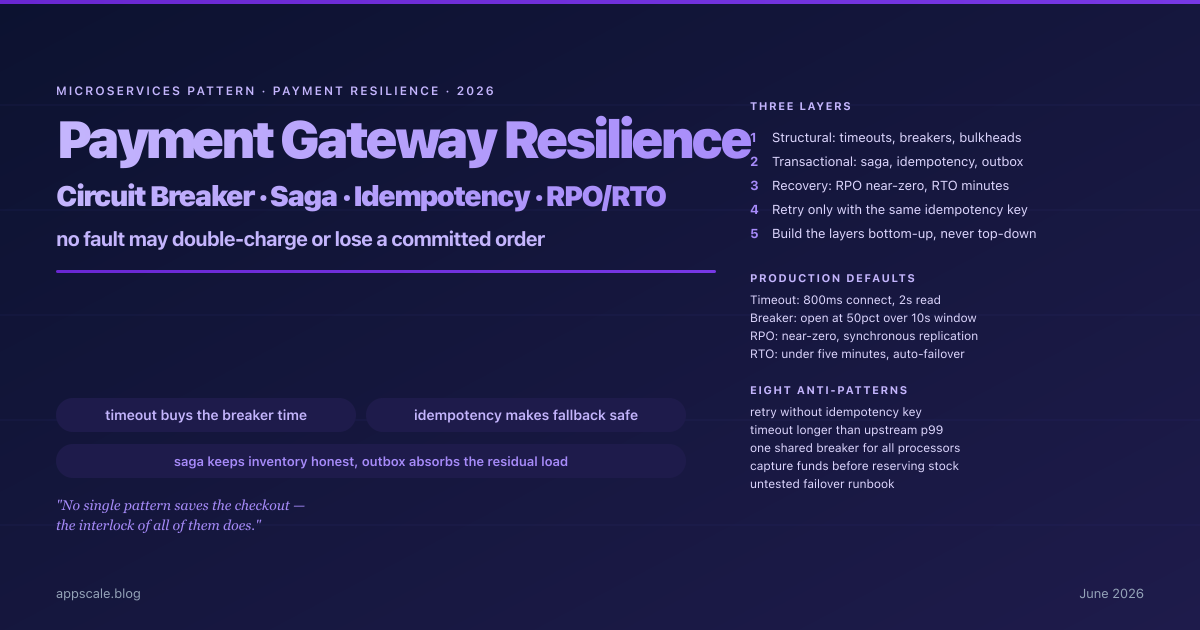
The Circuit Breaker Pattern: Stopping Cascading Failures Before They Take Down Your System (2026)
ai-architecture1 min read

The Circuit Breaker Pattern: Stopping Cascading Failures Before They Take Down Your System (2026)

A single slow downstream dependency is the most common cause of complete system outages in modern microservices architectures. The circuit breaker pattern prevents the cascade by stopping calls to a failing downstream and failing fast for upstream callers. This article covers the three states (closed, open, half-open), the metrics that drive transitions (failure rate, slow-call rate, sliding windows), production-tested configuration values, the composition with bulkheads and retries, fallback strategies, and the failure modes of the breaker pattern itself — with examples from Resilience4j, Polly, and service-mesh implementations in Istio and Linkerd.

April 20, 2026Read
LLM Fine-Tuning Guide: LoRA, QLoRA, DoRA, and Full Fine-Tuning Compared (2026)
enterprise-ai-platforms1 min read

LLM Fine-Tuning Guide: LoRA, QLoRA, DoRA, and Full Fine-Tuning Compared (2026)

Fine-tuning is the production capability most teams underestimate. With a few thousand high-quality examples and a single GPU, a 7 to 14B open-weights model can match or exceed a frontier model on the target task at one to two orders of magnitude lower cost. This guide compares full fine-tuning, LoRA, QLoRA, and DoRA — when each is the right choice, the hardware and dataset requirements, the hyperparameters that matter, the evaluation discipline, and the deployment patterns (merged weights, multi-LoRA serving, hot-swap adapters) that turn one base model into many specialised production endpoints.

April 20, 2026Read
AI for DevOps and AIOps: Automated Incident Response and Intelligent Monitoring (2026)
multi-cloud-infrastructure1 min read

AI for DevOps and AIOps: Automated Incident Response and Intelligent Monitoring (2026)

Most enterprises in 2026 still alert on static thresholds while operating systems too complex for any human to triage. AIOps closes the gap with adaptive anomaly detection, event correlation that collapses storms into incidents, automated root cause analysis, and autonomous remediation for known patterns. This guide covers what AIOps actually does in production, the leading platforms (Dynatrace Davis, Datadog Bits AI, PagerDuty AIOps, Moogsoft, BigPanda, Splunk ITSI, New Relic AI), the reference architecture for inserting AI into an existing observability stack, the maturity model, the common failure modes, and how AIOps integrates with AI workload observability.

April 20, 2026Read

ابق في صدارة المنحنى

التعمق الأسبوعي في أنظمة الذكاء الاصطناعي والبنية السحابية والأنظمة الموزعة والقيادة الهندسية. انضم إلى أكثر من 5000 مهندس.