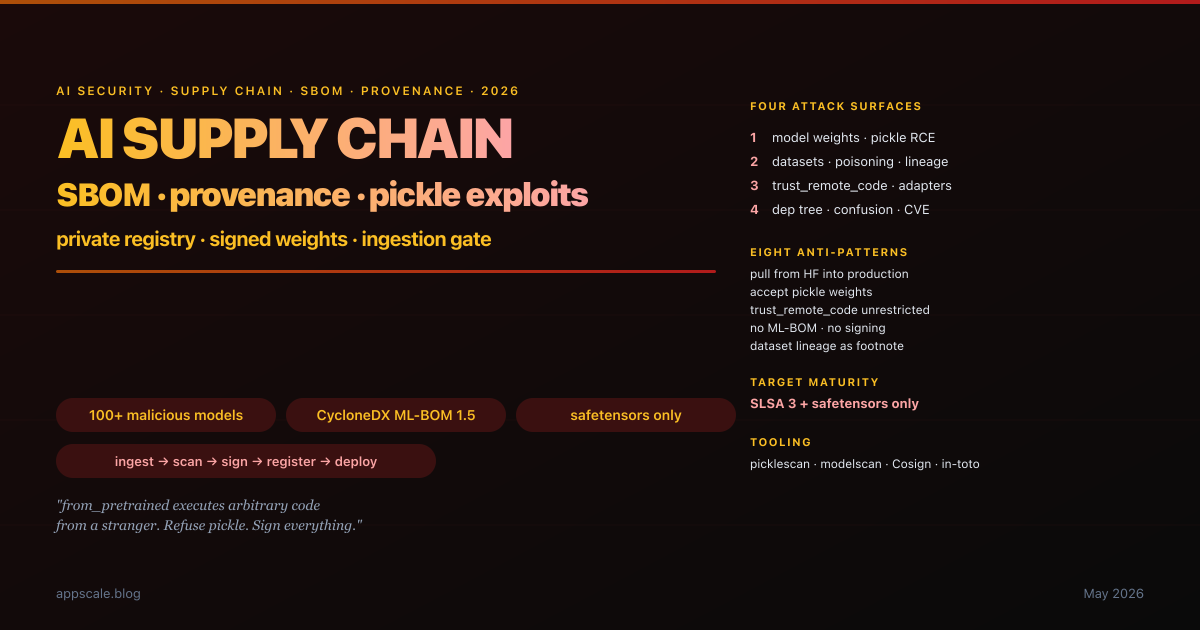
In February 2024 security researchers disclosed that a popular text-classification model on HuggingFace had been quietly modified to execute a reverse-shell payload at import time. Six months later a similar pattern hit a fork of a widely-used embedding model. Twelve months later JFrog disclosed more than a hundred malicious models sitting in plain sight on the public registry. The enterprise response in most cases was a shrug and a reminder to "be careful what you download" — which is the same response the software industry gave to npm and PyPI for a decade before SBOM-and-provenance discipline finally became table stakes. The AI supply chain is the next attack surface. This article is the deep-architecture guide: the four asset categories (weights, datasets, custom-code adapters, dep tree), the pickle problem precisely (why from_pretrained is arbitrary-code execution), the safetensors migration, CycloneDX ML-BOM, Sigstore/Cosign/in-toto for models, the Linux Foundation Model Signing project, the reference ingestion-gate architecture (picklescan + modelscan + CVE scan + provenance verify + private registry + fleet-side signature verification), dependency confusion in ML packages, embedded backdoors and stealth fine-tunes, dataset lineage and the EU AI Act, eight anti-patterns, five-stage maturity ladder, and the Monday-morning checklist.