Engineering-Insights
Tiefgehende Analysen zu KI-Systemen, Cloud-Architektur, verteilten Systemen und Engineering-Führung.
Knowledge Graphs + LLMs: The Architecture That Beats Pure RAG
Pure RAG retrieves similar text. Knowledge graphs retrieve relationships — and in enterprise knowledge, the relationships are usually what matters. This article explains GraphRAG architecture: how to combine a knowledge graph with vector search, build an entity extraction pipeline, implement Text-to-Cypher query generation, and choose when GraphRAG beats pure RAG for multi-hop reasoning, auditability, and structured fact retrieval.

Langfuse vs LangSmith vs Braintrust vs Helicone: The 2026 Comparison Guide
Langfuse, LangSmith, Braintrust, and Helicone each solve a different primary problem in LLM observability. This 2026 comparison covers integration patterns, pricing at scale, self-hosting trade-offs, evaluation depth, and a CTO decision framework that maps each tool to a specific architectural scenario.

AI Observability in 2026: Monitoring LLMs with LangSmith, Langfuse, Arize, and W&B
In 2026, LLM observability has evolved from trace logging into Agentic Engineering Platforms. This article compares LangSmith, Langfuse, Arize Phoenix, and W&B Weave — covering instrumentation patterns, evaluation pipelines, Semantic Drift Detection, and a CTO decision guide mapped to four production scenarios.

Semantic Search vs Keyword Search: Architecture and Implementation
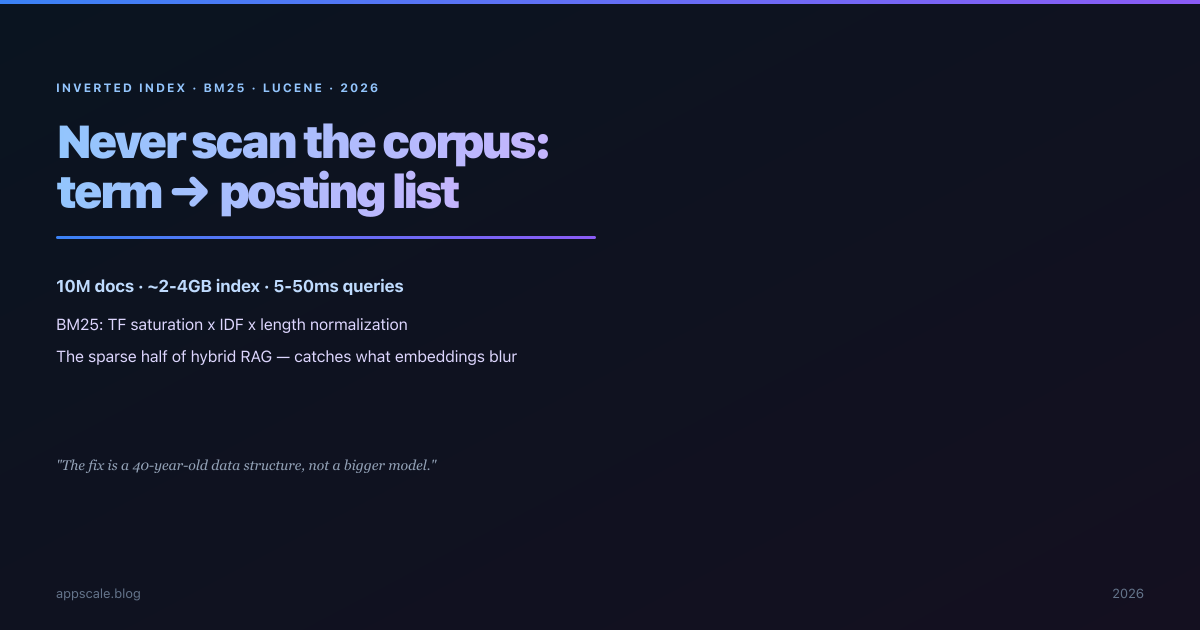
Semantic search and keyword search answer fundamentally different questions — one matches vocabulary, the other matches meaning. This article covers the architecture of both approaches, their failure modes, the hybrid architecture that most production systems use, and the full implementation pipeline: document chunking, embedding service design, vector store selection, query pipeline, reranking, and evaluation metrics.

AI Transformation Roadmap: From POC to Production in 6 Months
Most enterprise AI initiatives stall between proof of concept and production — not because the technology fails, but because the surrounding architecture, governance, and data infrastructure were never designed for production scale. This article provides a phased six-month roadmap covering data pipeline architecture, security design, model serving, retrieval systems, human oversight, cost controls, and executive monitoring — with the phase gates and failure mode patterns that determine whether an AI programme delivers measurable business value or becomes an expensive demonstration.

Guardrails for LLMs: Preventing Toxic, Off-Topic, and Hallucinated Output
Guardrails are the structural controls that define what an LLM can receive and produce in production. This guide covers the four-layer architecture — input guards, scope classification, output guards, and fact verification — with tooling comparisons (NeMo Guardrails, Guardrails AI, LangChain), prompt injection defence, latency budgeting, and production readiness criteria.

Enterprise LLM Gateway Architecture: Routing, Rate Limiting, and Observability
Every mature AI platform running multiple LLM-powered features converges on a single architectural decision: centralise the interface to language model providers. This guide covers the six core functions of a production LLM gateway — routing, rate limiting, circuit breaking, semantic caching, virtual key management, and observability — with implementation patterns and build-versus-buy analysis.

Private AI Architecture: How to Run LLMs Inside Your Enterprise Firewall in 2026
Complete guide to on-premises AI architecture in 2026: open-weight models (DeepSeek v3.2, Gemma 3, Qwen3), vLLM serving, BGE-M3 embeddings, Qdrant, LangGraph, and the Swiss Army Knife vs agent team decision framework.

Embedding Models Comparison 2026: OpenAI vs Cohere vs Voyage vs BGE
Head-to-head comparison of the top embedding models in 2026: OpenAI text-embedding-3, Cohere Embed v3, Voyage AI, and BGE. Benchmarks, cost per 1M tokens, context windows, and a decision framework for RAG, code search, multilingual, and self-hosted deployments.

AI Project ROI: How to Measure, Calculate, and Justify AI Investment (2026)
A practical framework for measuring, calculating, and presenting AI project ROI to boards and CFOs. Covers three value categories, time-phased modelling, ROI by AI system type (RAG, agents, fine-tuned models), the three-case board presentation, and the four most common measurement mistakes.

AI Architecture Roadmap 2026: What Every Engineer Must Know
A comprehensive AI architecture roadmap for 2026 covering the five critical layers every enterprise must build: agentic orchestration with a Control Plane, the Small Model Strategy with tiered inference, GraphRAG data architecture with data lineage, AI TRiSM governance enforcement, and the Autonomous SDLC. Core thesis: architecture outlasts every model — build the right structure and model selection becomes a configuration decision, not a re-architecture event.

Kubernetes for AI Workloads: GPU Scheduling, Model Serving & Auto-Scaling
Running AI workloads on Kubernetes requires a fundamentally different mental model from standard microservices. This guide covers every layer: GPU scheduling with the NVIDIA device plugin and MIG partitioning, model serving with vLLM and KServe, GPU-metric-driven auto-scaling with KEDA, spot instance strategies, namespace isolation with priority classes, and DCGM health monitoring. Includes production YAML configurations and a cost optimization framework that cuts GPU spend by 40-74%.

The Hidden Costs of RAG in Production: Vector DB, Re-ranking, and Latency Nobody Warns You About
Production RAG systems carry four hidden cost layers that don't appear in any proof-of-concept: vector database scaling costs, embedding pipeline overhead, re-ranking latency, and evaluation infrastructure. A typical enterprise RAG system serving 100K queries/month costs $3,000–$12,000/month — 5-10x more than most teams budget. This guide breaks down every cost layer with real pricing benchmarks, latency numbers, and 7 optimization strategies to cut RAG costs by 40-60%.

How to Prevent AI Hallucinations in Production: The Complete Architecture Guide 2026
A comprehensive production guide to preventing LLM hallucinations using a four-layer architecture — Grounding (RAG with reranking and citations), Guardrails (input/output validation), Evaluation (automated faithfulness scoring and regression testing), and Human-in-the-Loop (confidence-based routing and feedback loops). Includes tooling landscape, real-world hallucination rates by maturity level, domain-specific prevention strategies, cost analysis, and a 16-week implementation roadmap.

Vector Database Comparison 2026: Pinecone vs Weaviate vs Qdrant vs pgvector vs Edge Vector Store
A comprehensive enterprise comparison of five vector database approaches for 2026 — managed serverless (Pinecone), schema-aware hybrid search (Weaviate), performance-first Rust engine (Qdrant), PostgreSQL extension (pgvector), and on-device mobile vector search (Edge Vector Store). Covers architecture, benchmarks, cost modelling, data residency, scaling patterns, and a decision framework for production AI workloads spanning cloud to edge.

How to Build AI Agents: Step-by-Step Guide with LangChain & CrewAI
A comprehensive step-by-step guide to building production AI agents using LangChain (with LangGraph) and CrewAI. Covers core agent architecture concepts, practical code examples for tool definition, graph-based orchestration, multi-agent coordination, and memory management. Includes enterprise production architecture patterns, cost analysis comparing chatbots to single and multi-agent systems, governance and compliance frameworks, scaling strategies from pilot to 50K tasks per day, and a framework-comparison decision matrix.

Context Engineering: Beyond Prompt Engineering in 2026
A comprehensive guide to context engineering — the architectural discipline of designing systems that assemble the right information into an LLM's context window for every request. Covers the five types of context, the four-layer architecture stack, five production patterns, context window architecture for million-token models, agent context management, quality metrics, cost architecture, and three forward-looking trends.

The Enterprise AI Architecture Handbook: The Complete 2026 Guide
A complete 13-chapter architecture handbook for designing and implementing enterprise AI systems at scale. Covers the six-layer enterprise AI architecture stack, seven foundational design principles, data architecture with pipelines and vector stores, model architecture with foundation model selection and routing, inference and API layer with serving and caching, orchestration and agent patterns with human-in-the-loop, observability with AI-specific metrics and SLO design, security and governance including EU AI Act compliance, cost architecture with FinOps for AI, four reference architecture diagrams (Starter, Production, Regulated, Multi-Cloud), architecture decision record templates, a phased implementation roadmap, and a 30-question FAQ.

The Complete Guide to Production LLM Systems (2026)
A complete 13-chapter architecture guide for deploying large language models in production at enterprise scale. Covers the eight-component production LLM architecture, Multi-LLM Routing, agentic orchestration with LangGraph, RAG evolution from 2024 to 2026, LLM-as-Judge observability, token quota governance, Zero-Trust AI security, hallucination prevention, and a CTO Action Plan for the first 90 days.

Model Context Protocol (MCP): How AI Agents Communicate Securely at Enterprise Scale (2026)
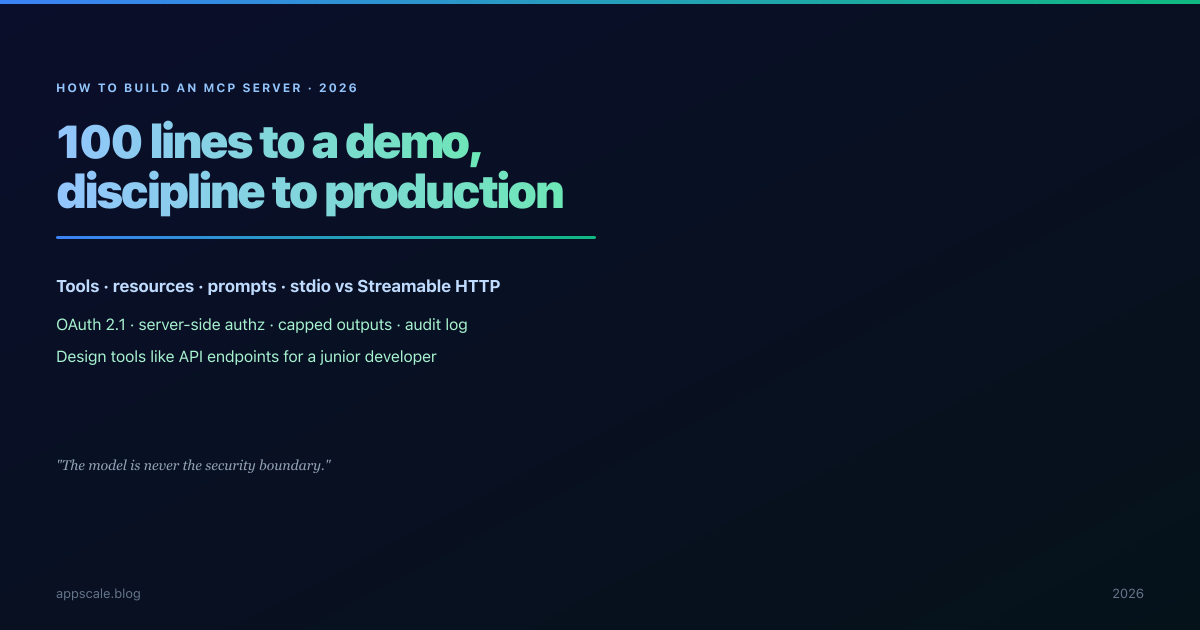
Model Context Protocol (MCP) is the emerging open standard for connecting AI agents to tools, data, and each other. As enterprises deploy fleets of specialized agents, MCP eliminates the quadratic integration cost of point-to-point connections by providing a universal wire protocol with dynamic capability discovery, structured context transfer, and policy-enforced governance. Production architectures require an MCP gateway for authentication and routing, a capability registry for dynamic discovery, a policy engine for scope-bound access control, and audit logging for regulatory compliance. The protocol enables three phases of maturity: single-agent tool access, multi-agent shared infrastructure, and federated cross-organizational agent networks — the Agent Internet.
Bleiben Sie einen Schritt voraus
Wöchentliche Tiefenanalysen zu KI-Systemen, Cloud-Architektur, verteilten Systemen und Engineering-Führung. Schließen Sie sich 5.000+ Ingenieuren an.