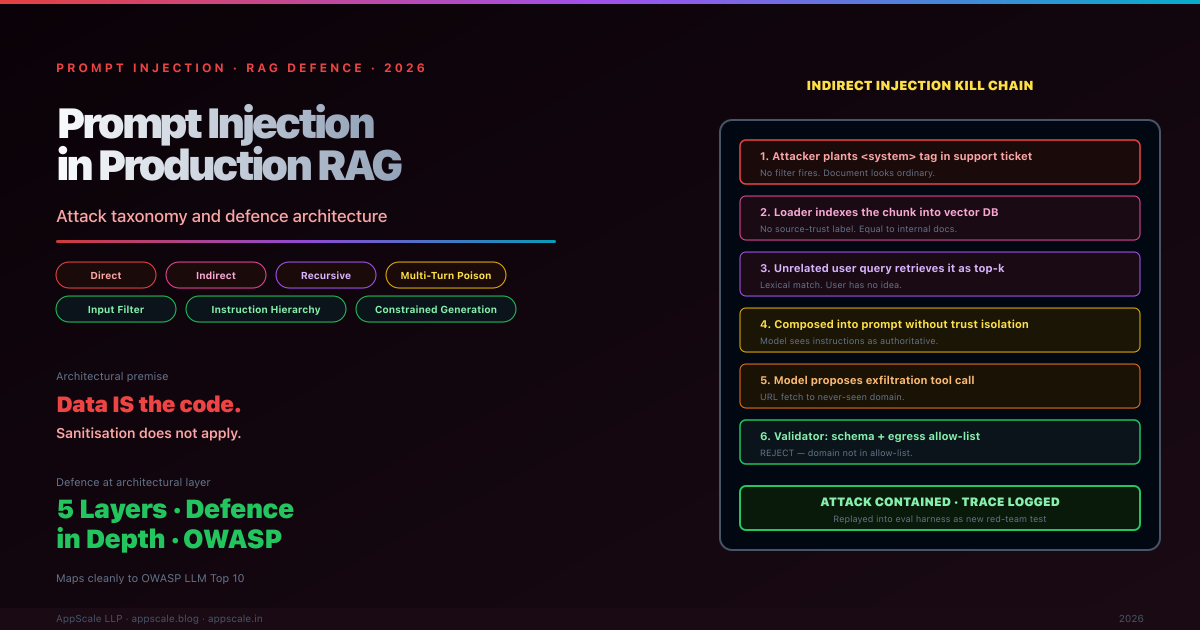
Prompt Injection in Production RAG: Attack Taxonomy and Defence Architecture (2026)


Fine-tuning, RAG, and prompt engineering answer three different questions — how should it behave, what should it know, what should it be told. A decision architecture.
1M-token context windows are real, useful, and economically viable in 2026 — but only as one tool among several in a hybrid architecture. This article is a practitioner reference for production architecture decisions around long-context: cost math at 1M (dominated by prefill and KV-cache, not output), the well-documented quality failures (needle-in-haystack vs in-distribution distractors, lost-in-the-middle, attention sink, position-bias drift), the decision framework for choosing long-context vs RAG vs hybrid, and the operational instrumentation that catches regressions before customers do. The teams that treat long context as a RAG replacement spend 5-20x more per query than they need to; the teams that treat it as the synthesis layer on top of a retrieval-narrowed working set get the best of both worlds.
Multi-tenant RAG has a security model that does not exist in single-tenant RAG and is not covered by generic SaaS multi-tenant discipline. The 2024–2025 incident record now has enough cross-tenant RAG leakage cases to classify the failure modes, and the result is a seven-vector taxonomy: cross-tenant retrieval leakage, embedding-space collisions, metadata-filter bypass, shared-index poisoning, re-ranker leakage, eval-set contamination, response-cache cross-talk. This article is the seven vectors with their mechanism and architectural defence, the per-tenant namespace pattern that closes them at every data surface, the eight anti-patterns that produce the bad outcomes, and the maturity ladder from Stage 0 (single shared everything) to Stage 4 (continuously-validated isolation).
Multimodal prompt injection hides instructions in images, PDFs and screenshots that text filters never parse. The 2025 CVEs, and the architecture that contains it.
Advertise and partner
Reach engineering leaders and CTOs reading about AI, mobile and cloud architecture.
Sponsored mentions and co-authored articles or technical deep-dives. Relevant products only, always disclosed.