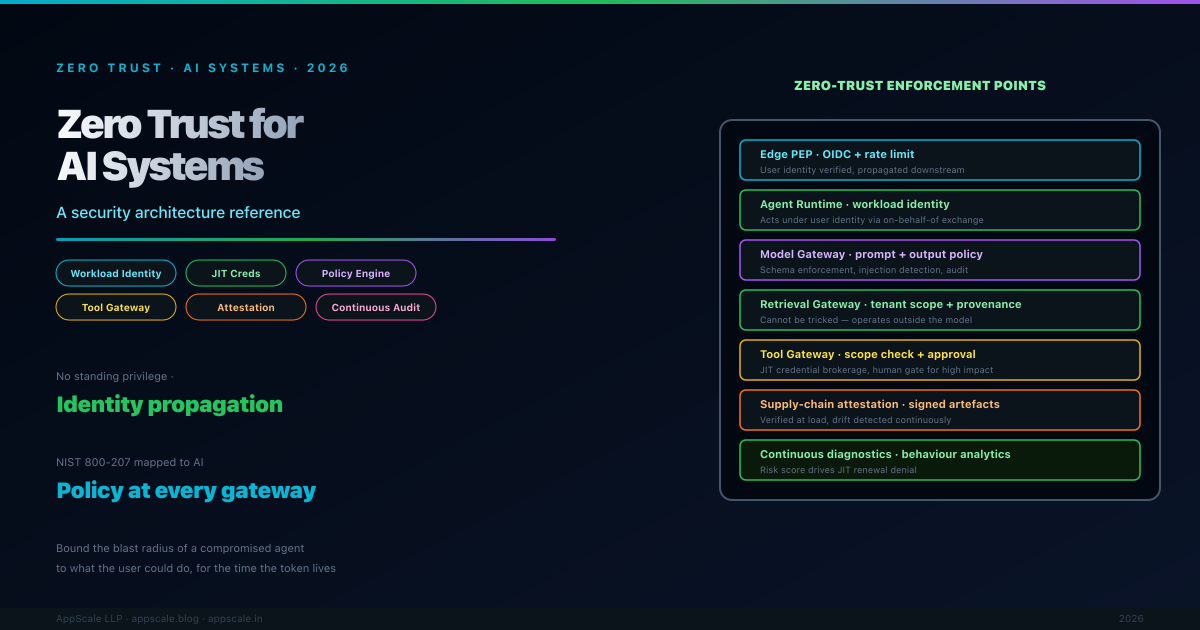
Zero Trust for AI Systems: A Security Architecture Reference (2026)


Building HIPAA-compliant AI systems requires more than a Business Associate Agreement. This guide covers the complete architecture: PHI de-identification and pseudonymisation layers, sensitivity-based model routing, RBAC for minimum necessary compliance, immutable audit trails, and clinical use cases — ambient scribing, decision support, and patient-facing chatbots.
A complete 13-chapter enterprise reference for designing, building, and evolving an AI platform — the shared substrate that lets every team ship AI features without rebuilding the same plumbing. Covers the 7-layer platform model (data, model management, inference, orchestration, evaluation, governance, developer experience), 4 reference architectures (Startup, Growth, Enterprise, Regulated-Industry), the model lifecycle and registry, multi-tenant data isolation, semantic caching and routing, FinOps with attribution and budget guardrails, EU AI Act and HIPAA-aligned governance, and the Phase 0 to Phase 4 maturity roadmap with team sizes and timelines. Includes a 20-question platform readiness assessment and a 30-question FAQ optimized for the decisions enterprise architects actually face.
An AI product built in Bengaluru that serves a German healthcare buyer is governed by two regulators that do not coordinate — DPDP in India and the EU AI Act in Europe. This article is the architect's reference for shipping an India-EU AI platform that satisfies both regimes from one codebase: the DPDP versus AI Act overlap matrix, data residency arithmetic for India localisation alongside GDPR cross-border rules, the dual consent ledger that captures both DPDP notice-acknowledgement and GDPR lawful basis, the combined DPIA-FRIA workflow, the role mapping between Data Fiduciary, Provider, and Deployer, the SCC + TIA mechanics for EU-to-India transfers, and a reference architecture with shared control plane and regional data planes.
A reference architecture for offline LLM systems in air-gapped environments. Covers signed update flows, local registries, offline retrieval, observability, security controls, and the real cost profile of air-gapped AI.
Advertise and partner
Reach engineering leaders and CTOs reading about AI, mobile and cloud architecture.
Sponsored mentions and co-authored articles or technical deep-dives. Relevant products only, always disclosed.