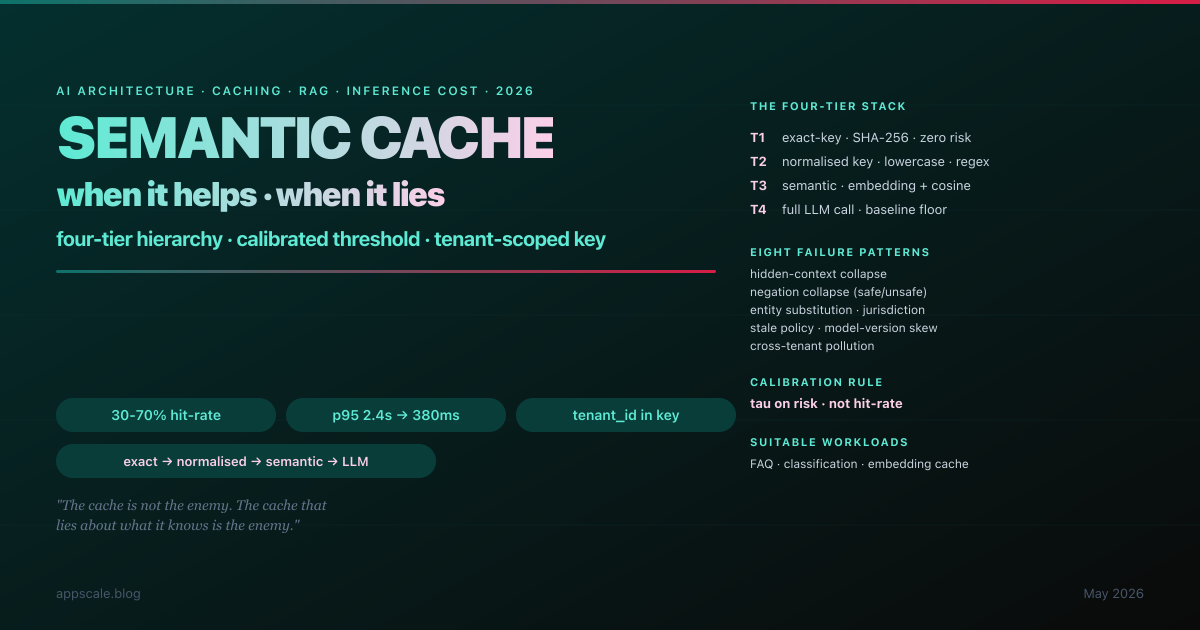
返回博客ai-architectureSemantic Cache Pattern: When It Helps, When It Lies — A 2026 Architecture Guide for LLM FeaturesMay 25, 202621 min read semantic cache llm cache ai architecture cache hierarchy embedding cache cosine similarity cache calibration multi-tenant cache cache invalidation cache ttl prompt caching rag caching llm cost optimization inference latency p95 latency ai service patterns false positive rate production llm 2026Frequently Asked QuestionsWhat is a semantic cache, and how is it different from exact-key cache, prefix cache, and provider prompt cache?When does semantic cache help, and on which workloads does it lie?How is the four-tier cache hierarchy structured, and why is each tier independently valuable?How should the semantic-cache threshold be calibrated, and what is wrong with using the vendor default?Why must the cache key include tenant_id in a multi-tenant B2B SaaS deployment, and what are the implementation choices?What is the role of TTL and model-version in cache-key design, and how is silent ground-truth drift handled?What are the eight failure patterns that recur across semantic-cache production incidents?What hit-rates are actually achievable in production, and what is the relationship between hit-rate and workload diversity?How does semantic cache compose with the rest of the AI service stack — model router, retrieval cache hierarchy, KV-cache, prompt cache?What is the Monday-morning checklist for shipping a defensible semantic-cache architecture this quarter? 分享这篇文章 Twitter LinkedIn WhatsApp复制链接Download as PDFSatyam人工智能和云架构师。帮助团队构建可扩展到数百万的系统。Comments Leave a commentPost Comment