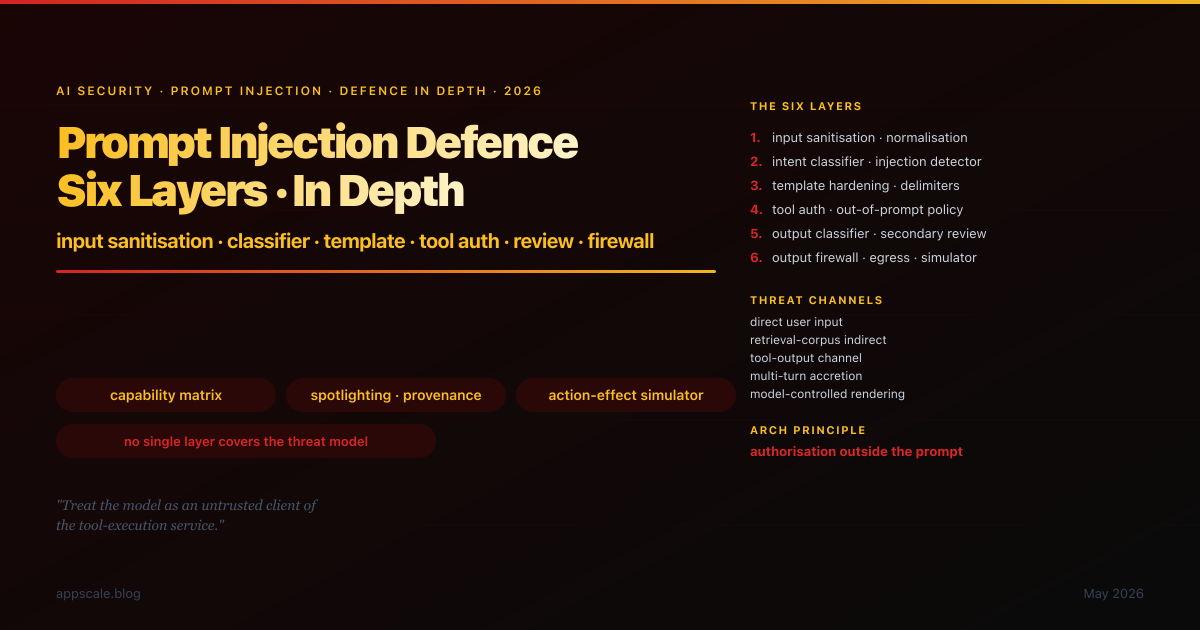
返回博客ai-architecturePrompt Injection Defence in Depth (2026): Six Layers from Input Sanitisation to Output FirewallMay 13, 202622 min read prompt injection ai security defence in depth llm security output firewall tool use authorisation capability matrix spotlighting injection detector secondary review llm egress filter action effect simulator rag security agent security jailbreak defence guardrails ai architecture 2026Frequently Asked QuestionsWhy has the field moved from a single strong filter to a six-layer defence-in-depth stack in 2026?What does Layer 1 (input sanitisation and normalisation) actually deliver, and what are its known limitations?How are the Layer 2 classifiers trained, and why does generic off-the-shelf training fail?What does Layer 3 (prompt-template hardening) cover, and what is the spotlighting pattern?Why must tool-use authorisation (Layer 4) be outside the prompt, and what does the capability matrix look like?How should the Layer 5 secondary-review LLM be structured, and how are disagreements between primary and secondary handled?What does the Layer 6 output firewall enforce, and how does the action-effect simulator work?In what order should an organisation build the six layers, and what is the engineering rationale?How does the six-layer stack compose with category-aware guardrails, agent circuit breakers, observability, and incident response?What does the maturity ladder look like, and where do most production LLM applications sit in early 2026? 分享这篇文章 Twitter LinkedIn WhatsApp复制链接Download as PDFSatyam人工智能和云架构师。帮助团队构建可扩展到数百万的系统。Comments Leave a commentPost Comment