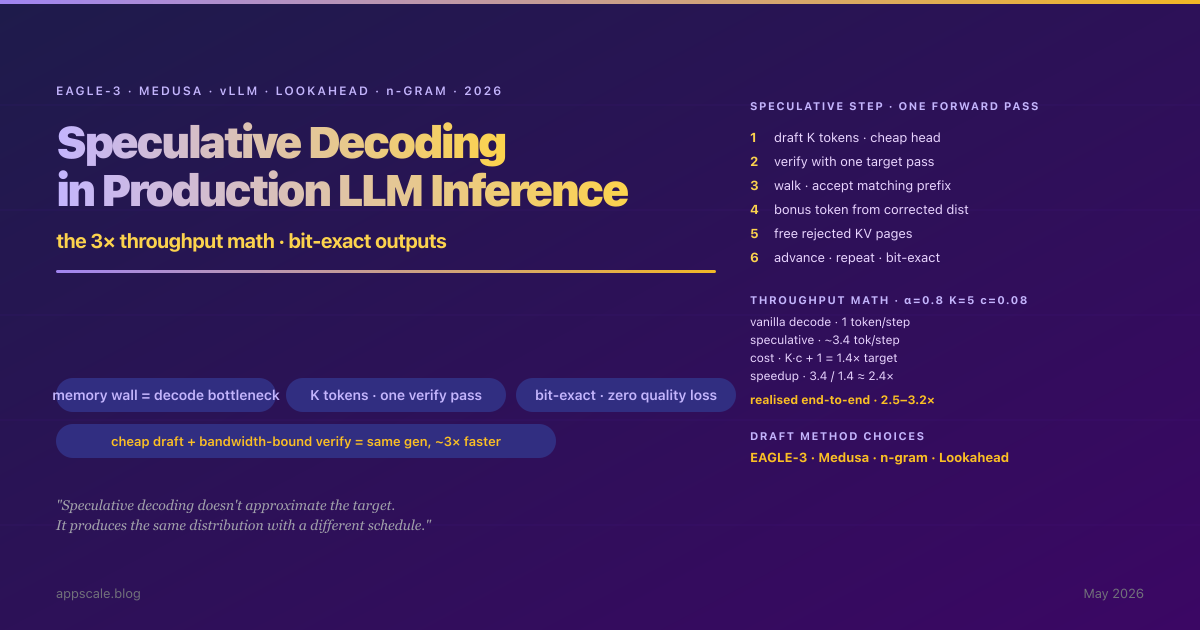
返回博客ai-architectureSpeculative Decoding in Production LLM Inference: EAGLE-3, Medusa, vLLM, and the 3× Throughput Math (2026)May 20, 202634 min read speculative decoding llm inference eagle eagle-3 medusa vllm lookahead decoding n-gram speculation kv cache paged attention inference optimization gpu serving tensorrt-llm sglang autoregressive decoding ai infrastructure production llm 2026Frequently Asked QuestionsIs speculative decoding an approximation of the target model's output, and could it ever produce a different answer than vanilla decoding?How is acceptance rate measured in production and what should the alert threshold be for detecting head drift or workload shift?When does speculative decoding hurt throughput rather than help it, and how does the team detect and disable it for those workloads automatically?What is the practical training recipe for an EAGLE-3 head against a custom fine-tuned target model and what does the budget look like?How does speculative decoding interact with PagedAttention and the KV-cache management in vLLM, and what is the memory cost of speculation?How does speculative decoding interact with prefill / decode disaggregation and is there a workload where the two techniques fight each other?What is the right way to A/B-test a new draft head deployment without exposing customers to a regression on a subset of workloads?How do different model architectures (dense, MoE, hybrid attention) interact with speculative decoding, and is the speedup the same across them?How does speculative decoding interact with structured-output enforcement (JSON schema, regex constraints, function-calling) and is the speedup preserved?What is the relationship between speculative decoding and other inference optimisations like quantisation, KV-cache compression, and pruning — are they complementary or do they compete? 分享这篇文章 Twitter LinkedIn WhatsApp复制链接Download as PDFSatyam人工智能和云架构师。帮助团队构建可扩展到数百万的系统。Comments Leave a commentPost Comment