工程见解
深入探讨人工智能系统、云架构、分布式系统和工程领导力。
AWS Lambda + Fargate Hybrid Architecture: When to Use Which (2026)
The Lambda-versus-Fargate question stopped being binary and became openly hybrid by 2026. Teams shipping the cleanest production architectures use Lambda for its cold-start economics on sporadic event-driven work, Fargate for its long-running container economics on sustained traffic, and route between the two intelligently. This article covers the cost-curve arithmetic that decides most choices, the AI inference workload caveats including the 2026 GPU-on-Fargate gap, the hybrid routing pattern using ALB / EventBridge / Step Functions, NestJS deployment patterns that target both runtimes from one codebase, a real cost comparison spreadsheet for a 50M-request-per-month API, and the observability discipline required to run both together.

DPDP + EU AI Act: A Dual-Compliance Architecture for India-EU AI Systems (2026)
An AI product built in Bengaluru that serves a German healthcare buyer is governed by two regulators that do not coordinate — DPDP in India and the EU AI Act in Europe. This article is the architect's reference for shipping an India-EU AI platform that satisfies both regimes from one codebase: the DPDP versus AI Act overlap matrix, data residency arithmetic for India localisation alongside GDPR cross-border rules, the dual consent ledger that captures both DPDP notice-acknowledgement and GDPR lawful basis, the combined DPIA-FRIA workflow, the role mapping between Data Fiduciary, Provider, and Deployer, the SCC + TIA mechanics for EU-to-India transfers, and a reference architecture with shared control plane and regional data planes.

Microservices Infrastructure Anti-Patterns: Synchronous Blocking, Missing Idempotency, Tight Coupling, Centralised Retries (2026)
Most microservices outages do not trace back to exotic edge cases — they trace back to four infrastructure anti-patterns that the team knew about in principle but had not engineered against in practice. Synchronous blocking calls turn one slow downstream into a complete platform freeze. Missing idempotency turns a network blip into duplicate charges and ghost orders. Tightly coupled services turn the independent-deployment promise into a distributed monolith. Centralised retry logic turns a brief degradation into a stampede that prevents recovery. This article walks through all four with credible failure stories, architectural diagnoses, fix patterns with cross-links to the positive constructions, the unwinding order that works in production, detection signatures that catch the anti-patterns early, and configuration values that work at scale.

Microservices Orchestration Anti-Patterns: Centralised Bottlenecks and Synchronous Enrichment (2026)
Once a platform has more than a handful of services, orchestration becomes its own architectural concern. Two anti-patterns recur in every multi-service platform: synchronous blocking enrichment fans out to N downstream services in-line and waits for each, paying the sum of all latencies for every request and inheriting the product of all availabilities; centralised orchestration bottlenecks put every multi-step workflow through one shared orchestrator that becomes a single point of failure and a deployment chokepoint as the platform grows. Both share an underlying single-process mental model and both fail at scale. This article covers credible failure stories, architectural diagnoses, the fixes (parallel async enrichment and per-domain saga orchestration), the unwinding order that works in production, detection signatures including the latency-to-fan-out ratio, and configuration values from real platforms.

Zero Trust for AI Systems: A Security Architecture Reference (2026)
Zero trust is the security posture in which no network location, no identity, and no prior authentication is treated as inherently trustworthy — every access decision is made fresh, against current context, on the principle of least privilege, with continuous verification rather than perimeter assumption. This article maps the NIST 800-207 components onto AI-specific components: model endpoints, agent runtimes, tool gateways, retrieval indexes, fine-tuning jobs, and model artefacts. It walks through a threat model that names the realistic adversaries, presents a reference architecture diagram that names every enforcement point, and concludes with the operational disciplines (audit, behaviour analytics, key rotation, supply-chain attestation) that distinguish a zero-trust AI system from a conventional AI system with a few extra firewalls.

MCP vs A2A vs ACP: Choosing an Agent Interoperability Standard (2026)
Three protocols now compete to be the lingua franca of agent interoperability — Anthropic's Model Context Protocol (MCP), Google's Agent-to-Agent protocol (A2A), and IBM's Agent Communication Protocol (ACP) — and the architect choosing between them in 2026 is not picking a winner but deciding which protocol fits which boundary in their system. This article is the working comparison: each protocol's origin and sponsor, transport, auth model, schema and discovery, tool-calling shape, real-world adoption, and the use cases where it shines or struggles. The piece concludes with a decision matrix and an architecture diagram showing how a realistic production estate composes all three at different layers — MCP for the model-to-tool boundary, A2A for cross-organisational delegation, ACP for intra-platform coordination across mixed-framework agents.

AI Agent Mesh Architecture: Multi-Agent Coordination Without a Central Brain (2026)
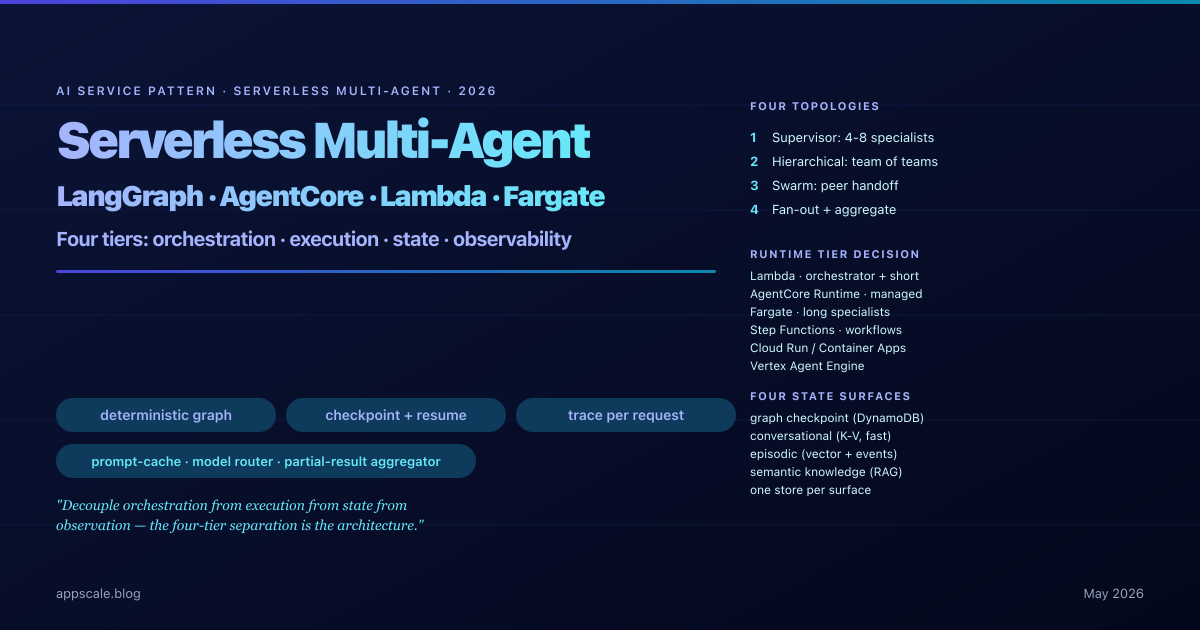
An agent mesh is what you end up with when you stop pretending one orchestrator can coordinate every autonomous capability in your enterprise. The orchestrator-as-central-brain works for ten agents, struggles at fifty, collapses at two hundred. The mesh is the alternative posture: agents discover each other through a registry, communicate through a message bus, negotiate work through coordinator-free patterns (gossip, role auctions, blackboards), and observe each other through trace propagation that survives asynchronous boundaries. This article covers the four topologies, the message bus options (NATS, Kafka, EventBridge), the coordinator-free coordination patterns, the role registry and capability discovery layer, observability across asynchronous agent boundaries, failure isolation through per-agent circuit breakers and dead-letter handling, and a reference implementation on NestJS plus AWS Bedrock with sequence diagrams.

Beyond NVIDIA: The 2026 AI Accelerator Landscape (Groq, Cerebras, Trainium, TPU, MI300, Tenstorrent)
NVIDIA is no longer the only sensible choice for serious AI inference and training in 2026. Groq serves Llama-70B at sub-second time-to-first-token; Cerebras WSE-3 fits an entire 70B model on one wafer; AWS Trainium2 has become the AWS-native cost leader; Google TPU v5p quietly trains models on JAX; AMD MI300X has reached the maturity threshold where ROCm is no longer an active impediment; and Tenstorrent has opened a workstation-class option with a fully open stack. This article is the architect's reference for choosing between them — per-vendor architecture, sweet spots, real benchmarks, tooling maturity, lock-in posture, and a comparison table that surfaces dollars per million output tokens for Llama-70B-class workloads in 2026.

Multimodal AI on React Native: On-Device Vision and Language Models (2026)
Multimodal AI on a phone is not a smaller version of multimodal AI in the cloud. It is a different engineering problem with different constraints — a 4GB RAM ceiling, a thermal budget that throttles after ninety seconds, a 3000mAh battery the user expects to last all day, an App Store review that rejects 800MB of model weights, and a device fleet from A18 Pro to Snapdragon 6 Gen 1. This article covers quantised on-device model formats (CoreML, ONNX, MLC, llama.cpp), the JSI bridge and TurboModule architecture that makes native model invocation cheap enough to run per camera frame, the vision pipeline (camera frame to label) and language pipeline (small Llama or Phi via llama.cpp) with realistic latency and battery numbers, cloud-fallback decision logic, thermal management, OTA model update strategy, and the testing discipline that catches regressions.

The Hidden Costs of Cloud: A FinOps Playbook for the AI Era (2026)
Most cloud cost overruns are not caused by the workloads themselves — they are caused by four hidden categories of spend (egress, idle resources, mis-tuned commitments, managed-service markups) that collectively account for 30 to 50 per cent of the monthly bill. FinOps is the discipline of making this spend visible, attributable, and governed. This 2026 playbook covers the four hidden-cost categories, the AI-specific anomalies (GPU idle, long-context inference, frontier API accumulation), the FinOps maturity model, the discount and commitment models compared, the tooling landscape (cloud-native, third-party platforms, Kubernetes-native, AI workload), and a 12-month implementation roadmap that typically reduces total spend by 25 to 40 per cent.

OpenTelemetry for NestJS: Distributed Tracing in Production (2026)
A request comes into OrderController, fans out to four downstream services, queues a fulfilment job, returns. When it fails, the support ticket says "the order didn't go through" — and the engineer has nothing but a timestamp and a user ID. With OpenTelemetry properly wired into every NestJS service, the engineer pastes the trace ID into a query and sees the entire request as a single waterfall, with the failing span highlighted in red. This NestJS-specific guide covers auto-instrumentation setup, custom spans for business operations, choosing between Jaeger, Tempo and Honeycomb, correlating traces with logs via trace_id injection, sampling strategy that captures error traces while limiting cost, and the performance overhead in production.

Prompt Injection in Production RAG: Attack Taxonomy and Defence Architecture (2026)
The first production prompt-injection incident most teams encounter does not arrive as a clever adversarial prompt — it arrives quietly inside a customer support ticket whose description contains a literal <system>ignore prior instructions</system> tag, which the document loader indexes and the retriever later returns as a top-k result for an unrelated query. This article is a working architect's reference for defending production RAG against prompt injection: an attack taxonomy (direct, indirect via documents, recursive prompt-in-output, multi-turn poisoning), CVE-style example walk-throughs, a five-layer defence-in-depth architecture (input filtering, instruction hierarchy, structured output validation, JSON-schema constrained generation, sandboxed tool execution), an OWASP LLM Top 10 mapping, an evaluation harness with red-team prompts, and the runtime monitoring patterns that turn a one-time hardening exercise into an ongoing security posture.

The Modular Monolith Comeback: When Microservices Were Overkill (2026)
Somewhere around 2014 the industry decided monoliths were the problem and microservices the answer. By 2026 the bills have arrived — observability, network, on-call, distributed transactions, hours-long integration tests — and "modular monolith" is a respectable architecture choice again. This article reconstructs how we ended up with too many microservices, defines what a modular monolith actually is (and is not), shows the NestJS module boundaries that make a monolith genuinely modular, sets out the scaling triggers that justify a real split, walks through the Strangler Fig migration path in both directions, examines the Shopify, Basecamp and Amazon Prime Video case studies, and offers a decision table for architects choosing between the two.

Domain-Driven Design in NestJS: A Practical Architecture Guide (2026)
Most teams that say they "do DDD" have a folder called domain/ and occasional meetings with a product manager. The genuine practice — bounded contexts that match the business, aggregates that protect invariants, ubiquitous language that survives the trip from whiteboard to code — is rare because it is harder than its surface description. NestJS is one of the few back-end frameworks whose primitives are well-suited to a serious DDD implementation. This guide covers bounded context mapping, aggregate sizing, the ideal layered folder structure, the repository pattern done correctly versus the DAO that pretends to be one, domain events through the in-process bus, and composition with the Saga, Outbox, and Event-Driven Architecture patterns.

Four AI System Anti-Patterns: Unclassified Query, Generic Single-Prompt, Monolithic Safety, and Confident Misclassification (2026)
Most AI system failures in production are not novel; they are repeat performances of a small number of well-known anti-patterns that teams keep rediscovering because the lessons are scattered across post-mortems that never get aggregated. This article bundles four of the most damaging into one reference: the unclassified query (treating every input as one category routed through one flow), the generic single-prompt (one giant 4-8k token system prompt covering every behaviour), monolithic safety (one configuration applied to every category and tenant regardless of differing requirements), and confident misclassification (the model is wrong but expresses high confidence so the system acts on the wrong answer). Each looks reasonable when small; each becomes a load-bearing failure mode as the system grows; each has a structural fix described in the dedicated positive patterns elsewhere in this series. The four share a structural theme — undifferentiated handling of inputs that have meaningfully different requirements — and they compound: each makes fixing the others harder. This article documents the failure modes, the detection signatures, the unwinding order, and a production case study that improved every metric.

The AI Observability Pattern: OpenTelemetry Tracing for LLM Calls, Token Cost Attribution, and Eval Metrics in Production (2026)
The first instinct when wiring observability into an LLM system is to treat the LLM call as just another HTTP outbound call. Within a week the team realises conventional observability is missing everything that matters — the span tells you the call took 4.2 seconds and returned 200 OK but does not tell you token counts, cost in dollars, model variant, prompt template version, eval scores, tool calls, or whether the response was a hallucination versus a useful answer. Conventional observability tells you the system is up; AI observability needs to tell you whether the system is producing useful output at acceptable cost. This article covers the OpenTelemetry GenAI semantic conventions stabilising in late 2025/early 2026, what to instrument and how, the agent trace hierarchy that makes multi-step debugging tractable, how to attribute token cost across a multi-tenant deployment, how to surface eval scores as first-class telemetry, and the dashboards every production AI team should have on day one.

The Human-in-the-Loop Escalation Pattern: Confidence-Triggered Routing, Reviewer Workflows, and Closing the Feedback Loop (2026)
The most common mistake in production AI systems is to treat the model as the final decision-maker for every input. The model is a probabilistic component — sometimes confident and correct, sometimes confident and wrong, sometimes uncertain and the right answer is "ask a human." A system that ignores the third case ships hallucinations as authoritative answers; a system that routes everything through humans defeats the point of automation. The Human-in-the-Loop escalation pattern is a structured routing mechanism that detects, before the prediction is acted upon, that the model's output should not be trusted, and routes that input to a human reviewer with the right context to decide. The reviewer's decision becomes both the immediate user-facing answer and a labelled training example that closes the feedback loop. This article covers the production design: which signals reliably indicate "this needs a human" (calibrated confidence, novelty, policy triggers, contradiction), how to build a reviewer queue that humans can keep up with, what the interface needs for sub-30-second decisions, and how to feed reviewer decisions back into training without contamination.

The Agent-Level Circuit Breakers Pattern: Per-Tool, Per-Provider, Per-Capability Isolation in Production AI Agents (2026)
The conventional circuit breaker was designed for a world where one service called one downstream and the failure modes were mostly availability — the dependency was up or down. AI agents inhabit a different world: an orchestrator that fans out to a heterogeneous set of tools, multiple LLM providers, and internal capabilities, each with its own failure profile, latency distribution, cost per call, and consequence on the agent's task. A single per-host breaker treats them all the same and is wrong almost everywhere. The agent-level circuit breaker pattern replaces the conventional one with a hierarchy of breakers — per-tool, per-provider, per-capability — each tuned to the failure mode it is meant to protect against. This article walks through the hierarchy in production: which dimensions need their own breakers, how thresholds should differ, what fallback semantics make sense at each layer, how to compose breakers with retries and timeouts without amplifying load, and the operational dashboards that make agent-level breakers debuggable.

The Async Parallel Enrichment Pattern: Fan-Out, Gather, and Partial-Result Tolerance for Production APIs (2026)
Almost every interesting endpoint in a modern system is an enrichment endpoint — assembling a response from eight or twelve upstream services. Sequential chaining produces a sum-of-dependencies latency floor; one failed dependency takes the whole endpoint down. The async parallel enrichment pattern replaces the chained sequence with a fan-out: every independent enrichment is fired in parallel, the responses are gathered with a deadline, and the assembly step copes gracefully with the responses that did not arrive in time. This article walks through the discipline the pattern actually requires — Promise.allSettled, per-call timeouts composed from the outside in, AbortController-based cancellation, request coalescing and DataLoader-style deduplication, the required-vs-optional API contract, partial-aware response schemas, per-dependency observability, and the configuration values that work in production.

Multi-Tenant SaaS Data Architecture: Silo, Bridge, Pool — Trade-Offs, Migration Paths, and Production Hardening (2026)
Multi-tenant data architecture is one of the highest-leverage decisions a SaaS team ever makes — and one of the most under-discussed. The choice between silo (database per tenant), bridge (schema per tenant), and pool (shared schema with tenant_id) determines unit economics, blast radius, compliance posture, noisy-neighbour behaviour, and the cost of every migration for the rest of the product's life. This article is the production design guide: trade-off matrix, Postgres RLS for defence in depth, envelope encryption with per-tenant KMS keys, GDPR right-to-erasure per model, per-tenant cost attribution, migration paths, and the day-one infrastructure that pays back at year three.
保持领先地位
每周深入探讨人工智能系统、云架构、分布式系统和工程领导力。加入 5,000 多名工程师的行列。