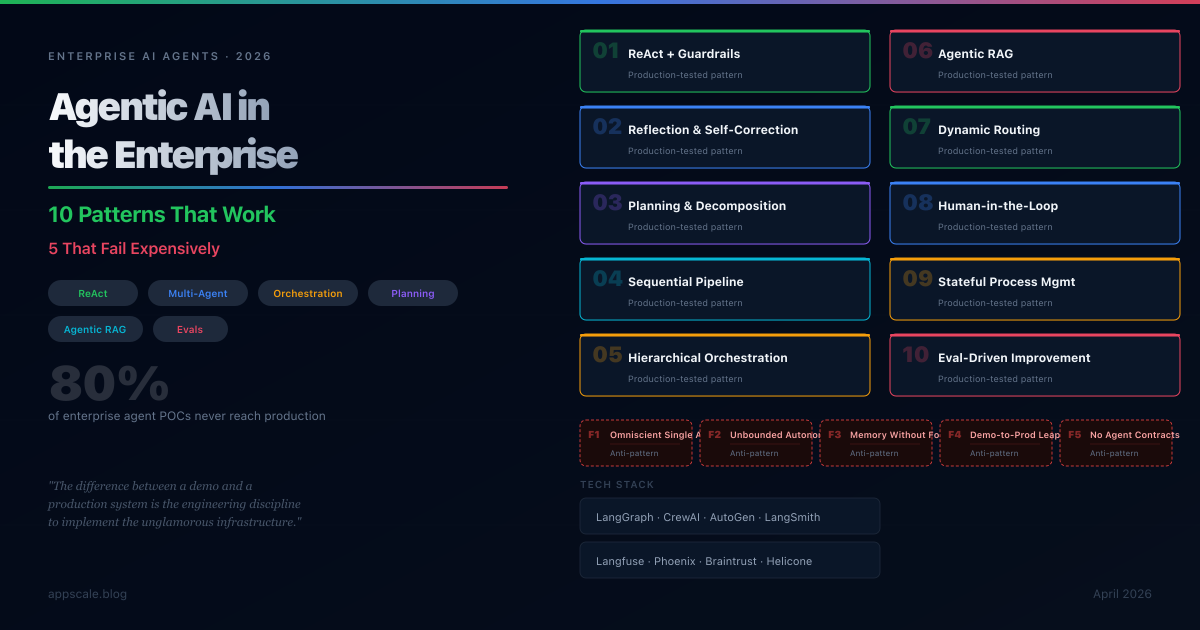
Agentic AI in the Enterprise: 10 Patterns That Work (and 5 That Fail Expensively)


The Japanese ringi seido is not a workflow to optimise around — it is the consensus-decision substrate on which the firm's J-SOX internal-control framework rests, and an agentic AI deployed without ringi-aware architecture fails the audit committee's review on first sample. This article walks the engineering deliverables: deterministic decision classifier reading the internal-control manifest; structured nemawashi surface for pre-circulation; agent-generated Japanese ringisho from internal-control-approved templates; electronic hanko circulation integrated with the firm's approval system; chain-of-approval execution gate; decision-narrative audit trail composed with J-SOX retention. 8 anti-patterns, 5-stage maturity ladder, portable to Korean chaebol gyeolje, Taiwanese family-business consensus, and broader multi-approver enterprise decision cultures.
Most AI projects fail not because the models are wrong, but because the engineering around them is underprepared for production realities. This article dissects the real architectural failure patterns in LLM, RAG, and compound AI systems — covering retrieval degradation, silent model failures, cost explosions, cascade failures, and the observability gaps that make them invisible — and provides the production-grade architectural patterns that fix them.
The single index to 50+ production AI architecture patterns — retrieval, agents, serving, evaluation, security, cost — with decision tables and anti-patterns.
SEO vs AEO vs GEO vs AIO vs SXO explained: the five layers of search visibility in 2026, how they stack, the ambiguous AIO acronym, and which to prioritise first.
Advertise and partner
Reach engineering leaders and CTOs reading about AI, mobile and cloud architecture.
Sponsored mentions and co-authored articles or technical deep-dives. Relevant products only, always disclosed.