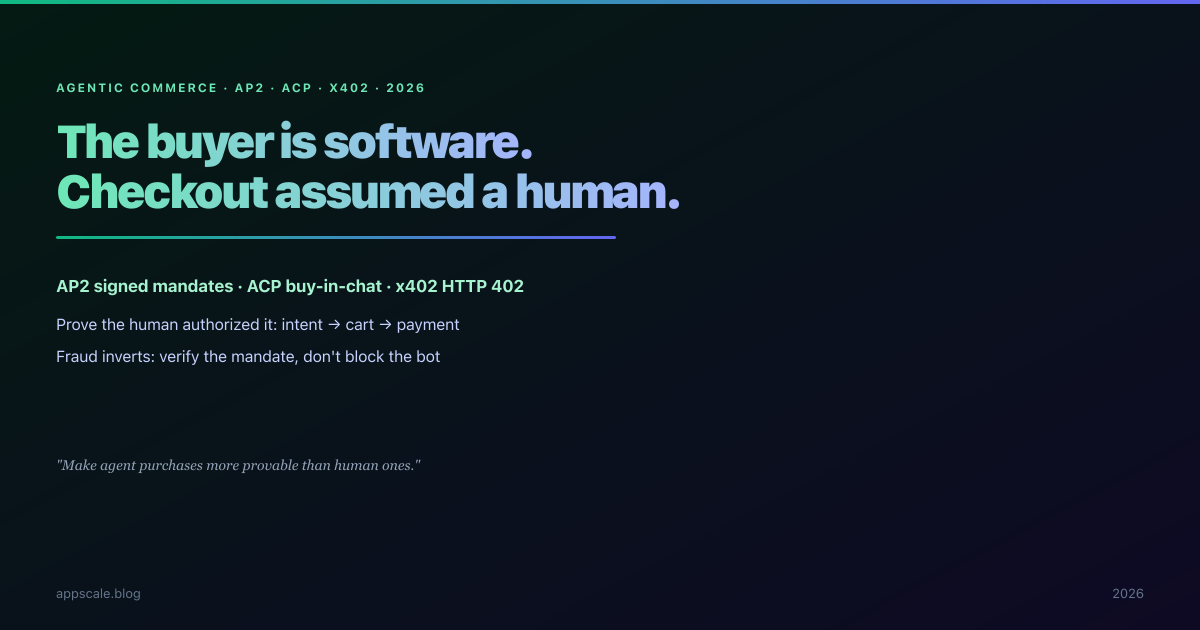
Agentic Commerce Architecture: AI Agent Payments with AP2, ACP, and x402


Agents are bursty, long-tailed, and untrusted — exactly what an always-on fleet handles worst. A serverless microVM runtime: scale-to-zero, isolation, and cold-start mitigation.
An agent mesh is what you end up with when you stop pretending one orchestrator can coordinate every autonomous capability in your enterprise. The orchestrator-as-central-brain works for ten agents, struggles at fifty, collapses at two hundred. The mesh is the alternative posture: agents discover each other through a registry, communicate through a message bus, negotiate work through coordinator-free patterns (gossip, role auctions, blackboards), and observe each other through trace propagation that survives asynchronous boundaries. This article covers the four topologies, the message bus options (NATS, Kafka, EventBridge), the coordinator-free coordination patterns, the role registry and capability discovery layer, observability across asynchronous agent boundaries, failure isolation through per-agent circuit breakers and dead-letter handling, and a reference implementation on NestJS plus AWS Bedrock with sequence diagrams.
The same agent that mitigates an incident in 3 minutes can cause one in 3 seconds. AI SRE agents: the diagnose-and-remediate loop, the five guardrails, and where to start.
The Japanese ringi seido is not a workflow to optimise around — it is the consensus-decision substrate on which the firm's J-SOX internal-control framework rests, and an agentic AI deployed without ringi-aware architecture fails the audit committee's review on first sample. This article walks the engineering deliverables: deterministic decision classifier reading the internal-control manifest; structured nemawashi surface for pre-circulation; agent-generated Japanese ringisho from internal-control-approved templates; electronic hanko circulation integrated with the firm's approval system; chain-of-approval execution gate; decision-narrative audit trail composed with J-SOX retention. 8 anti-patterns, 5-stage maturity ladder, portable to Korean chaebol gyeolje, Taiwanese family-business consensus, and broader multi-approver enterprise decision cultures.
Advertise and partner
Reach engineering leaders and CTOs reading about AI, mobile and cloud architecture.
Sponsored mentions and co-authored articles or technical deep-dives. Relevant products only, always disclosed.