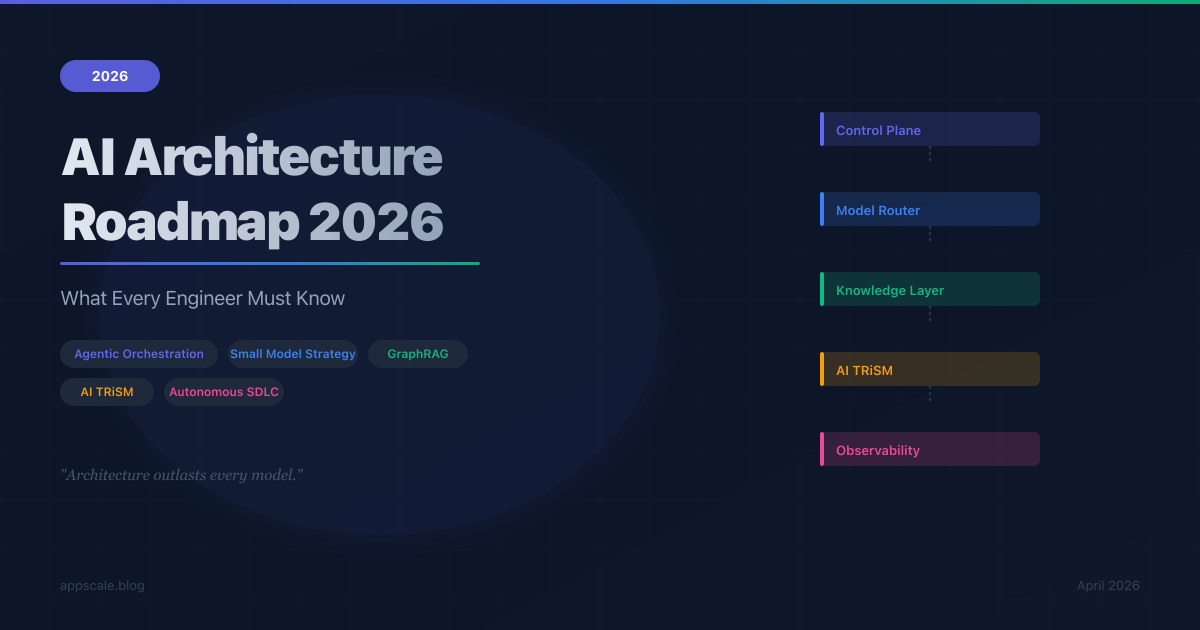
AI Architecture Roadmap 2026: What Every Engineer Must Know


As AI systems move from internal pilots to customer-facing production at enterprise scale, the risk profile fundamentally changes. This article provides a comprehensive framework for CTOs building AI governance architecture — covering the five categories of AI risk, the layered architecture required to manage them, hallucination governance patterns, security threats specific to AI systems, regulatory expectations on auditability and explainability, executive metrics for governance oversight, build-vs-buy decision frameworks, and the production readiness criteria that must be met before scaling. Written from the perspective of an enterprise architect who has built and operated large-scale AI and platform systems, the article argues that AI governance architecture is not the constraint on AI ambition — it is the foundation that makes AI ambition sustainable and defensible.
The single index to 50+ production AI architecture patterns — retrieval, agents, serving, evaluation, security, cost — with decision tables and anti-patterns.
Enterprise AI fragments because every team optimises locally and nothing owns coherence. The fix is a senior architecture authority — its six responsibilities, mapped.
Angular, Vue, Svelte, Solid and Preact converged on signals in two years, and TC39 is standardising them. What fine-grained reactivity changes, and what it does not.
Advertise and partner
Reach engineering leaders and CTOs reading about AI, mobile and cloud architecture.
Sponsored mentions and co-authored articles or technical deep-dives. Relevant products only, always disclosed.