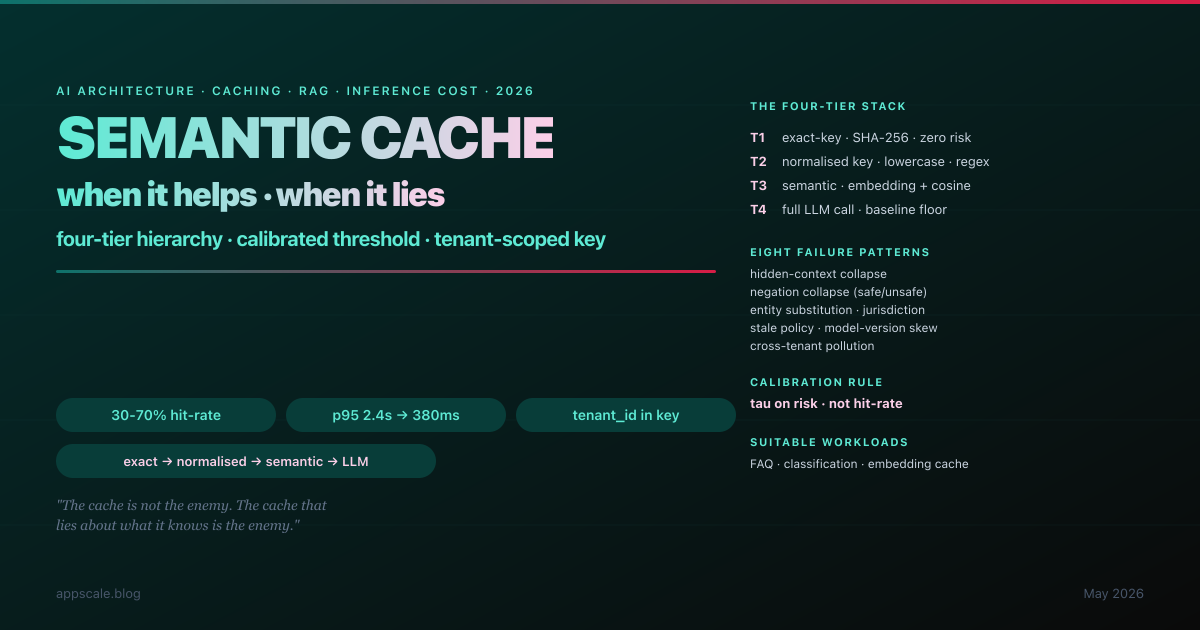
Semantic Cache Pattern: When It Helps, When It Lies — A 2026 Architecture Guide for LLM Features


Most AI value in a business is glue. n8n vs Zapier vs Make vs custom code, the LLM/agent/RAG node layer, the flows that earn money, and how to run it seriously.
The single index to 50+ production AI architecture patterns — retrieval, agents, serving, evaluation, security, cost — with decision tables and anti-patterns.
The static model choice has become the most expensive architectural decision in a 2026 LLM system. The provider market now spans a 60-200x price spread end to end, the quality gap on the dominant production workload is below the noise floor of A/B telemetry, and the latency profile of frontier models has widened — not narrowed. The Model Router Pattern is the architectural answer: a routing layer that, for every inbound request, chooses the cheapest model on the provider mix whose expected quality and latency clear the workload-specific gate, with a deterministic fallback when the routing decision turns out wrong. This article specifies the three routing axes (cost, quality, latency) and why single-axis routing always degrades, the four router primitives (cascade, classifier, learned, embedding-similarity) and when each is right, the 2026 landscape (Martian, NotDiamond, RouteLLM, Bedrock Intelligent Prompt Routing, OpenRouter Auto, Portkey, LiteLLM), the four-component calibration loop, the cost math with worked per-million-token economics, eight anti-patterns, and the five-stage maturity ladder from "we picked GPT" to a router that contributes a measurable line item to gross margin.
Building HIPAA-compliant AI systems requires more than a Business Associate Agreement. This guide covers the complete architecture: PHI de-identification and pseudonymisation layers, sensitivity-based model routing, RBAC for minimum necessary compliance, immutable audit trails, and clinical use cases — ambient scribing, decision support, and patient-facing chatbots.
Advertise and partner
Reach engineering leaders and CTOs reading about AI, mobile and cloud architecture.
Sponsored mentions and co-authored articles or technical deep-dives. Relevant products only, always disclosed.