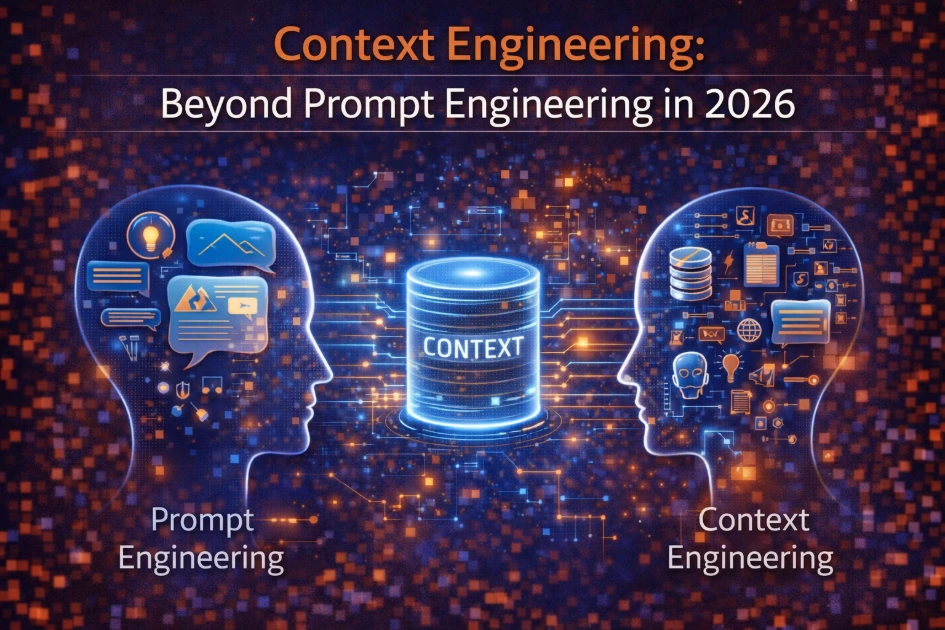
Context Engineering: Beyond Prompt Engineering in 2026


Fine-tuning, RAG, and prompt engineering answer three different questions — how should it behave, what should it know, what should it be told. A decision architecture.
Production LLM agents fail on cost, latency, and memory when the context window is filled like a bucket. Context engineering treats it as a budget allocated every turn.
Agent architecture in 2026 has three stages — prompt engineering, loop engineering, orchestrated teams — with a routing tree, cost matrix, and the eight anti-patterns to avoid.
NVIDIA is no longer the only sensible choice for serious AI inference and training in 2026. Groq serves Llama-70B at sub-second time-to-first-token; Cerebras WSE-3 fits an entire 70B model on one wafer; AWS Trainium2 has become the AWS-native cost leader; Google TPU v5p quietly trains models on JAX; AMD MI300X has reached the maturity threshold where ROCm is no longer an active impediment; and Tenstorrent has opened a workstation-class option with a fully open stack. This article is the architect's reference for choosing between them — per-vendor architecture, sweet spots, real benchmarks, tooling maturity, lock-in posture, and a comparison table that surfaces dollars per million output tokens for Llama-70B-class workloads in 2026.
Advertise and partner
Reach engineering leaders and CTOs reading about AI, mobile and cloud architecture.
Sponsored mentions and co-authored articles or technical deep-dives. Relevant products only, always disclosed.