Back to BlogAI Architecture 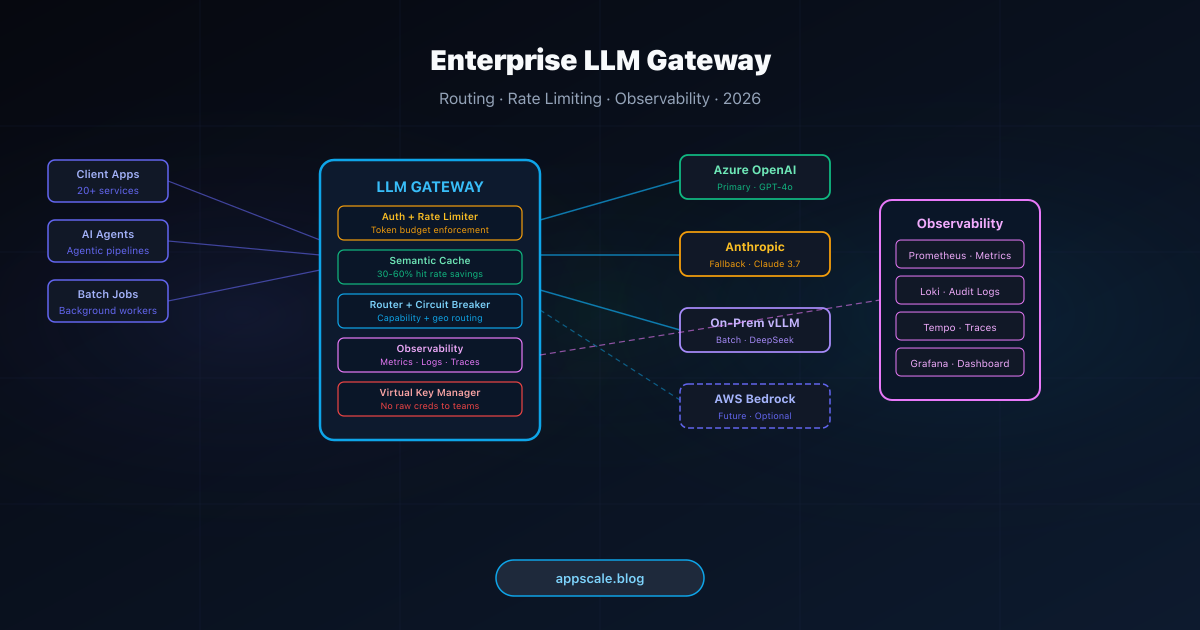
Enterprise LLM Gateway Architecture: Routing, Rate Limiting, and Observability
llm gateway ai gateway llm routing rate limiting ai observability semantic caching enterprise ai litellm ai infrastructure production ai
Key sprawl, surprise bills, and provider outages all trace to model calls scattered across services. An AI gateway is the control plane that centralizes them.
A complete 13-chapter architecture handbook for designing and implementing enterprise AI systems at scale. Covers the six-layer enterprise AI architecture stack, seven foundational design principles, data architecture with pipelines and vector stores, model architecture with foundation model selection and routing, inference and API layer with serving and caching, orchestration and agent patterns with human-in-the-loop, observability with AI-specific metrics and SLO design, security and governance including EU AI Act compliance, cost architecture with FinOps for AI, four reference architecture diagrams (Starter, Production, Regulated, Multi-Cloud), architecture decision record templates, a phased implementation roadmap, and a 30-question FAQ.
AI in production is not an accuracy problem. It is a reliability problem. This article is a practical guide for technology and business leaders on the six dimensions of genuine AI reliability, the five failure patterns that emerge without it, what reliable AI leaders do differently, and the architectural decisions — SLOs, observability, failure isolation, guardrails, controlled fallbacks, and capacity planning — that determine whether AI delivers predictable business value or becomes a source of operational and financial risk at scale. The companies that scale AI safely will win. This article explains what that takes.
RAG, RLM, and Agent architectures represent fundamentally different computational models with distinct performance profiles, failure modes, and cost structures. This production-grade guide provides principal-architect-level analysis of all three paradigms, their hybrid combinations, multi-agent recursive reasoning networks, and a complete multi-cloud enterprise reference architecture.
Advertise and partner
Reach engineering leaders and CTOs reading about AI, mobile and cloud architecture.
Sponsored mentions and co-authored articles or technical deep-dives. Relevant products only, always disclosed.