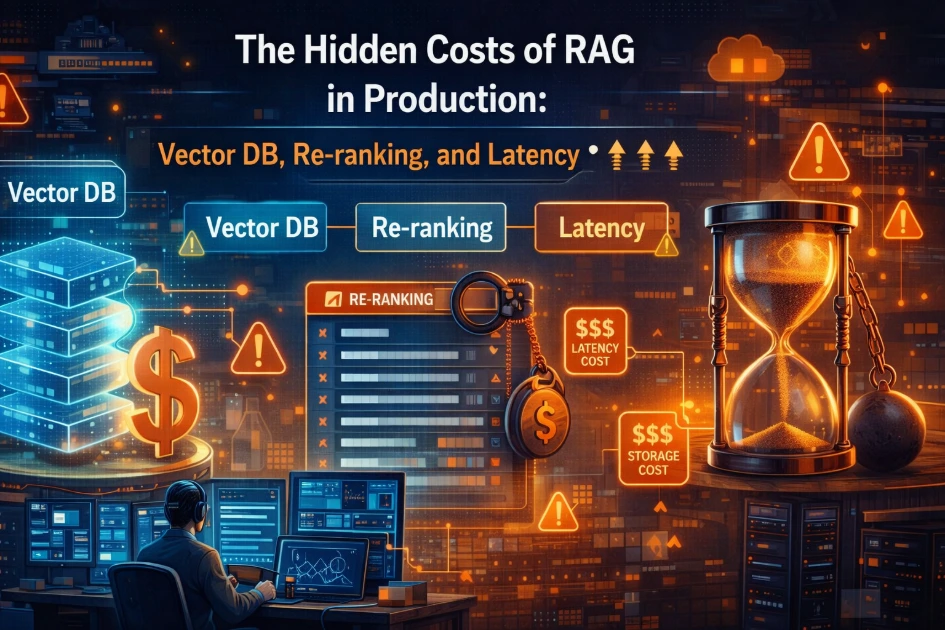
The Hidden Costs of RAG in Production: Vector DB, Re-ranking, and Latency Nobody Warns You About


The single biggest reason production RAG systems return confident wrong answers is not the LLM, the prompt, or the chunking — it is the retriever returning the wrong documents into the top-k. Dense-vector-only retrieval gives 70% recall on conceptual queries and 30% on exact-term queries — and a better embedding model does not fix it because the failure mode is structural. The architecture the field has converged on in 2026: sparse retriever (BM25 or SPLADE) + dense retriever (bi-encoder embeddings) running in parallel, fused via RRF or weighted-α, cross-encoder re-ranker over the top-50 candidates, MMR diversification, ACL/freshness pre-filter, query understanding in front. This article is the deep-dive on what each primitive is doing, why each fails, the latency budget, eight anti-patterns, and the five-stage maturity ladder from single-retriever to calibrated-fusion-with-online-feedback.
The index parameters, not the database brand, decide whether RAG answers in 20ms at 95% recall or 200ms at 80%. Tuning HNSW, IVF, and Product Quantization in production.
The gap between a RAG demo and a production RAG pipeline is the 15 engineering decisions you make before and after the retrieval algorithm. This complete tutorial covers document ingestion, chunking strategies, embedding model selection, hybrid retrieval, reranking, context assembly, generation, evaluation with RAGAS, and production operations.
The honest reason most production RAG systems plateau is that dense-vector retrieval has no notion of a relationship. The retriever finds top-k cosine-similar chunks and hands them to the model; if the answer requires composing facts across three documents, vector RAG returns only the chunks lexically close to the query and silently drops the bridging fact. Microsoft GraphRAG named this in 2024; LightRAG offered a cheaper alternative in 2025; the 2026 conversation is no longer "should we add a graph" but "which slice of the workload deserves the graph and how do we compose vector and graph without doubling the indexing bill". This article is the deep-architecture decision guide: the multi-hop and global-query failure modes that motivate graphs, what pure vector RAG actually does and the workloads it serves well, the five-stage Microsoft GraphRAG pipeline and its honest cost (300x to 1000x vector indexing), LightRAG and the simpler-cheaper variants, Neo4j vector index for unified storage, three production hybrid architectures (vector-first plus graph expansion, graph-first with vector grounding, router-based dispatch), the decision framework by workload, indexing cost math worked through at 2026 prices, drift and freshness operational patterns, eight anti-patterns, five-stage maturity ladder.
Advertise and partner
Reach engineering leaders and CTOs reading about AI, mobile and cloud architecture.
Sponsored mentions and co-authored articles or technical deep-dives. Relevant products only, always disclosed.