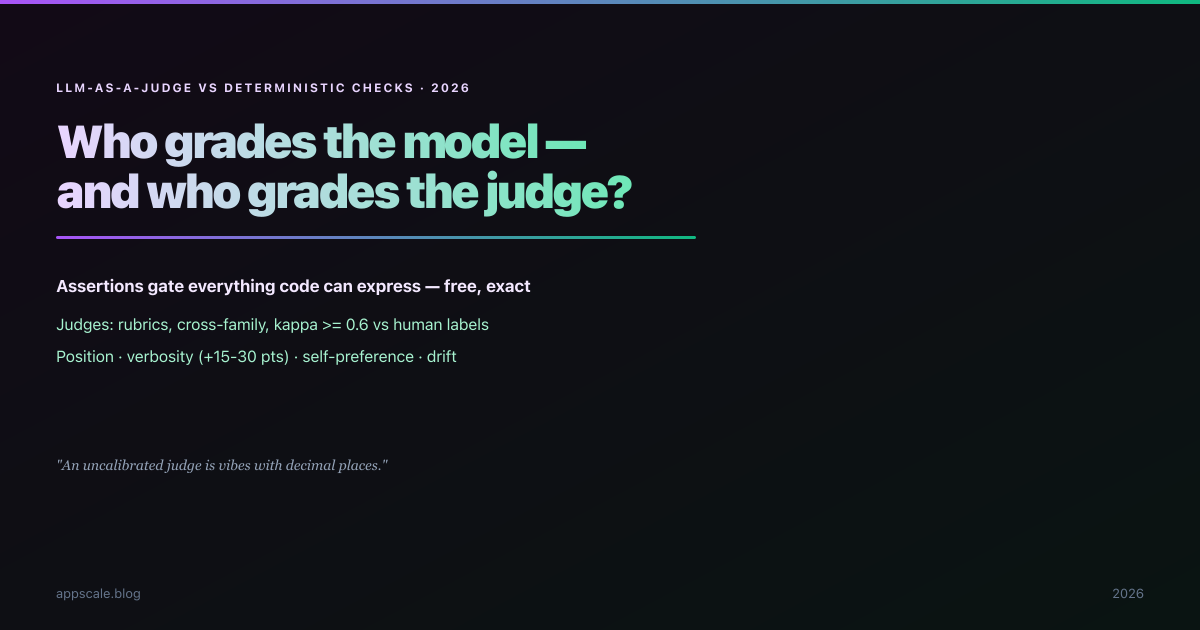
LLM-as-a-Judge vs Deterministic Heuristics: Who Grades the Model?


Test-driven development does not survive the transition to LLM systems — the assertion cannot be strict-equality, the correct output is a distribution, the red-green-refactor loop has no green, and the assertion itself is fallible. Evaluation-driven development is the discipline that replaces TDD: the same shape of "write the assertion before the implementation, ratchet it as the implementation improves, gate every change on the verdict", but with eval sets instead of unit tests, distribution verdicts instead of boolean pass-fail, calibrated LLM judges instead of strict equality, and a ratcheted baseline instead of a fixed expected output. This article is the methodology, the eval-set hygiene (golden, regression, adversarial, drift), the four eval layers (unit, scenario, shadow, canary), the LLM-as-judge calibration practice, the CI integration, 8 anti-patterns, and the 5-stage maturity ladder.
Public benchmarks tell you which LLM is best in general. They do not tell you which model is best for your RAG pipeline, your agentic system, or your summarisation workflow. This guide covers how to build a golden dataset, measure faithfulness and relevance, automate evaluation in CI/CD, and make model selection decisions based on real task performance data.
Why LLMs give different answers at temperature 0, how batch invariance in vLLM and SGLang fixes it, what it costs, and which 2026 workloads should pay.
When every AI team builds its own evaluation, "working" means a dozen incompatible things. Make it a shared service: versioned datasets, governed judges, a CI regression gate.
Advertise and partner
Reach engineering leaders and CTOs reading about AI, mobile and cloud architecture.
Sponsored mentions and co-authored articles or technical deep-dives. Relevant products only, always disclosed.