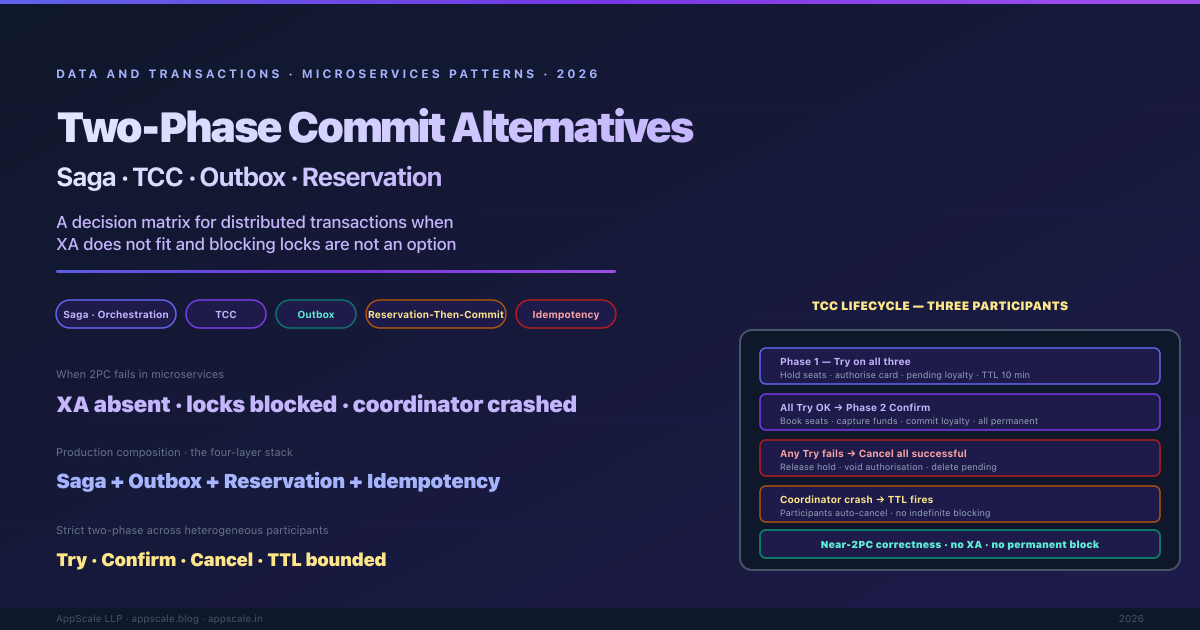
Two-Phase Commit Alternatives: Saga vs TCC vs Outbox vs Reservation-Then-Commit — A Decision Matrix for Distributed Transactions (2026)


The Saga and Outbox patterns are most often essential when combined. This article is the production recipe for combining them: the five invariants you must preserve, the schemas, the state machine, six failure modes the combination survives, common implementation mistakes, observability, and an incremental migration path from a synchronous chained-call implementation. With four Mermaid diagrams, full SQL schemas, and a 30-question FAQ.
Two-phase commit breaks at scale. The Saga Orchestration pattern manages distributed transactions across microservices using a sequence of local transactions and compensating operations — no cross-service locks, no cascading failures. This guide covers orchestration vs choreography, compensating transaction design, Temporal vs database-backed orchestrators, and the Outbox pattern that makes it all reliable.
The 2026 architecture for database-per-service plus cross-service joins via Debezium CDC, Kafka, and ksqlDB / Flink materialised views — with the operational runbook.
The classic concert-ticketing failure is the same every time: ten thousand users hit "buy" simultaneously for a hundred seats; ninety-nine hundred get an error somewhere in the payment flow because the seat was already sold. The reservation-then-commit pattern closes the race window by introducing an explicit hold step: the seat is reserved (decrementing available stock immediately) before payment begins, and the reservation either commits or expires within a bounded time window. This article covers the two-phase lifecycle, TTL decisions, implementation patterns (database, Redis with Lua, event-sourced services), composition with Saga and Idempotency, anti-patterns, configuration values, and the operational discipline of monitoring reservation lifetimes and expiry rates.
Advertise and partner
Reach engineering leaders and CTOs reading about AI, mobile and cloud architecture.
Sponsored mentions and co-authored articles or technical deep-dives. Relevant products only, always disclosed.