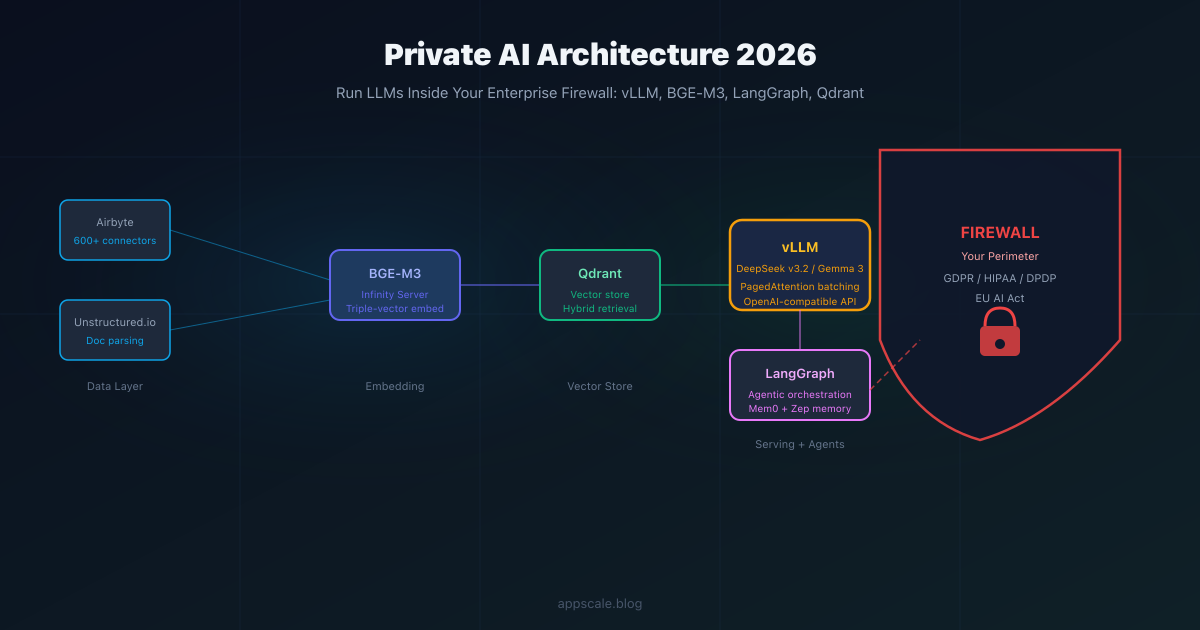
Private AI Architecture: How to Run LLMs Inside Your Enterprise Firewall in 2026


A complete 13-chapter architecture handbook for designing and implementing enterprise AI systems at scale. Covers the six-layer enterprise AI architecture stack, seven foundational design principles, data architecture with pipelines and vector stores, model architecture with foundation model selection and routing, inference and API layer with serving and caching, orchestration and agent patterns with human-in-the-loop, observability with AI-specific metrics and SLO design, security and governance including EU AI Act compliance, cost architecture with FinOps for AI, four reference architecture diagrams (Starter, Production, Regulated, Multi-Cloud), architecture decision record templates, a phased implementation roadmap, and a 30-question FAQ.
Enterprise AI security is an architectural discipline, not a compliance checklist. This article frames the real threat landscape, from prompt injection and model poisoning to sensitive data leakage and over-permissive access, and describes the production architecture patterns that address these risks at scale. Written for CEOs, CTOs, and board-level leaders, it covers secure RAG design, data isolation, policy-driven access control, human oversight frameworks, and the governance structures that make AI deployments trustworthy, auditable, and regulatorily defensible. The conclusion is direct: organizations that embed security into AI architecture from the beginning will scale further, access higher-value markets, and carry lower long-term risk than those who treat security as an afterthought.
You cannot grade an agent by its final answer. Evaluate the trajectory — tool use, safety, efficiency, robustness — and gate every change. The agent-eval architecture.
AI-generated code fails as plausibility, not a crash. The 2026 taxonomy of that debt, how to detect it by provenance and churn, and the containment architecture.
Advertise and partner
Reach engineering leaders and CTOs reading about AI, mobile and cloud architecture.
Sponsored mentions and co-authored articles or technical deep-dives. Relevant products only, always disclosed.