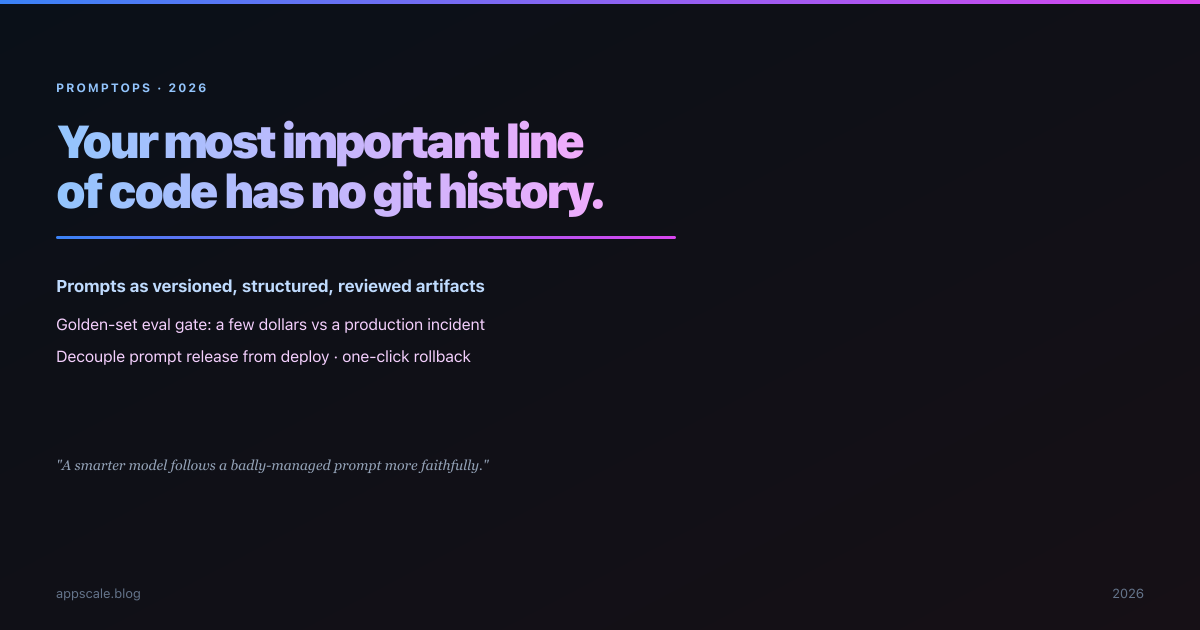
PromptOps: Managing Prompts as Code Before They Break Production


The most consequential string in any production AI system is the prompt template. It controls behaviour, tone, safety, accuracy, cost, and latency. A small change can move quality up or down by ten per cent; a thoughtless edit can introduce regressions that take weeks to detect. Yet in the early demo era, prompts were typically pasted into application code as multi-line string literals, edited directly, with no review, no version history, no rollback story. The versioned prompt templates pattern fixes this by treating prompts as first-class system assets — stored in a versioned repository, referenced by explicit version IDs, deployed through review-and-rollout discipline, logged in the audit trail. This article covers immutability of published versions, implementation patterns (file-based, database-backed, managed platforms, hybrid), composition with classification-first and prompt routing, anti-patterns, configuration values, and the operational discipline of A/B testing and quality-gated promotion.
A production-grade deep-dive into the sidecar pattern — covering Kubernetes, ECS, and VM deployment models, Envoy and Fluent Bit resource sizing, service mesh trade-offs (Istio vs Dapr), graceful shutdown ordering, and the real cost of 200 pods of sidecars.
Three weeks nudging a prompt and it still breaks. Stop hand-tuning: programmatic prompt optimization (DSPy) specifies the task and metric and compiles the prompt for you.
The first production prompt-injection incident most teams encounter does not arrive as a clever adversarial prompt — it arrives quietly inside a customer support ticket whose description contains a literal <system>ignore prior instructions</system> tag, which the document loader indexes and the retriever later returns as a top-k result for an unrelated query. This article is a working architect's reference for defending production RAG against prompt injection: an attack taxonomy (direct, indirect via documents, recursive prompt-in-output, multi-turn poisoning), CVE-style example walk-throughs, a five-layer defence-in-depth architecture (input filtering, instruction hierarchy, structured output validation, JSON-schema constrained generation, sandboxed tool execution), an OWASP LLM Top 10 mapping, an evaluation harness with red-team prompts, and the runtime monitoring patterns that turn a one-time hardening exercise into an ongoing security posture.
Advertise and partner
Reach engineering leaders and CTOs reading about AI, mobile and cloud architecture.
Sponsored mentions and co-authored articles or technical deep-dives. Relevant products only, always disclosed.