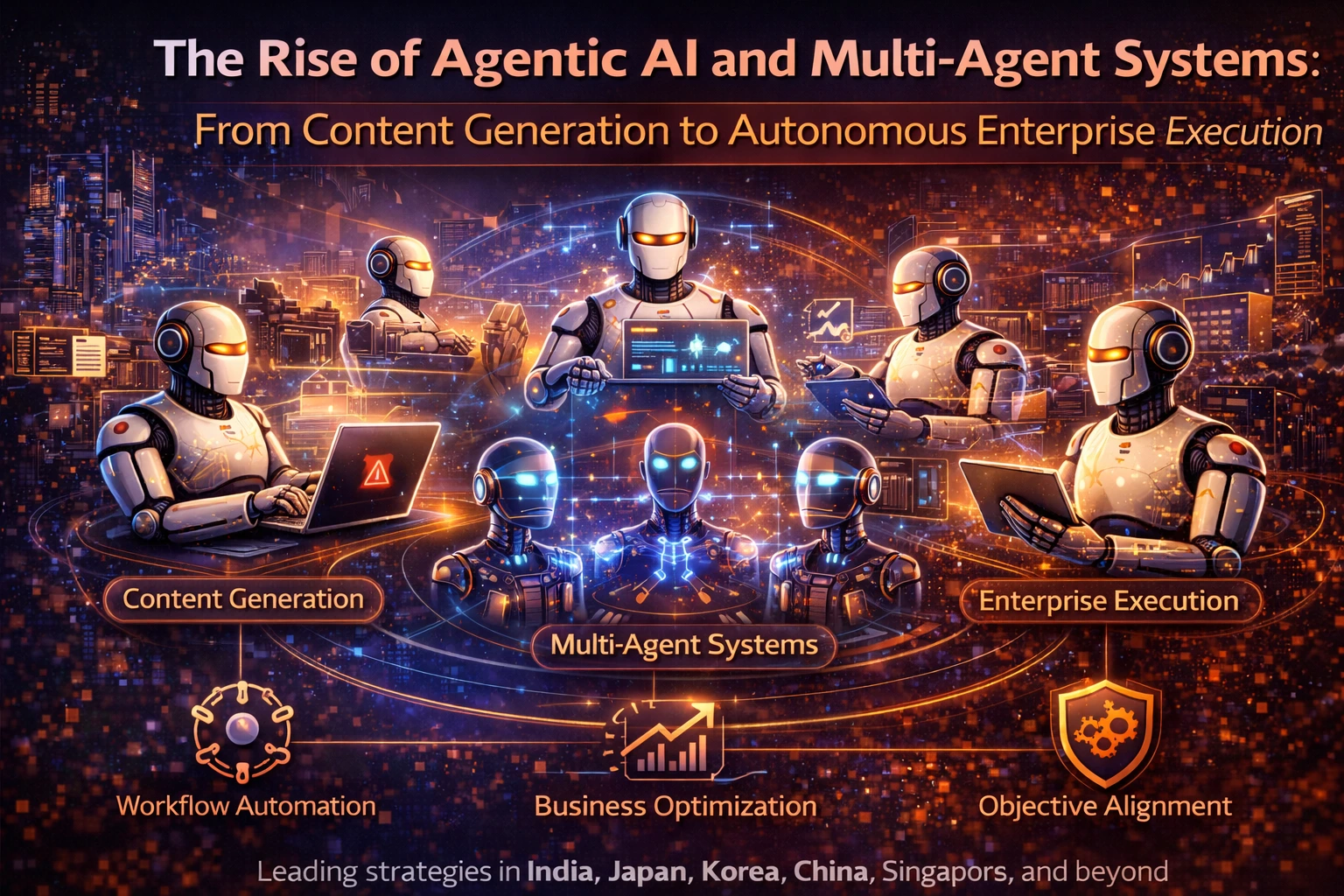
The Rise of Agentic AI and Multi-Agent Systems: From Content Generation to Autonomous Enterprise Execution


The enterprise AI landscape is evolving from copilot-style assistance through agentic execution toward fully autonomous business operations. This article provides a strategic and architectural framework for leadership navigating this transition, covering the maturity path from copilot to agent to self-driving enterprise, the platform architecture required for autonomous operations, the economics of cost versus performance versus reliability, governance and compliance imperatives, operational resilience under failure, and the organizational readiness challenges that represent the true barrier to adoption. It includes enterprise-grade architecture diagrams and practical guidance on build-versus-buy decisions, scaling from pilot to global operations, and the long-term tradeoffs that shape competitive advantage.
RAG, RLM, and Agent architectures represent fundamentally different computational models with distinct performance profiles, failure modes, and cost structures. This production-grade guide provides principal-architect-level analysis of all three paradigms, their hybrid combinations, multi-agent recursive reasoning networks, and a complete multi-cloud enterprise reference architecture.
AI agents are not magic — they are engineering. This guide walks you through exactly how an AI agent works in production: the prompt-to-execution loop, tool dispatch, memory architecture, multi-agent orchestration, cost controls, failure modes, and observability infrastructure. If you are building or evaluating agent systems, this is the deep technical foundation you need.
Accuracy is only one metric in a production AI system's health story. AIRE — AI Reliability & Observability — is the engineering discipline that captures the full signal surface of AI systems in production: quality drift, latency profiles, trust signals, and cost attribution. This guide walks solution architects and CTOs through the complete production architecture, from telemetry collection through hyper-scale processing, with real-world component design, failure resilience patterns, and a maturity model for building AI observability that turns production data into a continuous improvement engine.ShareArtifactsDownload allAire production systemsDocument · MD
Advertise and partner
Reach engineering leaders and CTOs reading about AI, mobile and cloud architecture.
Sponsored mentions and co-authored articles or technical deep-dives. Relevant products only, always disclosed.