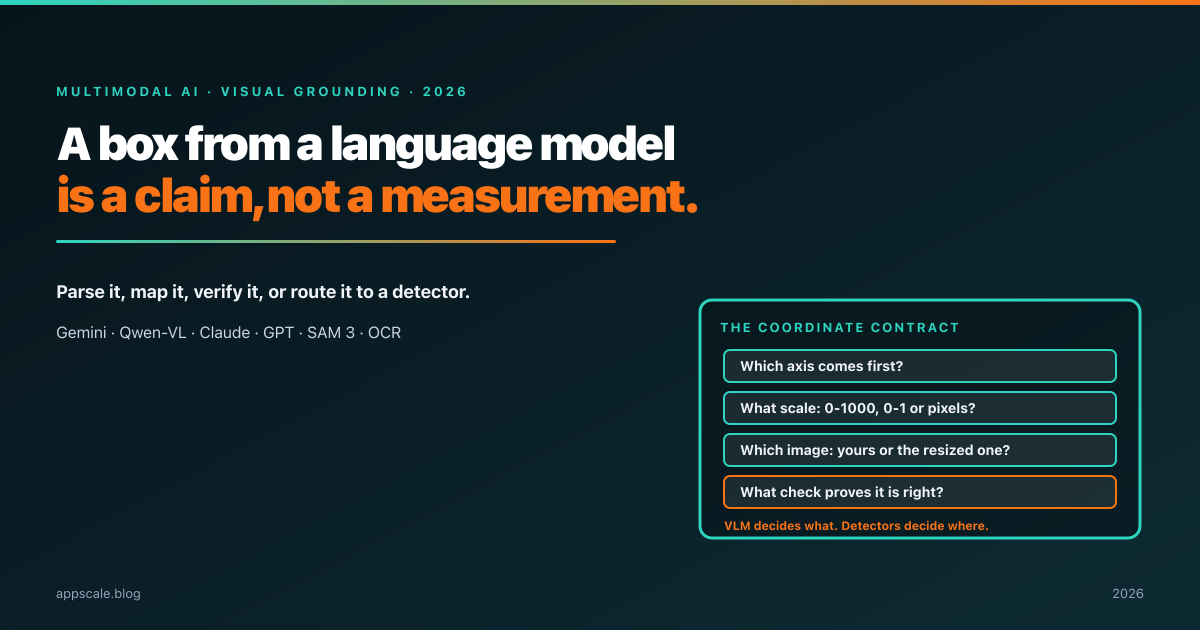
Vision Grounding in 2026: A Bounding Box From a Language Model Is a Claim, Not a Measurement


Multimodal AI on a phone is not a smaller version of multimodal AI in the cloud. It is a different engineering problem with different constraints — a 4GB RAM ceiling, a thermal budget that throttles after ninety seconds, a 3000mAh battery the user expects to last all day, an App Store review that rejects 800MB of model weights, and a device fleet from A18 Pro to Snapdragon 6 Gen 1. This article covers quantised on-device model formats (CoreML, ONNX, MLC, llama.cpp), the JSI bridge and TurboModule architecture that makes native model invocation cheap enough to run per camera frame, the vision pipeline (camera frame to label) and language pipeline (small Llama or Phi via llama.cpp) with realistic latency and battery numbers, cloud-fallback decision logic, thermal management, OTA model update strategy, and the testing discipline that catches regressions.
How to test AI systems for bias in production in 2026: impact ratios on live decisions, a separate attribute vault, NYC LL144, the EU delay and Colorado's rewrite.
Architecture decision matrix for the eight specialised AI model classes of 2026 — LLM, LCM, LAM, MoE, VLM, SLM, MLM, SAM — with routing tree, costs, and composition patterns.
Robot teleoperation fallback done right: the robot owns safety, remote operators advise rather than drive, and the operator ratio is your real business model.
Advertise and partner
Reach engineering leaders and CTOs reading about AI, mobile and cloud architecture.
Sponsored mentions and co-authored articles or technical deep-dives. Relevant products only, always disclosed.