- The AI Platform Architecture Blueprint: The Complete Enterprise Reference (2026)
A complete 13-chapter enterprise reference for designing, building, and evolving an AI platform — the shared substrate that lets every team ship AI features without rebuilding the same plumbing. Covers the 7-layer platform model (data, model management, inference, orchestration, evaluation, governance, developer experience), 4 reference architectures (Startup, Growth, Enterprise, Regulated-Industry), the model lifecycle and registry, multi-tenant data isolation, semantic caching and routing, FinOps with attribution and budget guardrails, EU AI Act and HIPAA-aligned governance, and the Phase 0 to Phase 4 maturity roadmap with team sizes and timelines. Includes a 20-question platform readiness assessment and a 30-question FAQ optimized for the decisions enterprise architects actually face.
- Building AI-Powered Internal Tools: Architecture for Enterprise Copilots (2026)
The biggest AI productivity gains inside large organisations in 2026 come from internal copilots — embedded, identity-aware assistants that read and write across the messy reality of enterprise data. This guide is the practical 2026 architecture: the five-plane reference design, end-to-end identity propagation with row-level retrieval ACLs, per-source knowledge with intent-aware routing, scope-limited action tools with staged approvals and idempotency, layered session/user/organisational memory, the evaluation loop most teams skip, the build/buy/platform calculus, and the rollout playbook that gets sustained adoption past 70 percent instead of stalling at 15.
- Agentic AI Debugging: When the Loop Doesn't Stop (2026)
The single most expensive failure mode of an agentic system is not the agent producing the wrong answer — it is the agent producing no answer while burning through tool calls, context, and provider budget in a tight loop the runtime did not detect. Six failure modes (infinite tool-call loop, plan-execute oscillation, sub-agent recursion, context thrash, hallucinated arguments, silent budget burn), six detection signals (step cap, semantic similarity, cost slope, identical call, delegation depth, context utilisation), five containment primitives (hard step-cap, budget kill-switch, tool-call dedupe, plan-diff guard, supervisor halt), a state machine with running/watching/throttled/halted, a seven-field RCA template, 8 anti-patterns, and a 5-stage maturity ladder. This is how runaway loops become bounded incidents.
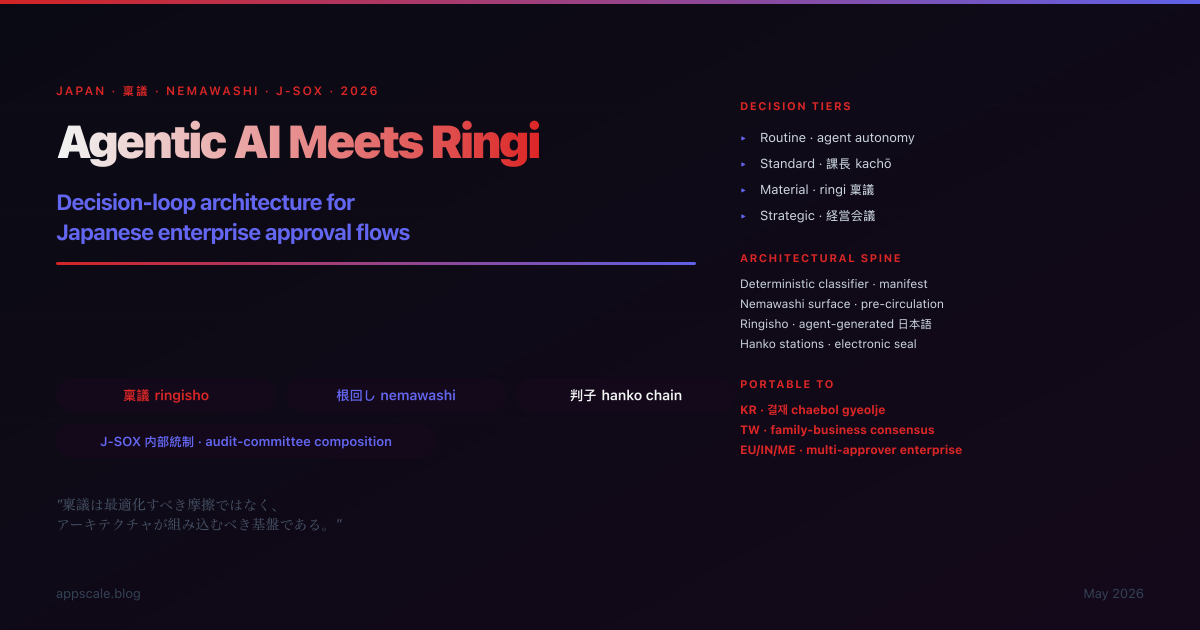
- Document AI for Japanese Paper-Heavy Enterprises: Tategaki, Hanko, Fax Pipelines, and the Ringi Document Workflow (2026)
Japanese paper-heavy enterprises in 2026 still run on fax, hanko stamps, tategaki documents, and ringi-sho approval workflows — and the document AI architecture that survives this reality looks nothing like the US-EU document AI playbook. This article walks the architecture: tategaki + yokogaki OCR with layout analysis, hanko/inkan detection and seal-registry validation, IP-fax intake gateway with sender authentication, ringi workflow modelling with AI drafting and retrieval, JIS X 0208/0213/Shift-JIS/EUC-JP encoding edges, JP-fine-tuned model selection (ELYZA, Stockmark, PLaMo, Sakana, Karakuri), J-SOX and APPI composition, 8 anti-patterns, and the 5-stage maturity ladder. Portable to KR, TW, ID, TH, IN paper-heavy markets.