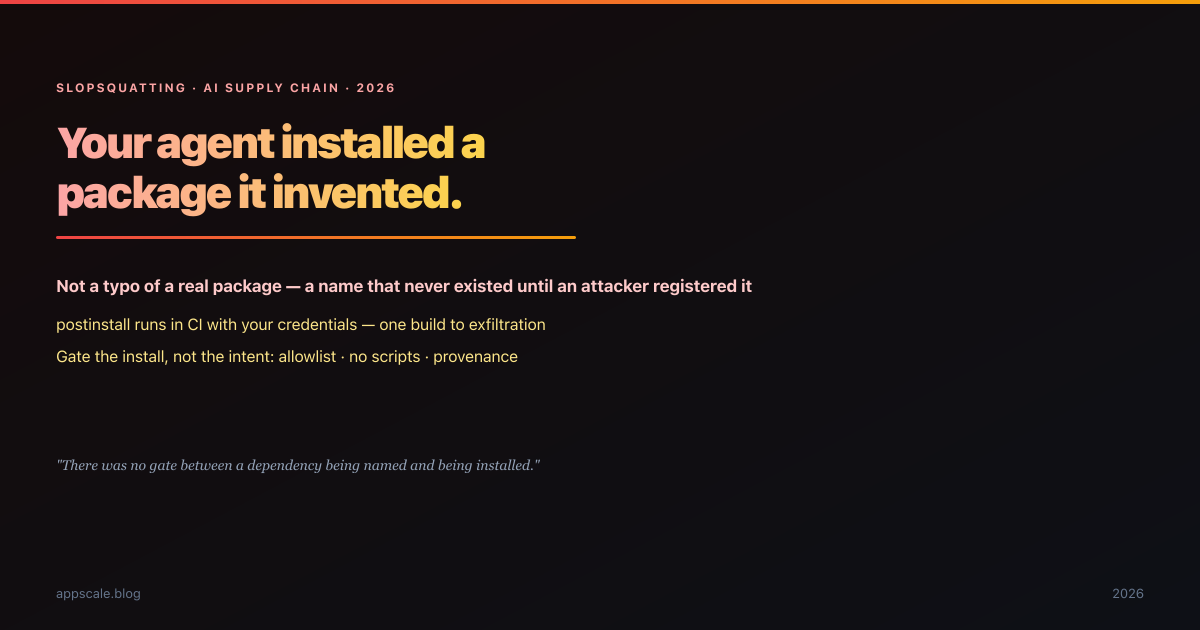
Slopsquatting: Your AI Agent Installs Packages That Don't Exist — Until an Attacker Registers Them


Cursor, Windsurf, Cline, and GitHub Copilot are the four dominant AI coding agents in 2026. This comparison covers agent architecture, IDE experience, model flexibility, enterprise readiness, pricing economics, and codebase context handling — with a four-constraint decision framework that maps each tool to specific team scenarios.
Your dependency tree rests on volunteers whose inboxes became unreviewable. Maintenance health as a risk signal your CVE scanner structurally cannot see.
A finance team walked into the office on a Monday morning in early 2025 and found an $84,000 invoice for the previous 48 hours. The application had not been defaced; no customer data had been exfiltrated; the dashboards were green. The bill was the breach. This is LLMjacking — the unauthorised hijack of cloud-hosted LLM resources for compute monetisation, the AI-security failure mode that does not look like a security incident until the invoice arrives. The seven-layer defence-in-depth stack is the architectural response: workload identity replacing static keys, hard quota at the gateway, model-level RBAC, network isolation, behavioural analytics, automated kill switch, and continuous credential hygiene. AWS-native reference architecture with Azure and GCP equivalents, attack-lifecycle map from initial access to weekend burn, eight anti-patterns retired, five-stage maturity ladder, and the Monday-morning 24h / 7d / 30d action checklist that materially reduces exposure by Friday.
An AI agent can contain an intrusion in 90 seconds — or be turned against you by one poisoned alert. The agentic SOC: bounded authority, six guardrails, investigator-first.
Advertise and partner
Reach engineering leaders and CTOs reading about AI, mobile and cloud architecture.
Sponsored mentions and co-authored articles or technical deep-dives. Relevant products only, always disclosed.