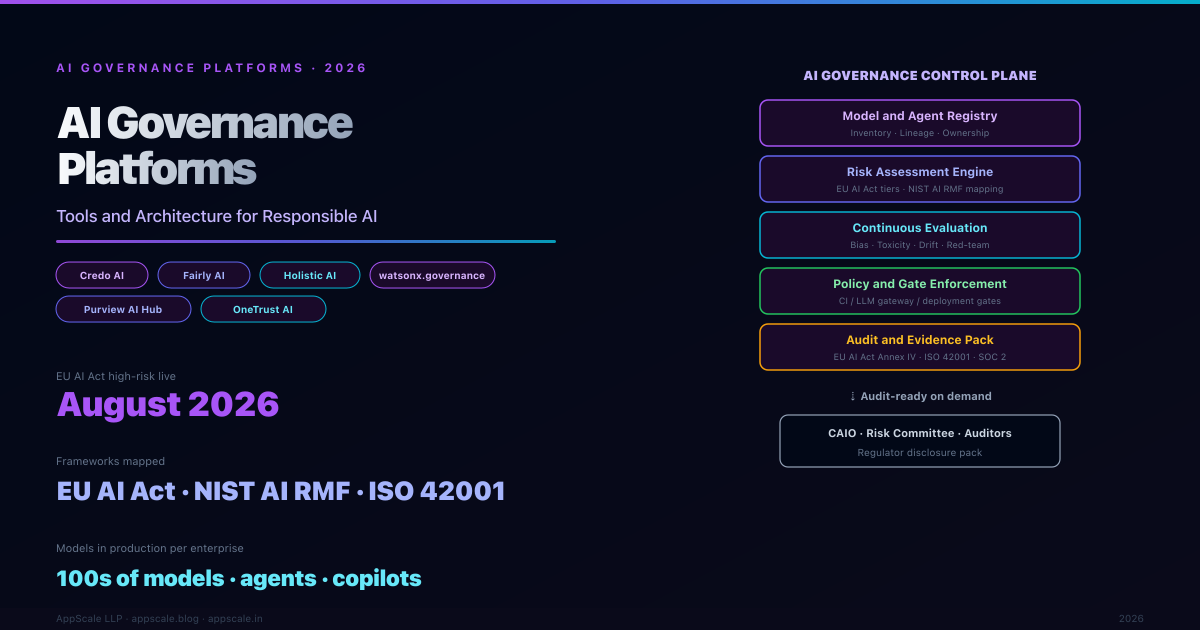
AI Governance Platforms: Tools and Architecture for Responsible AI (2026)


The biggest AI productivity gains inside large organisations in 2026 come from internal copilots — embedded, identity-aware assistants that read and write across the messy reality of enterprise data. This guide is the practical 2026 architecture: the five-plane reference design, end-to-end identity propagation with row-level retrieval ACLs, per-source knowledge with intent-aware routing, scope-limited action tools with staged approvals and idempotency, layered session/user/organisational memory, the evaluation loop most teams skip, the build/buy/platform calculus, and the rollout playbook that gets sustained adoption past 70 percent instead of stalling at 15.
AI does not scale because of talent alone. It scales because of architecture, tooling, and governance. Many enterprises invest heavily in AI hires but fail to create the structural foundation that allows multiple teams to build safely and quickly. The result is fragmented experiments, duplicated pipelines, inconsistent compliance, rising cost, and isolated innovation that cannot compound. This article frames the business stakes of that gap, walks through the real architecture of enterprise AI platforms, explains what breaks when teams build independently at scale, and describes what enterprise-grade AI enablement actually looks like in production. It connects architectural decisions to board-level outcomes — faster adoption across business units, controlled compliance exposure, predictable cost structures, and compounding innovation — and provides leadership with the strategic perspective needed to make platform investments that pay for themselves many times over. The core argument is straightforward: enterprises that treat AI scaling as a platform and governance strategy will consistently outpace those treating it as a collection of projects. The goal is not to slow teams down with governance. It is to build a foundation where teams can move fast without breaking trust, cost discipline, or operational stability. The window to build that foundation deliberately is open now.
As AI systems move from internal pilots to customer-facing production at enterprise scale, the risk profile fundamentally changes. This article provides a comprehensive framework for CTOs building AI governance architecture — covering the five categories of AI risk, the layered architecture required to manage them, hallucination governance patterns, security threats specific to AI systems, regulatory expectations on auditability and explainability, executive metrics for governance oversight, build-vs-buy decision frameworks, and the production readiness criteria that must be met before scaling. Written from the perspective of an enterprise architect who has built and operated large-scale AI and platform systems, the article argues that AI governance architecture is not the constraint on AI ambition — it is the foundation that makes AI ambition sustainable and defensible.
The single index to 50+ production AI architecture patterns — retrieval, agents, serving, evaluation, security, cost — with decision tables and anti-patterns.
Advertise and partner
Reach engineering leaders and CTOs reading about AI, mobile and cloud architecture.
Sponsored mentions and co-authored articles or technical deep-dives. Relevant products only, always disclosed.