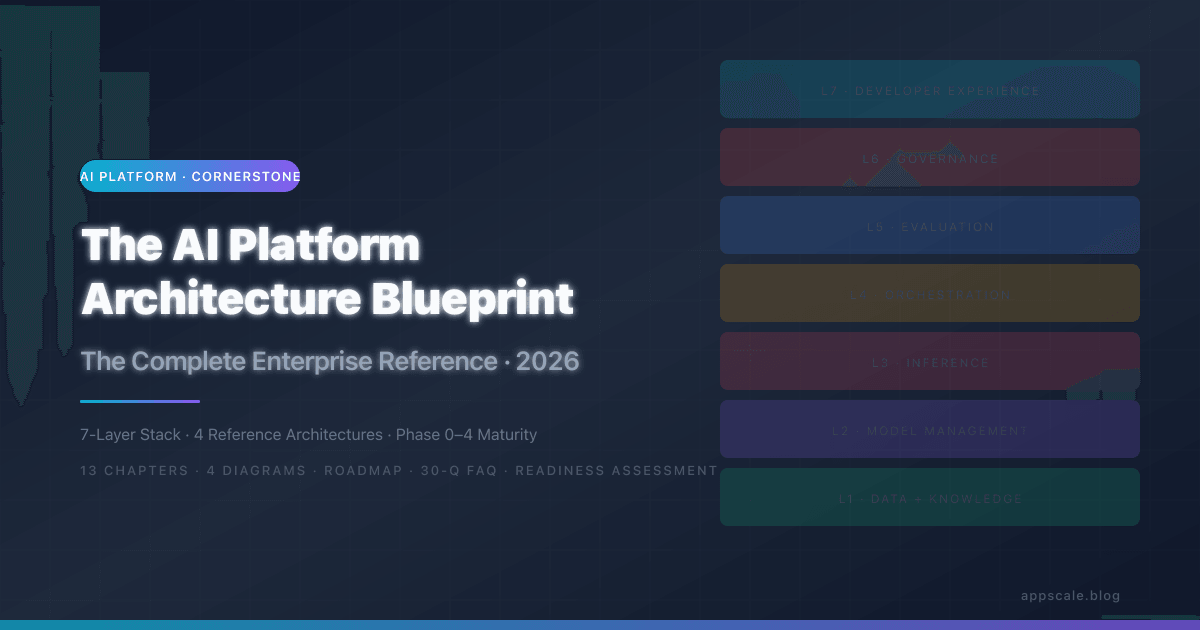
The AI Platform Architecture Blueprint: The Complete Enterprise Reference (2026)


A complete 13-chapter architecture handbook for designing and implementing enterprise AI systems at scale. Covers the six-layer enterprise AI architecture stack, seven foundational design principles, data architecture with pipelines and vector stores, model architecture with foundation model selection and routing, inference and API layer with serving and caching, orchestration and agent patterns with human-in-the-loop, observability with AI-specific metrics and SLO design, security and governance including EU AI Act compliance, cost architecture with FinOps for AI, four reference architecture diagrams (Starter, Production, Regulated, Multi-Cloud), architecture decision record templates, a phased implementation roadmap, and a 30-question FAQ.
The single index to 50+ production AI architecture patterns — retrieval, agents, serving, evaluation, security, cost — with decision tables and anti-patterns.
A comprehensive production guide to preventing LLM hallucinations using a four-layer architecture — Grounding (RAG with reranking and citations), Guardrails (input/output validation), Evaluation (automated faithfulness scoring and regression testing), and Human-in-the-Loop (confidence-based routing and feedback loops). Includes tooling landscape, real-world hallucination rates by maturity level, domain-specific prevention strategies, cost analysis, and a 16-week implementation roadmap.
Zero trust is the security posture in which no network location, no identity, and no prior authentication is treated as inherently trustworthy — every access decision is made fresh, against current context, on the principle of least privilege, with continuous verification rather than perimeter assumption. This article maps the NIST 800-207 components onto AI-specific components: model endpoints, agent runtimes, tool gateways, retrieval indexes, fine-tuning jobs, and model artefacts. It walks through a threat model that names the realistic adversaries, presents a reference architecture diagram that names every enforcement point, and concludes with the operational disciplines (audit, behaviour analytics, key rotation, supply-chain attestation) that distinguish a zero-trust AI system from a conventional AI system with a few extra firewalls.
Advertise and partner
Reach engineering leaders and CTOs reading about AI, mobile and cloud architecture.
Sponsored mentions and co-authored articles or technical deep-dives. Relevant products only, always disclosed.