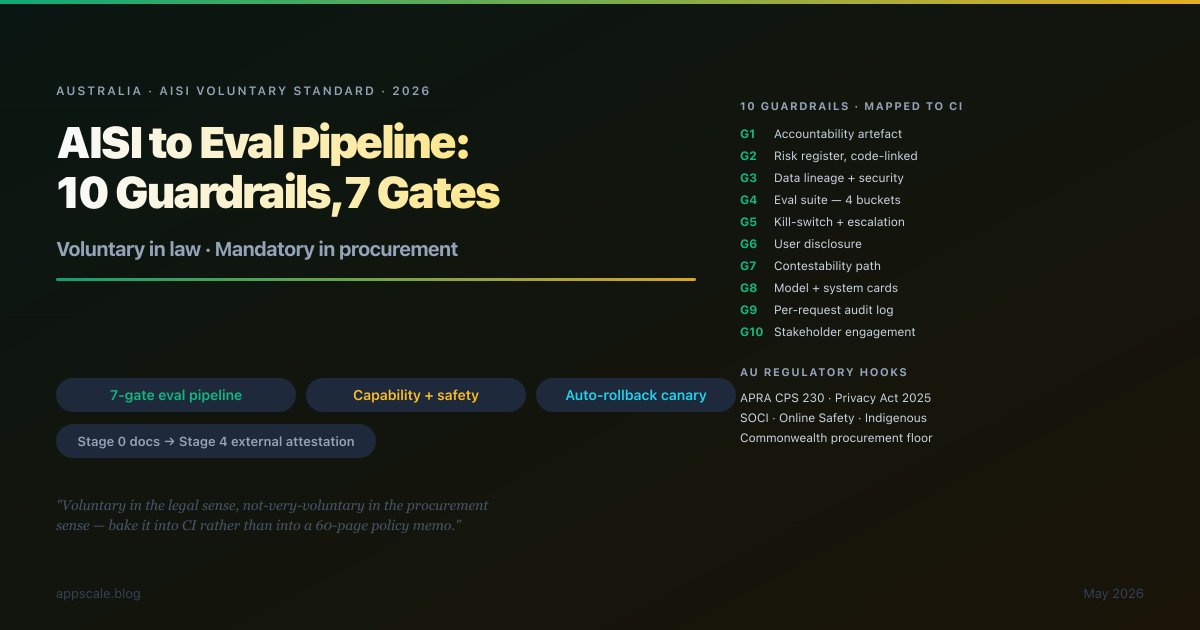
AI Safety Evals: Mapping the Australian AI Safety Institute Voluntary Standard to a Concrete Eval-Gate Pipeline (2026)


How to test AI systems for bias in production in 2026: impact ratios on live decisions, a separate attribute vault, NYC LL144, the EU delay and Colorado's rewrite.
A three-person team can now scope a fifteen-person game — if the build runs as a pipeline. AI-assisted game dev in the Fable 5 era: direction bibles, verification gates, playtests.
Traditional CI/CD breaks for LLM features because outputs are non-deterministic, evaluation costs are non-trivial, and failure modes are silent. This article gives you a five-gate pipeline — lint, offline eval, cost and latency budget, shadow eval on production traces, canary with auto-rollback — that catches regressions at the cheapest gate that catches them, with a maturity ladder from manual review to full canary that most teams should walk in stages over twelve to eighteen months.
The first instinct when wiring observability into an LLM system is to treat the LLM call as just another HTTP outbound call. Within a week the team realises conventional observability is missing everything that matters — the span tells you the call took 4.2 seconds and returned 200 OK but does not tell you token counts, cost in dollars, model variant, prompt template version, eval scores, tool calls, or whether the response was a hallucination versus a useful answer. Conventional observability tells you the system is up; AI observability needs to tell you whether the system is producing useful output at acceptable cost. This article covers the OpenTelemetry GenAI semantic conventions stabilising in late 2025/early 2026, what to instrument and how, the agent trace hierarchy that makes multi-step debugging tractable, how to attribute token cost across a multi-tenant deployment, how to surface eval scores as first-class telemetry, and the dashboards every production AI team should have on day one.
Advertise and partner
Reach engineering leaders and CTOs reading about AI, mobile and cloud architecture.
Sponsored mentions and co-authored articles or technical deep-dives. Relevant products only, always disclosed.