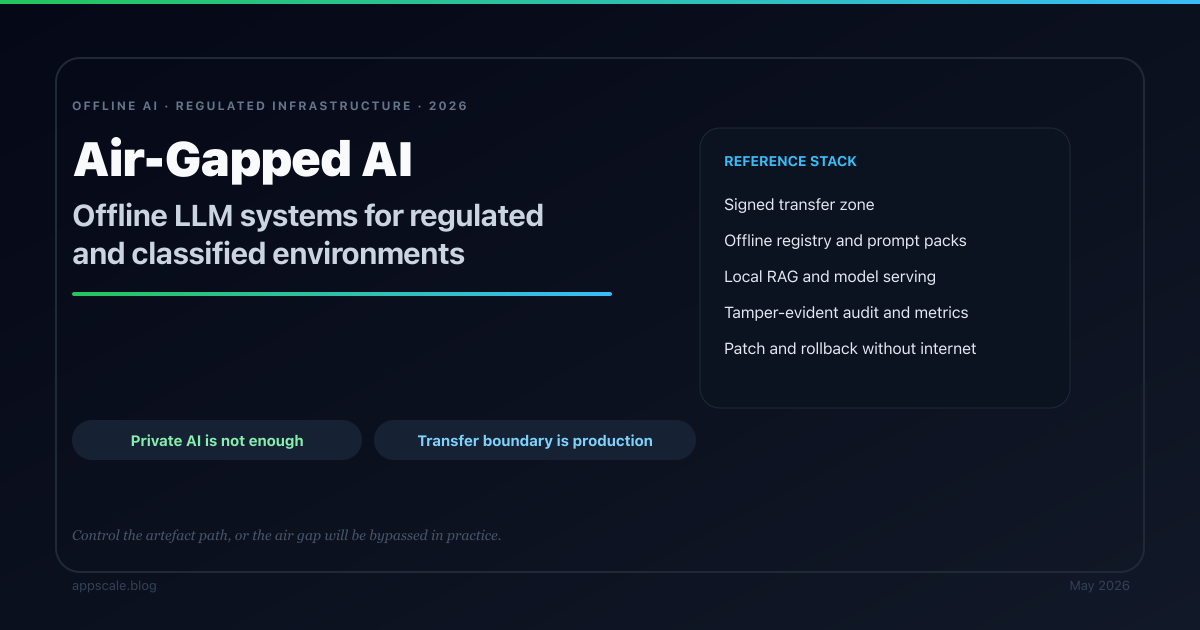
Air-Gapped AI Architecture: Offline LLM Systems for Regulated and Classified Environments (2026)


Building HIPAA-compliant AI systems requires more than a Business Associate Agreement. This guide covers the complete architecture: PHI de-identification and pseudonymisation layers, sensitivity-based model routing, RBAC for minimum necessary compliance, immutable audit trails, and clinical use cases — ambient scribing, decision support, and patient-facing chatbots.
An enterprise API endpoint is not data residency. Sovereign AI keeps data, inference, and keys in-boundary — the tiered, key-controlled architecture and trade-offs.
Game AI in 2026 collides hardest with frame-rate budgets, session-cost economics, and the modding community's ability to break any system without adversarial assumptions. This article walks the engineering deliverables for an LLM-driven game AI architecture in 2026: tier-routed inference (on-device 1-3B small model, edge 7-13B mid-size, cloud frontier) with budget-aware routing; state-machine-augmented dialogue with LLM-generated surface variation; procedural quest skeletons with LLM in-fill within writer-defined templates; multi-layer content-safety and prompt-injection defence; per-session cost budget as engineering discipline; semantic cache as first-class architectural element. PL-anchored to the Warsaw/Krakow game-dev cluster (CD Projekt Red, Techland, 11 bit, People Can Fly, Bloober Team) and globally portable. 8 anti-patterns, 5-stage maturity ladder.
Zero trust is the security posture in which no network location, no identity, and no prior authentication is treated as inherently trustworthy — every access decision is made fresh, against current context, on the principle of least privilege, with continuous verification rather than perimeter assumption. This article maps the NIST 800-207 components onto AI-specific components: model endpoints, agent runtimes, tool gateways, retrieval indexes, fine-tuning jobs, and model artefacts. It walks through a threat model that names the realistic adversaries, presents a reference architecture diagram that names every enforcement point, and concludes with the operational disciplines (audit, behaviour analytics, key rotation, supply-chain attestation) that distinguish a zero-trust AI system from a conventional AI system with a few extra firewalls.
Advertise and partner
Reach engineering leaders and CTOs reading about AI, mobile and cloud architecture.
Sponsored mentions and co-authored articles or technical deep-dives. Relevant products only, always disclosed.