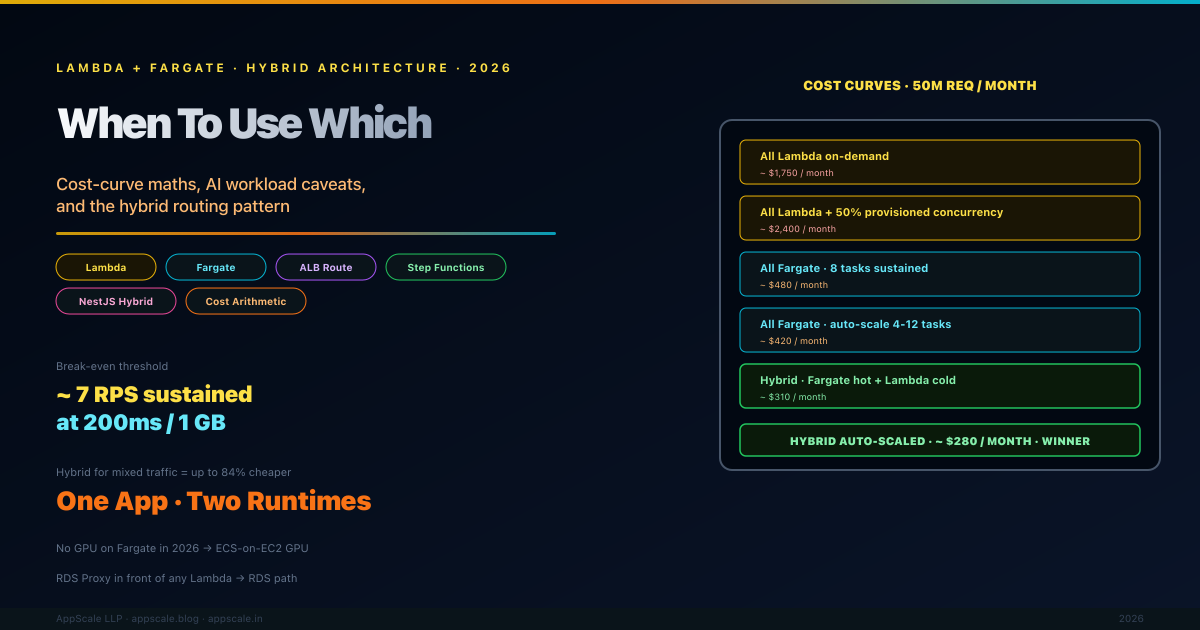
AWS Lambda + Fargate Hybrid Architecture: When to Use Which (2026)


Most AI value in a business is glue. n8n vs Zapier vs Make vs custom code, the LLM/agent/RAG node layer, the flows that earn money, and how to run it seriously.
Honest decision matrix for the 2026 Japanese LLM stack: when do ELYZA, Stockmark, PLaMo, and Sakana beat frontier APIs (GPT-4o, Claude, Gemini) — and when do they not? Tokenisation cost penalty, keigo handling, vertical vocabulary, sovereignty requirements, and the multi-LLM routing architecture that lets you have all three. Globally portable pattern: Japanese is the demanding instance, the routing layer that survives Japanese will survive Korean, Mandarin, Hindi, and every other language with similar characteristics.
A production-grade reference for building AI agents on AWS Bedrock with a NestJS gateway in 2026 — Bedrock AgentCore, action groups backed by Lambda, knowledge bases over S3 + OpenSearch, the routing-and-guardrail layer that NestJS must own, the model-selection cost arithmetic, three-layer observability (gateway + agent-internal + per-token cost), Bedrock Guardrails plus app-specific PII redaction, multi-agent collaboration patterns, and the failure modes you only learn about by running this in production.
The honest reason most production RAG systems plateau is that dense-vector retrieval has no notion of a relationship. The retriever finds top-k cosine-similar chunks and hands them to the model; if the answer requires composing facts across three documents, vector RAG returns only the chunks lexically close to the query and silently drops the bridging fact. Microsoft GraphRAG named this in 2024; LightRAG offered a cheaper alternative in 2025; the 2026 conversation is no longer "should we add a graph" but "which slice of the workload deserves the graph and how do we compose vector and graph without doubling the indexing bill". This article is the deep-architecture decision guide: the multi-hop and global-query failure modes that motivate graphs, what pure vector RAG actually does and the workloads it serves well, the five-stage Microsoft GraphRAG pipeline and its honest cost (300x to 1000x vector indexing), LightRAG and the simpler-cheaper variants, Neo4j vector index for unified storage, three production hybrid architectures (vector-first plus graph expansion, graph-first with vector grounding, router-based dispatch), the decision framework by workload, indexing cost math worked through at 2026 prices, drift and freshness operational patterns, eight anti-patterns, five-stage maturity ladder.
Advertise and partner
Reach engineering leaders and CTOs reading about AI, mobile and cloud architecture.
Sponsored mentions and co-authored articles or technical deep-dives. Relevant products only, always disclosed.