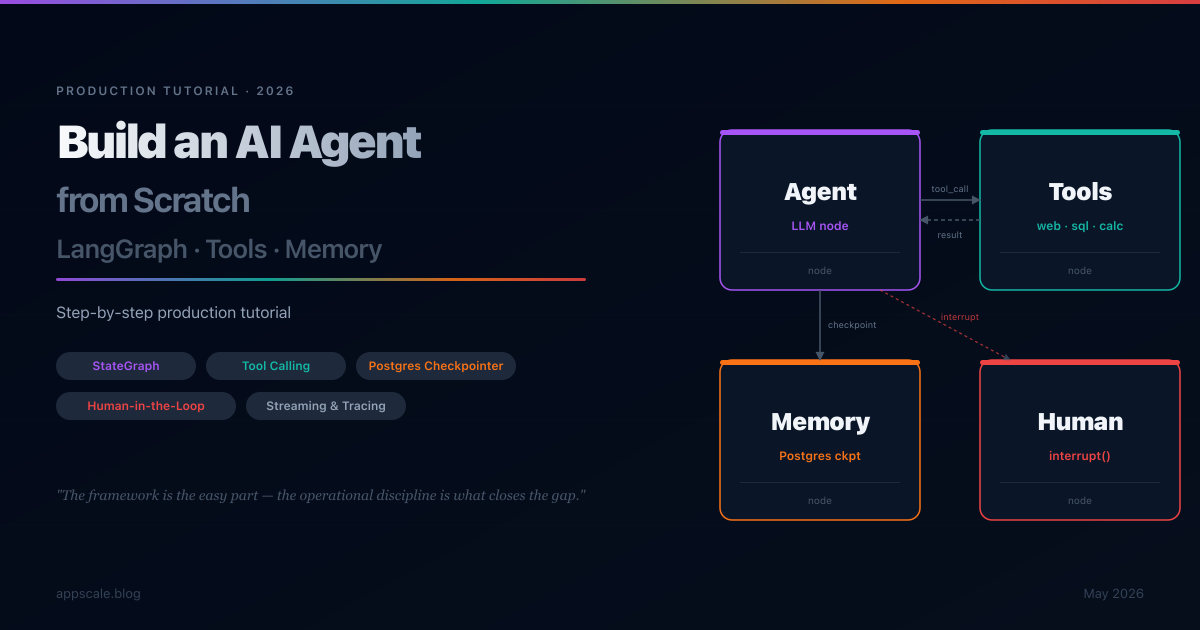
Build an AI Agent from Scratch: LangGraph + Tools + Memory — Step-by-Step Tutorial (2026)


A full beginner-friendly walk-through of building a four-agent AI system on a laptop with no GPU and a free LLM. We use LangGraph for orchestration (state, nodes, edges, conditional edges, checkpointing, human-in-the-loop with interrupt), MCP for tool access (the official filesystem server via stdio), and A2A for cross-process agent calls (agent card at /.well-known/agent-card.json, JSON-RPC message lifecycle). The four agents form a Learning Accelerator — a Curriculum Planner, an Explainer that reads local notes via MCP, a Quiz Generator exposed as an A2A server, and a Progress Coach supervisor that orchestrates the rest with SQLite checkpointing. Provider switch covers Gemini 2.0 Flash (free, default), Groq (free, fast) and OpenAI (cents per run). Langfuse for traces, DeepEval for LLM-as-judge regression tests. Every file is shown in full inline; no companion repo needed.
A comprehensive step-by-step guide to building production AI agents using LangChain (with LangGraph) and CrewAI. Covers core agent architecture concepts, practical code examples for tool definition, graph-based orchestration, multi-agent coordination, and memory management. Includes enterprise production architecture patterns, cost analysis comparing chatbots to single and multi-agent systems, governance and compliance frameworks, scaling strategies from pilot to 50K tasks per day, and a framework-comparison decision matrix.
The gap between a RAG demo and a production RAG pipeline is the 15 engineering decisions you make before and after the retrieval algorithm. This complete tutorial covers document ingestion, chunking strategies, embedding model selection, hybrid retrieval, reranking, context assembly, generation, evaluation with RAGAS, and production operations.
The agent that dazzled in week one is confidently wrong by month six — its memory only grows, never expires. Context rot, staleness, and the invalidation fix.
Advertise and partner
Reach engineering leaders and CTOs reading about AI, mobile and cloud architecture.
Sponsored mentions and co-authored articles or technical deep-dives. Relevant products only, always disclosed.