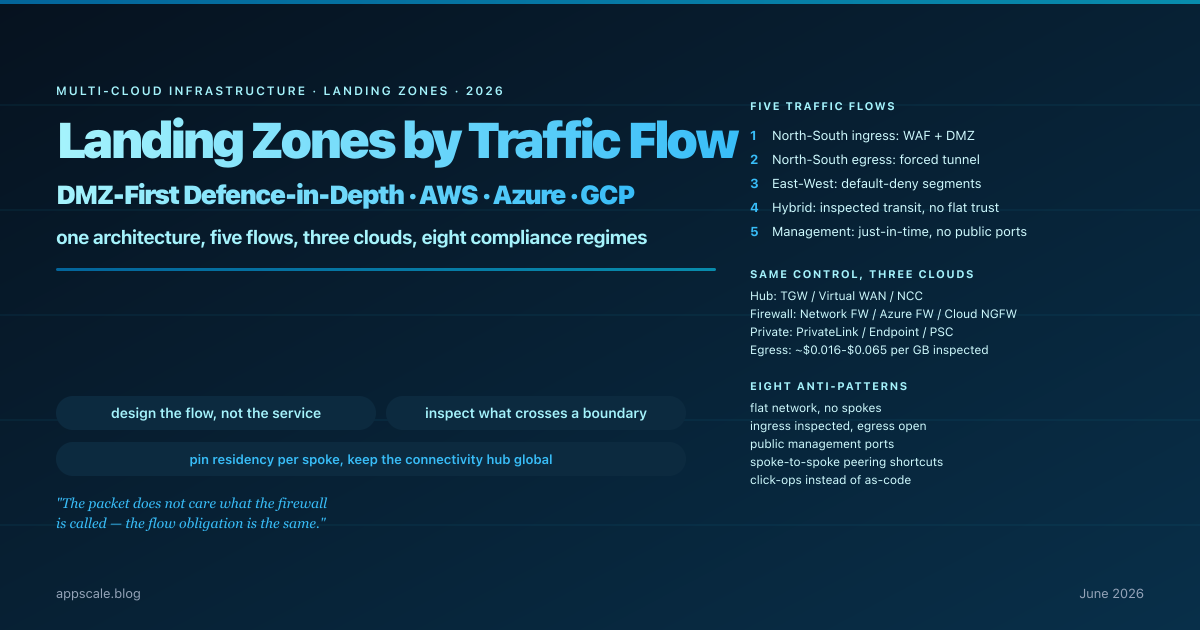
Designing Cloud Landing Zones by Traffic Flow — A Defence-in-Depth, DMZ-First Architecture for AWS, Azure, and GCP (2026)


A complete 2026 guide to multi-cloud infrastructure architecture — landing zones, zero-trust security, FinOps, data residency, and resilience across AWS, Azure, and GCP.
A working architects reference for Indian sovereign-cloud architecture in 2026 — MeitY empanelment levels, RBI cloud guidelines, IRDAI advisory, DPDP Act 2023 obligations, the residency and key-custody patterns that pass audit, BYOK vs HYOK decisions, the AI-inference-residency problem, and the programmatic enforcement (SCPs, mandatory tags, daily inventories, DPO-signed quarterly reports) that turns "we keep data in India" into an audit-grade evidence chain. Includes the regulator-by-workload compliance matrix, the reference India-only topology, and the most common audit findings to avoid.
Egress is a design constraint, not a line item. Where the six metered boundaries are, what the EU Data Act changes in January 2027, and four rules to design for data gravity.
Most cloud cost overruns are not caused by the workloads themselves — they are caused by four hidden categories of spend (egress, idle resources, mis-tuned commitments, managed-service markups) that collectively account for 30 to 50 per cent of the monthly bill. FinOps is the discipline of making this spend visible, attributable, and governed. This 2026 playbook covers the four hidden-cost categories, the AI-specific anomalies (GPU idle, long-context inference, frontier API accumulation), the FinOps maturity model, the discount and commitment models compared, the tooling landscape (cloud-native, third-party platforms, Kubernetes-native, AI workload), and a 12-month implementation roadmap that typically reduces total spend by 25 to 40 per cent.
Advertise and partner
Reach engineering leaders and CTOs reading about AI, mobile and cloud architecture.
Sponsored mentions and co-authored articles or technical deep-dives. Relevant products only, always disclosed.