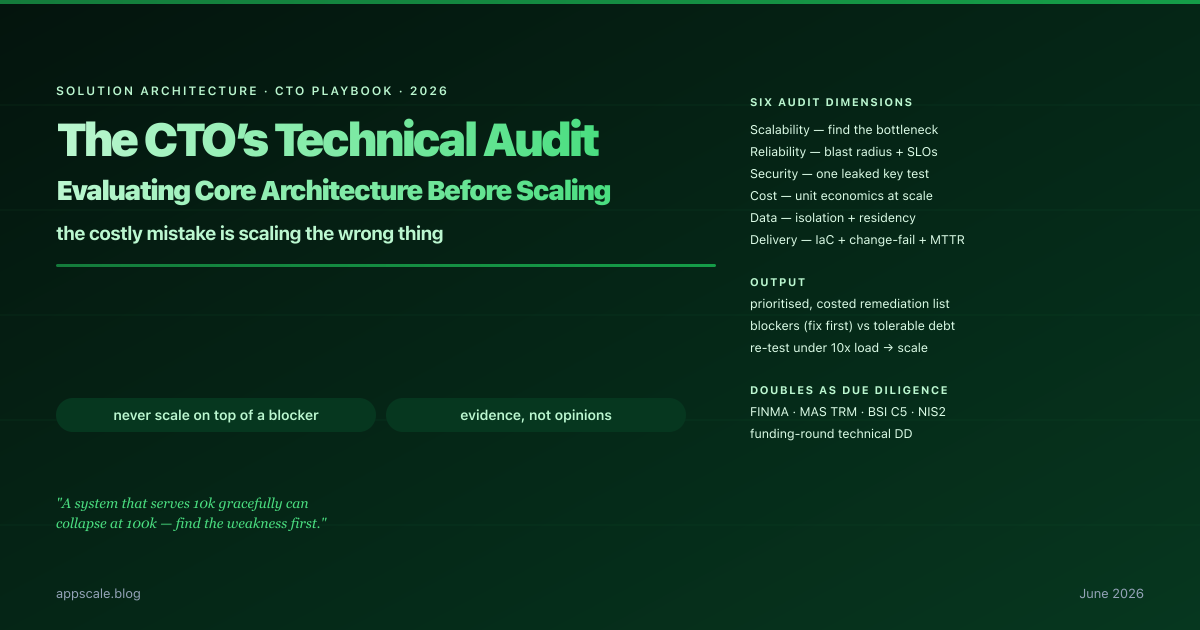
The CTO’s Playbook for Technical Audits — Evaluating Core Architecture Before Scaling (2026)


As AI systems move from internal pilots to customer-facing production at enterprise scale, the risk profile fundamentally changes. This article provides a comprehensive framework for CTOs building AI governance architecture — covering the five categories of AI risk, the layered architecture required to manage them, hallucination governance patterns, security threats specific to AI systems, regulatory expectations on auditability and explainability, executive metrics for governance oversight, build-vs-buy decision frameworks, and the production readiness criteria that must be met before scaling. Written from the perspective of an enterprise architect who has built and operated large-scale AI and platform systems, the article argues that AI governance architecture is not the constraint on AI ambition — it is the foundation that makes AI ambition sustainable and defensible.
AI governance has shifted from steering committees and slide decks to integrated control planes that inventory every model and agent, classify risk against EU AI Act and NIST AI RMF, run continuous bias and safety evaluation, enforce deployment gates, and generate audit-ready evidence. This guide covers the leading platforms (Credo AI, Fairly AI, Holistic AI, IBM watsonx.governance, Microsoft Purview AI Hub, OneTrust AI Governance, hyperscaler-native), the reference architecture for an internal AI governance plane, the build-versus-buy decision, and what good looks like 12 months in.
You cannot grade an agent by its final answer. Evaluate the trajectory — tool use, safety, efficiency, robustness — and gate every change. The agent-eval architecture.
AI-generated code fails as plausibility, not a crash. The 2026 taxonomy of that debt, how to detect it by provenance and churn, and the containment architecture.
Advertise and partner
Reach engineering leaders and CTOs reading about AI, mobile and cloud architecture.
Sponsored mentions and co-authored articles or technical deep-dives. Relevant products only, always disclosed.