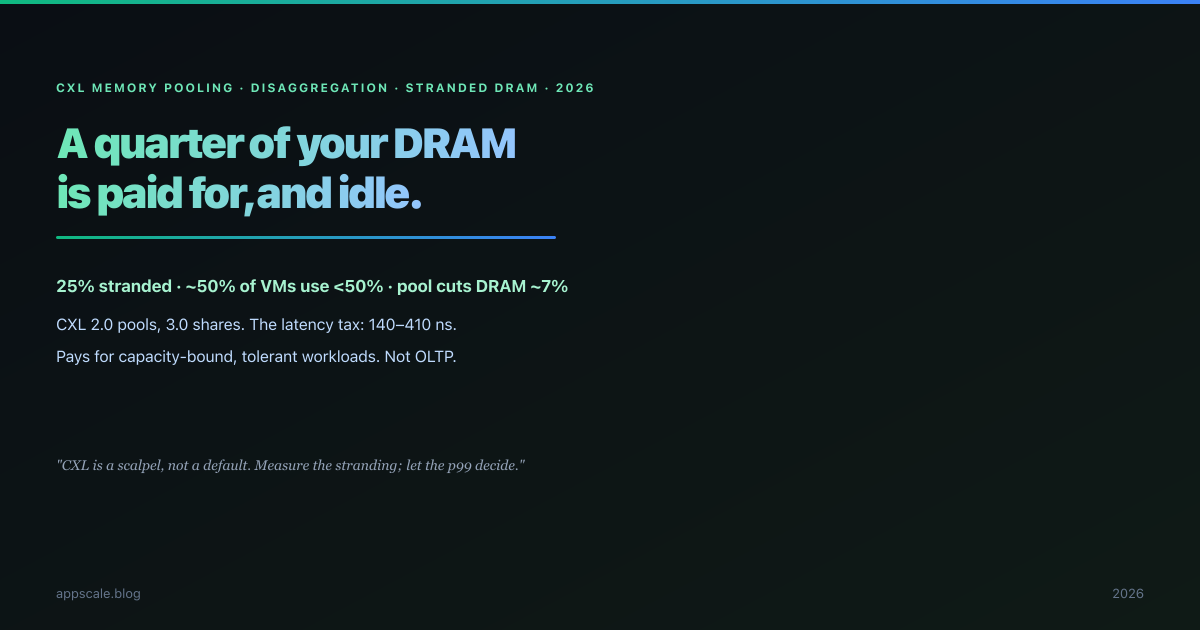
CXL Memory Pooling: Reclaiming the DRAM You Already Paid to Strand


Your GPU re-prefills the same 15,000-token prompt ten thousand times a day. KV-cache offloading to DRAM and NVMe turns that recompute into a cheap fetch — 10x users.
Memory safety versus bare-metal control for mobile AI engines. Where the three crash classes live, why ecosystem gravity beats safety, and where to put the unsafe seam.
The agent demos that survive contact with production all treat memory as an architecture, not as a context window. This is the three-tier pattern — episodic, semantic, procedural — that separates the lifecycles, read paths, write paths, and failure modes the naive single-store approach conflates. Read paths, write paths, the consolidation pipeline that earns the architecture, where each tier physically lives, eight anti-patterns to retire, the 5-stage maturity ladder, and a portable design that lands cleanly on LangGraph, AutoGen, the OpenAI Agents SDK, the Anthropic Claude Agent SDK, and the Microsoft Agent Framework.
A team raised max_connections from 100 to 5,000 and throughput fell. Connection pooling done right: PgBouncer modes, RDS Proxy, sizing math, and the serverless trap.
Advertise and partner
Reach engineering leaders and CTOs reading about AI, mobile and cloud architecture.
Sponsored mentions and co-authored articles or technical deep-dives. Relevant products only, always disclosed.