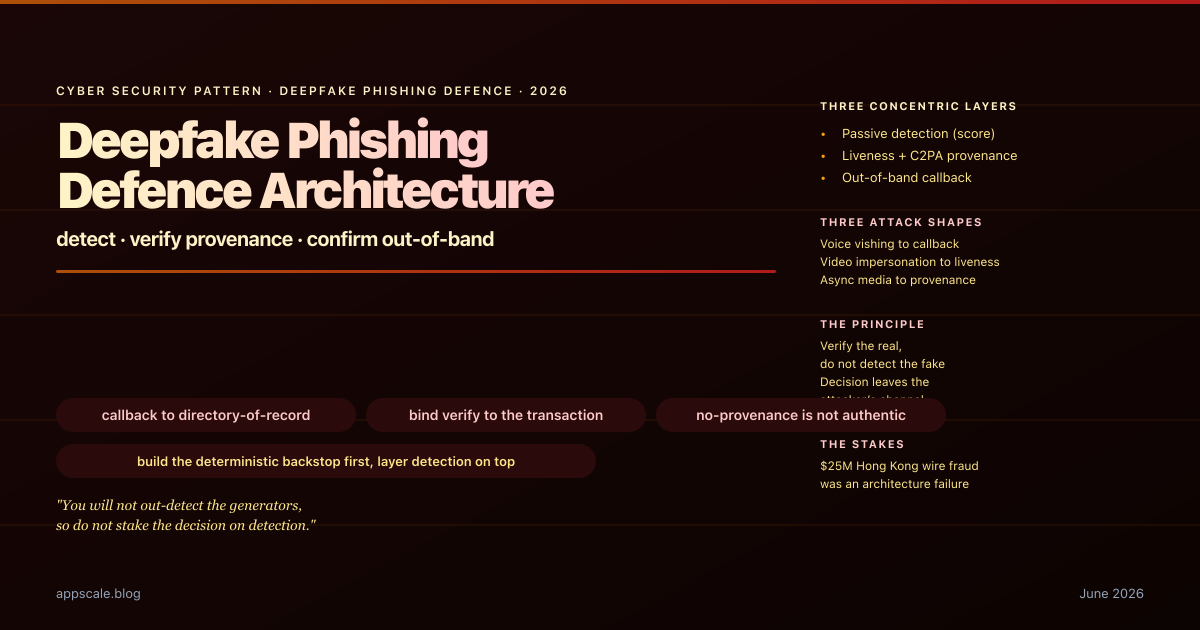
Deepfake Phishing Defence — Synthetic Voice and Video Detection and Verification Architecture (2026)


Generative AI defeats single-signal KYC. The defence: layered, signal-diverse verification with injection-attack detection, eID anchoring, and fused risk scoring.
Synthetic media — AI-generated video, voice, and 3D assets — has evolved from a research novelty into a production-grade enterprise capability. Models like Sora 2 and Veo produce broadcast-quality video, voice cloning is indistinguishable from human recordings, and 3D generation eliminates manual modeling bottlenecks. The enterprise architecture requires five layers: a multi-model generation layer with intelligent routing, a post-processing and quality assurance layer with perceptual metrics, a provenance and governance layer with C2PA metadata and consent management, cost-aware orchestration with semantic caching and tiered quality, and reliable delivery through existing CDN and DAM infrastructure.
Age assurance is an attribute-release problem, not identity collection: estimation with a buffer age, double-blind tokens and retention you can prove — the 2026 architecture.
SIM swap defeats SMS and voice OTP at the carrier, not in your stack. The architecture: demote the number, query carrier SIM-change signals, and tier recovery.
Advertise and partner
Reach engineering leaders and CTOs reading about AI, mobile and cloud architecture.
Sponsored mentions and co-authored articles or technical deep-dives. Relevant products only, always disclosed.