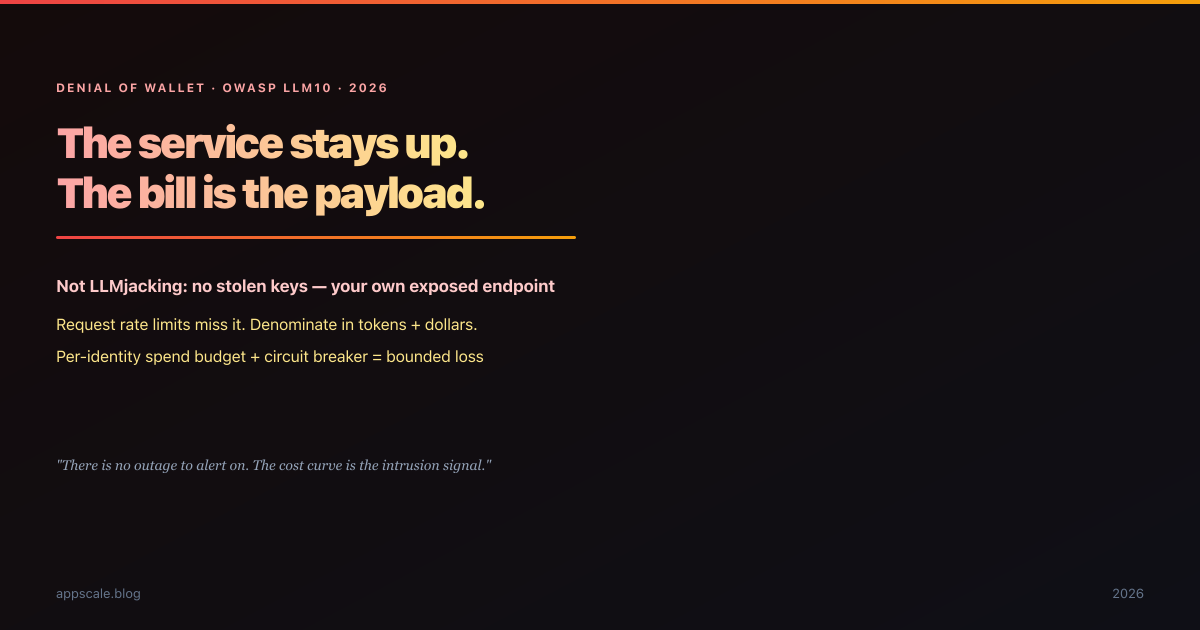
Denial of Wallet: When Your LLM Endpoint Stays Up and the Bill Is the Attack


Your SIEM bill grows with log volume, not threats. The security data lake pattern splits hot detection from cheap OCSF-on-Iceberg retention you can query for years.
Agents and RAG apps re-send the same long prefix every turn. Prompt caching cuts input cost up to ~90% and speeds first tokens — the win most teams leave off.
The first production prompt-injection incident most teams encounter does not arrive as a clever adversarial prompt — it arrives quietly inside a customer support ticket whose description contains a literal <system>ignore prior instructions</system> tag, which the document loader indexes and the retriever later returns as a top-k result for an unrelated query. This article is a working architect's reference for defending production RAG against prompt injection: an attack taxonomy (direct, indirect via documents, recursive prompt-in-output, multi-turn poisoning), CVE-style example walk-throughs, a five-layer defence-in-depth architecture (input filtering, instruction hierarchy, structured output validation, JSON-schema constrained generation, sandboxed tool execution), an OWASP LLM Top 10 mapping, an evaluation harness with red-team prompts, and the runtime monitoring patterns that turn a one-time hardening exercise into an ongoing security posture.
An enterprise spent nine months duplicating its AI stack across two clouds; every real incident was a quota ceiling. Multi-provider routing: the architecture that pays.
Advertise and partner
Reach engineering leaders and CTOs reading about AI, mobile and cloud architecture.
Sponsored mentions and co-authored articles or technical deep-dives. Relevant products only, always disclosed.