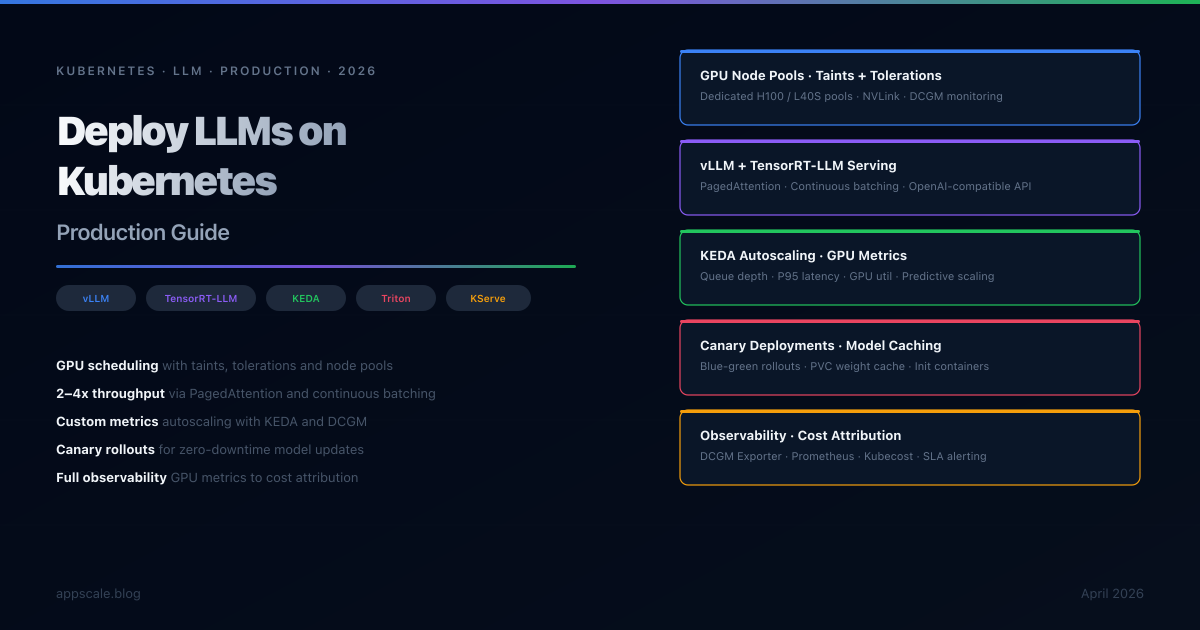
How to Deploy LLMs on Kubernetes: Production Guide (2026)


A complete 13-chapter architecture guide for deploying large language models in production at enterprise scale. Covers the eight-component production LLM architecture, Multi-LLM Routing, agentic orchestration with LangGraph, RAG evolution from 2024 to 2026, LLM-as-Judge observability, token quota governance, Zero-Trust AI security, hallucination prevention, and a CTO Action Plan for the first 90 days.
A comprehensive production guide to preventing LLM hallucinations using a four-layer architecture — Grounding (RAG with reranking and citations), Guardrails (input/output validation), Evaluation (automated faithfulness scoring and regression testing), and Human-in-the-Loop (confidence-based routing and feedback loops). Includes tooling landscape, real-world hallucination rates by maturity level, domain-specific prevention strategies, cost analysis, and a 16-week implementation roadmap.
The most common failure in production LLM systems is unparseable output. This guide covers every technique for getting reliable JSON from LLMs — provider-native enforcement (OpenAI, Anthropic, Google), open-source constrained generation (Outlines, Instructor, Guidance), production validation patterns, and prompt engineering strategies.
A systematic breakdown of the eight failure mode categories that cause the majority of LLM production incidents — prompt reliability, retrieval quality, hallucination, latency, agent safety, guardrails, observability, and cost governance — with root causes, detection signals, and architectural responses for each.
Advertise and partner
Reach engineering leaders and CTOs reading about AI, mobile and cloud architecture.
Sponsored mentions and co-authored articles or technical deep-dives. Relevant products only, always disclosed.