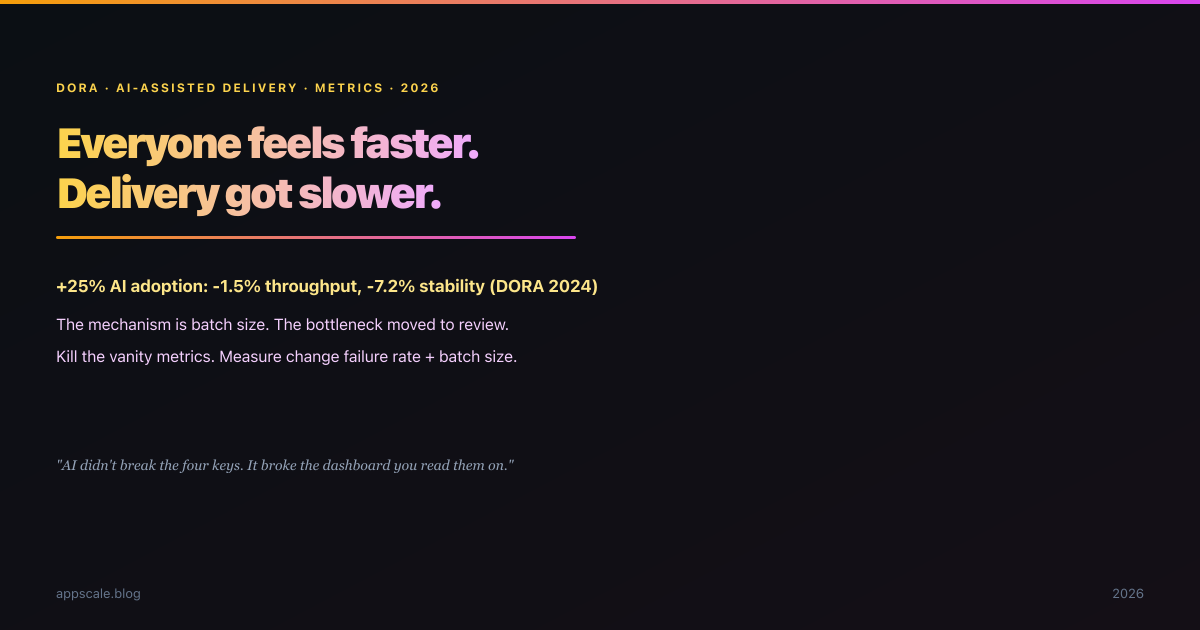
AI Broke Your DORA Dashboard: What to Measure When Everyone Ships Faster


A three-person team can now scope a fifteen-person game — if the build runs as a pipeline. AI-assisted game dev in the Fable 5 era: direction bibles, verification gates, playtests.
The AI feature demos on the founder’s flagship — and 60% of users can’t run it. The 2026 mobile stack: on-device models, hybrid routing, agents, battery budgets, fallbacks.
A comprehensive step-by-step guide to building production AI agents using LangChain (with LangGraph) and CrewAI. Covers core agent architecture concepts, practical code examples for tool definition, graph-based orchestration, multi-agent coordination, and memory management. Includes enterprise production architecture patterns, cost analysis comparing chatbots to single and multi-agent systems, governance and compliance frameworks, scaling strategies from pilot to 50K tasks per day, and a framework-comparison decision matrix.
The single most expensive failure mode of an agentic system is not the agent producing the wrong answer — it is the agent producing no answer while burning through tool calls, context, and provider budget in a tight loop the runtime did not detect. Six failure modes (infinite tool-call loop, plan-execute oscillation, sub-agent recursion, context thrash, hallucinated arguments, silent budget burn), six detection signals (step cap, semantic similarity, cost slope, identical call, delegation depth, context utilisation), five containment primitives (hard step-cap, budget kill-switch, tool-call dedupe, plan-diff guard, supervisor halt), a state machine with running/watching/throttled/halted, a seven-field RCA template, 8 anti-patterns, and a 5-stage maturity ladder. This is how runaway loops become bounded incidents.
Advertise and partner
Reach engineering leaders and CTOs reading about AI, mobile and cloud architecture.
Sponsored mentions and co-authored articles or technical deep-dives. Relevant products only, always disclosed.