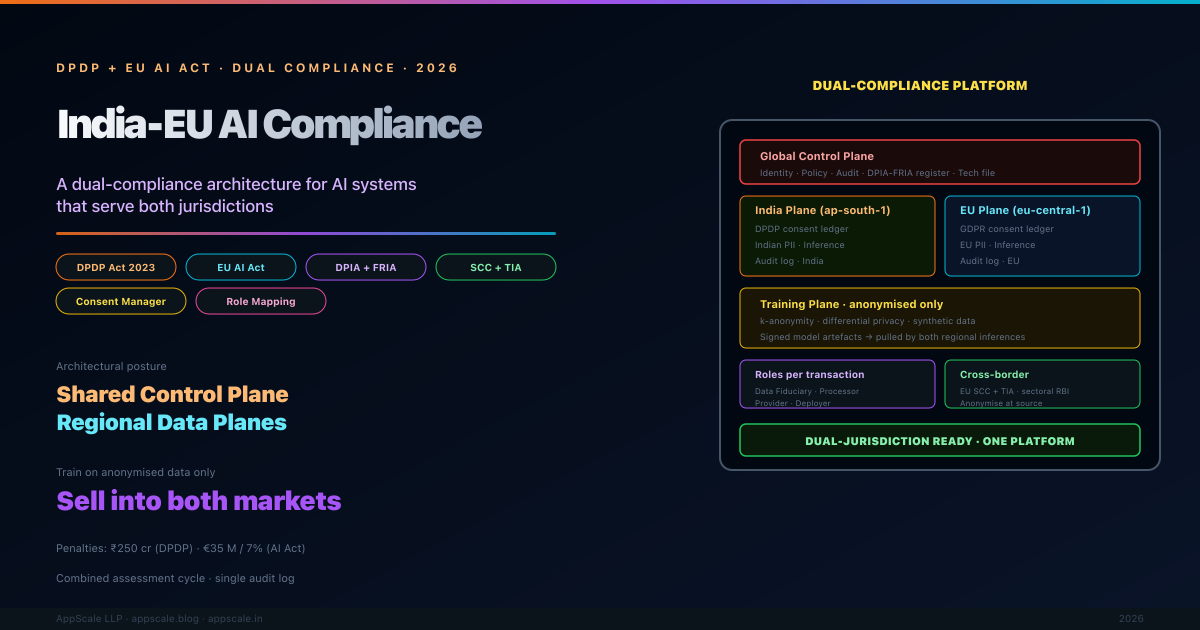
DPDP + EU AI Act: A Dual-Compliance Architecture for India-EU AI Systems (2026)


A reference control-plane architecture for AI systems that have to satisfy multiple regulatory regimes at once. Covers inventory, policy, release gates, runtime controls, and the evidence fabric that connects them.
A clause-by-clause architecture checklist for Articles 9–15 of the EU AI Act, the binding obligations for high-risk AI systems from 2 December 2027 (Annex III) after the Digital Omnibus. Seven articles, seven artefacts, one compliance-as-code pipeline. Risk file, dataset cards, technical file, logging pipeline, deployer instructions, human oversight architecture, and accuracy/robustness/cybersecurity test suite — all generated from the engineering repository, retained as immutable bundles, defensible at audit as a query rather than a project.
A NIS2 compliance blueprint: map the Article 21 measures to cloud controls, engineer the 24h/72h reporting clock, and reuse one control set across GDPR, the EU AI Act, and DORA.
Building HIPAA-compliant AI systems requires more than a Business Associate Agreement. This guide covers the complete architecture: PHI de-identification and pseudonymisation layers, sensitivity-based model routing, RBAC for minimum necessary compliance, immutable audit trails, and clinical use cases — ambient scribing, decision support, and patient-facing chatbots.
Advertise and partner
Reach engineering leaders and CTOs reading about AI, mobile and cloud architecture.
Sponsored mentions and co-authored articles or technical deep-dives. Relevant products only, always disclosed.