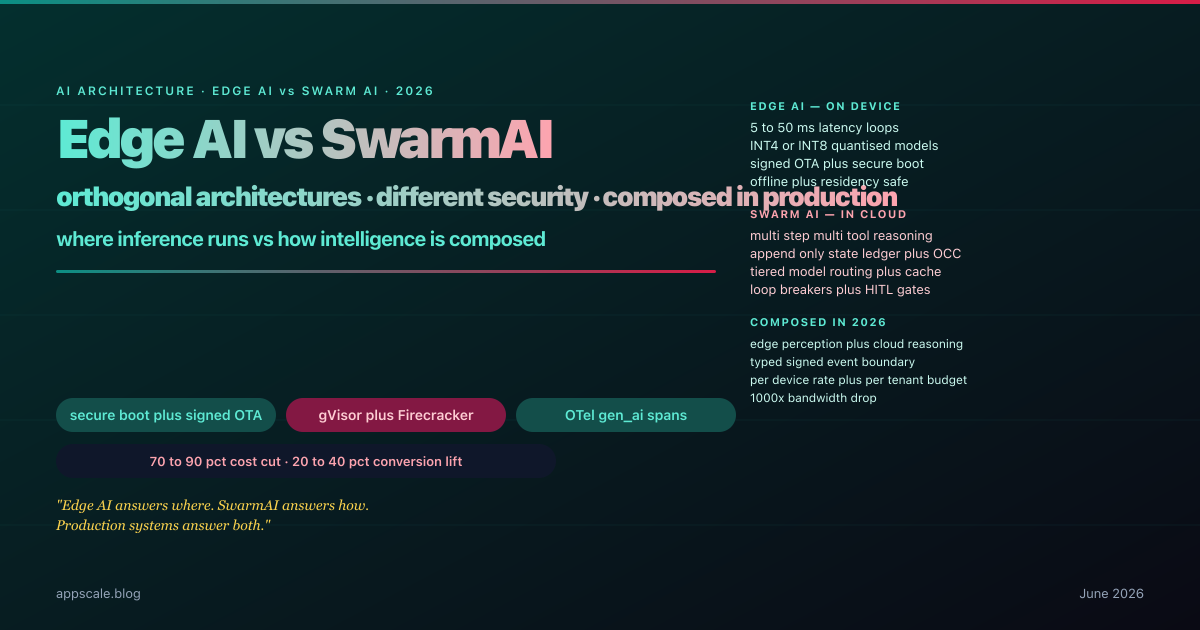
Edge AI vs SwarmAI — Differences, Security, Adoption, and Business Plus Consumer Benefits (2026)


How production SwarmAI platforms split into eight tiers, bound emergence with loop-breakers, route across model tiers, and cut costs by 90 percent without quality loss in 2026.
A physical AI swarm is a moving distributed system with a hostile network. The architecture for edge inference, masterless coordination, resilient mesh comms, and local safety.
Complete guide to edge AI architecture in 2026 — covering on-device inference on smartphones, embedded accelerators, and edge servers. Hardware landscape, model optimisation (quantisation, distillation, pruning), hybrid cloud-edge patterns, fleet deployment, security, and cost analysis.
Zero trust is the security posture in which no network location, no identity, and no prior authentication is treated as inherently trustworthy — every access decision is made fresh, against current context, on the principle of least privilege, with continuous verification rather than perimeter assumption. This article maps the NIST 800-207 components onto AI-specific components: model endpoints, agent runtimes, tool gateways, retrieval indexes, fine-tuning jobs, and model artefacts. It walks through a threat model that names the realistic adversaries, presents a reference architecture diagram that names every enforcement point, and concludes with the operational disciplines (audit, behaviour analytics, key rotation, supply-chain attestation) that distinguish a zero-trust AI system from a conventional AI system with a few extra firewalls.
Advertise and partner
Reach engineering leaders and CTOs reading about AI, mobile and cloud architecture.
Sponsored mentions and co-authored articles or technical deep-dives. Relevant products only, always disclosed.