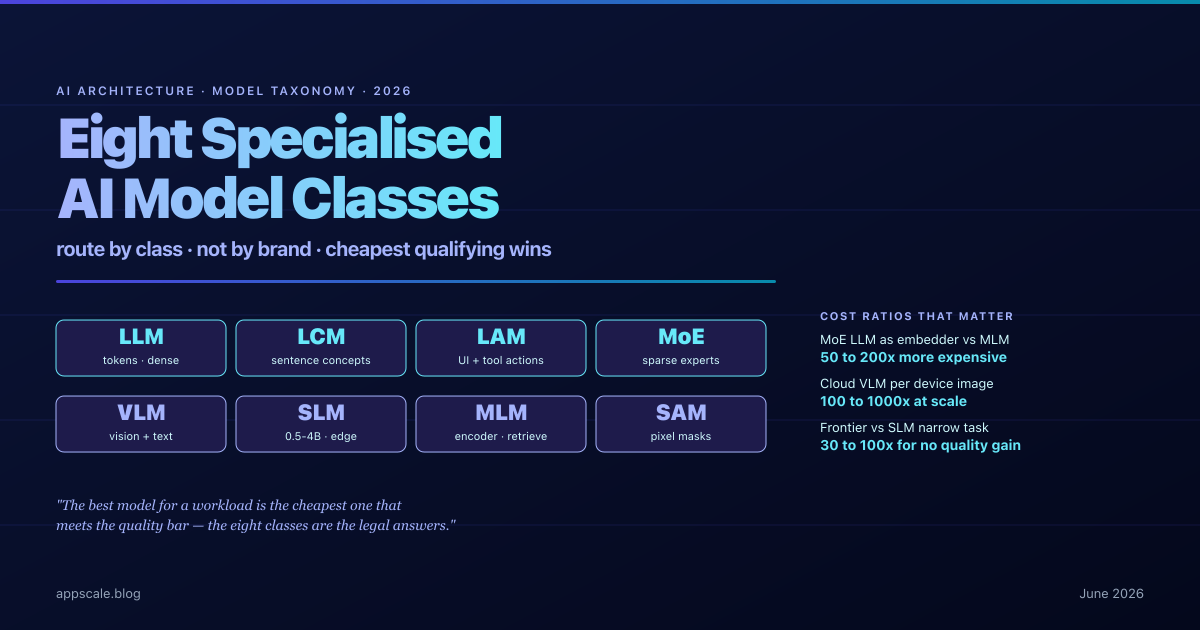
Eight Specialised AI Model Architectures 2026 — LLM, LCM, LAM, MoE, VLM, SLM, MLM, SAM Decision Matrix


You moved inference on-device for speed and privacy — and shipped your million-dollar weights to the attacker. Securing edge AI: theft, tampering, extraction, and the hybrid line.
Game AI in 2026 collides hardest with frame-rate budgets, session-cost economics, and the modding community's ability to break any system without adversarial assumptions. This article walks the engineering deliverables for an LLM-driven game AI architecture in 2026: tier-routed inference (on-device 1-3B small model, edge 7-13B mid-size, cloud frontier) with budget-aware routing; state-machine-augmented dialogue with LLM-generated surface variation; procedural quest skeletons with LLM in-fill within writer-defined templates; multi-layer content-safety and prompt-injection defence; per-session cost budget as engineering discipline; semantic cache as first-class architectural element. PL-anchored to the Warsaw/Krakow game-dev cluster (CD Projekt Red, Techland, 11 bit, People Can Fly, Bloober Team) and globally portable. 8 anti-patterns, 5-stage maturity ladder.
The static model choice has become the most expensive architectural decision in a 2026 LLM system. The provider market now spans a 60-200x price spread end to end, the quality gap on the dominant production workload is below the noise floor of A/B telemetry, and the latency profile of frontier models has widened — not narrowed. The Model Router Pattern is the architectural answer: a routing layer that, for every inbound request, chooses the cheapest model on the provider mix whose expected quality and latency clear the workload-specific gate, with a deterministic fallback when the routing decision turns out wrong. This article specifies the three routing axes (cost, quality, latency) and why single-axis routing always degrades, the four router primitives (cascade, classifier, learned, embedding-similarity) and when each is right, the 2026 landscape (Martian, NotDiamond, RouteLLM, Bedrock Intelligent Prompt Routing, OpenRouter Auto, Portkey, LiteLLM), the four-component calibration loop, the cost math with worked per-million-token economics, eight anti-patterns, and the five-stage maturity ladder from "we picked GPT" to a router that contributes a measurable line item to gross margin.
Polish enterprises in 2026 face a choice they are largely unprepared for: pick a frontier model and live with the cost and residency consequences, or build a stack around domestic models (Bielik, PLLuM) and live with the eval discipline that requires. This article maps the three-tier Polish stack (Bielik · PLLuM · Frontier), the 5-axis decision framework, the 5-step workload-specific eval methodology, the eval-driven routing architecture, PL-specific operational considerations (tokenisation, 7-case inflection, formality register, sector corpora, safety evals, data residency under DPA/GDPR/EU AI Act), 8 anti-patterns, and the 5-stage maturity ladder. Portable to NL, CZ, HU, KR, TH, VN ecosystems.
Advertise and partner
Reach engineering leaders and CTOs reading about AI, mobile and cloud architecture.
Sponsored mentions and co-authored articles or technical deep-dives. Relevant products only, always disclosed.