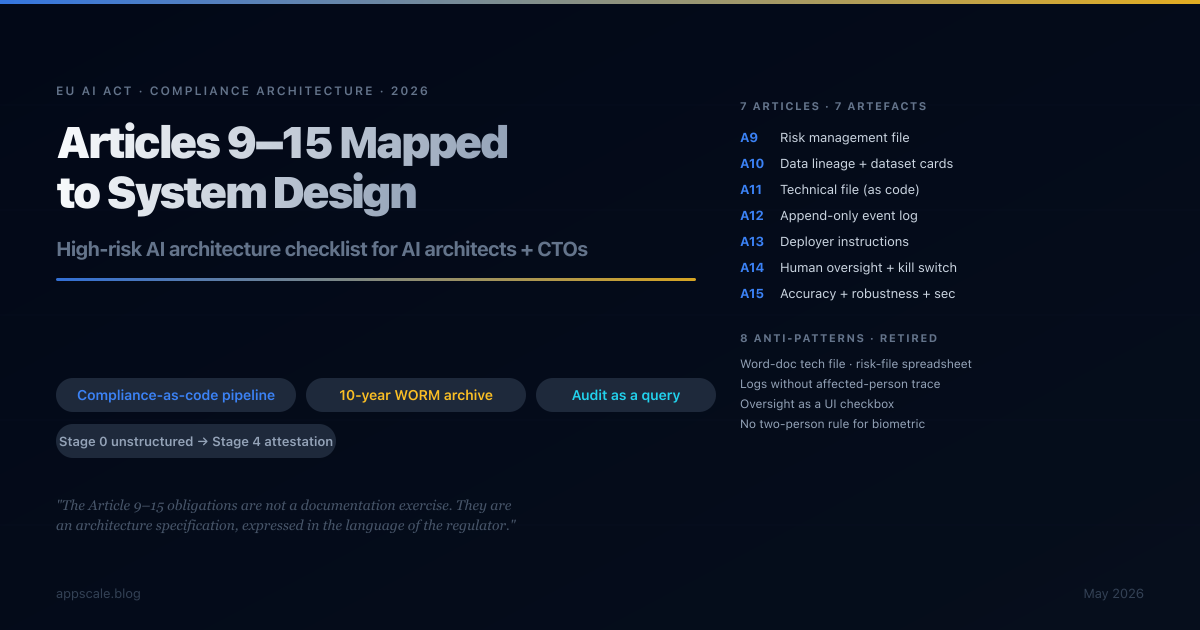
The EU AI Act High-Risk System Architecture Checklist: Articles 9–15 Mapped to System Design (2026)


AI system design interviews in 2026 are not the system design interviews of 2020. The senior bar now includes designing a multi-tenant LLM gateway, a real-time recommendation engine with two-tower retrieval and a learned-to-rank reranker, an image moderation pipeline grounded in policy, and a fraud detection system fusing streaming features with an online graph model. This guide walks through 15 of the most commonly asked AI system design questions — RAG, LLM gateway, recommendation, image generation, LLM search, inference platform, fraud, code review AI, voice assistant, evaluation platform, multi-agent orchestration, vector database, content moderation, MLOps, AI tutor — each with clarifying questions, capacity estimation, an architecture diagram, and the trade-offs interviewers listen for.
An AI product built in Bengaluru that serves a German healthcare buyer is governed by two regulators that do not coordinate — DPDP in India and the EU AI Act in Europe. This article is the architect's reference for shipping an India-EU AI platform that satisfies both regimes from one codebase: the DPDP versus AI Act overlap matrix, data residency arithmetic for India localisation alongside GDPR cross-border rules, the dual consent ledger that captures both DPDP notice-acknowledgement and GDPR lawful basis, the combined DPIA-FRIA workflow, the role mapping between Data Fiduciary, Provider, and Deployer, the SCC + TIA mechanics for EU-to-India transfers, and a reference architecture with shared control plane and regional data planes.
A reference control-plane architecture for AI systems that have to satisfy multiple regulatory regimes at once. Covers inventory, policy, release gates, runtime controls, and the evidence fabric that connects them.
The 2024-2025 Privacy Act reforms changed RAG architecture in Australia from a "we should think about privacy" posture to a "design for the tort claim and the OAIC inquiry" posture. This is the architecture that survives both — the PII boundary drawn before the embedding store, subject-keyed vault, placeholders in embeddings and prompts, storage-layer scoping with empty defaults, per-query provenance into an admissible audit log, deletion as transactional fan-out with a certificate, zero-retention enforced at the model gateway, and an automated-decision register that drives the privacy policy. Statutory tort hook, 8 anti-patterns, 5-stage maturity ladder, portable to UK/EU GDPR, India DPDP, and Singapore PDPA.
Advertise and partner
Reach engineering leaders and CTOs reading about AI, mobile and cloud architecture.
Sponsored mentions and co-authored articles or technical deep-dives. Relevant products only, always disclosed.