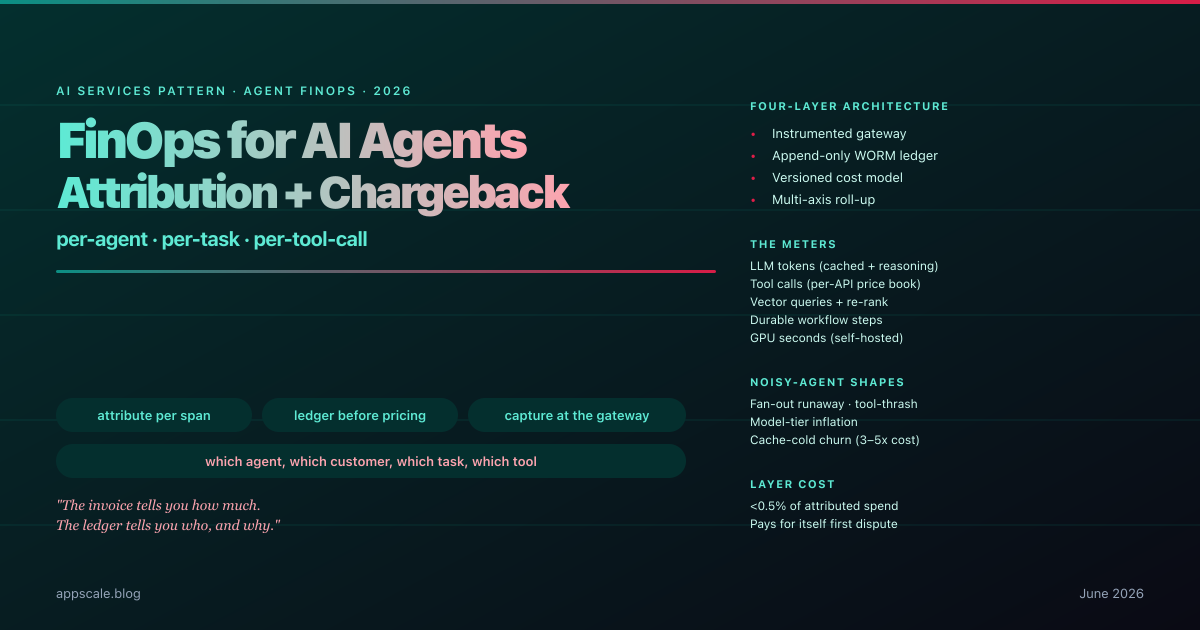
FinOps for AI Agents — Per-Agent, Per-Task, Per-Tool-Call Cost Attribution and Chargeback for Autonomous Fleets (2026)


Production tool-calling needs typed canonical schemas, eight-code error envelopes, per-tenant allow-lists, and lazy loading. The schema layer pays back at 95% cost cut.
The conventional circuit breaker was designed for a world where one service called one downstream and the failure modes were mostly availability — the dependency was up or down. AI agents inhabit a different world: an orchestrator that fans out to a heterogeneous set of tools, multiple LLM providers, and internal capabilities, each with its own failure profile, latency distribution, cost per call, and consequence on the agent's task. A single per-host breaker treats them all the same and is wrong almost everywhere. The agent-level circuit breaker pattern replaces the conventional one with a hierarchy of breakers — per-tool, per-provider, per-capability — each tuned to the failure mode it is meant to protect against. This article walks through the hierarchy in production: which dimensions need their own breakers, how thresholds should differ, what fallback semantics make sense at each layer, how to compose breakers with retries and timeouts without amplifying load, and the operational dashboards that make agent-level breakers debuggable.
The same agent that mitigates an incident in 3 minutes can cause one in 3 seconds. AI SRE agents: the diagnose-and-remediate loop, the five guardrails, and where to start.
Authenticating an agent is not authorizing it. Check every action per resource, scoped to the user — the ReBAC architecture that makes autonomous agents safe.
Advertise and partner
Reach engineering leaders and CTOs reading about AI, mobile and cloud architecture.
Sponsored mentions and co-authored articles or technical deep-dives. Relevant products only, always disclosed.