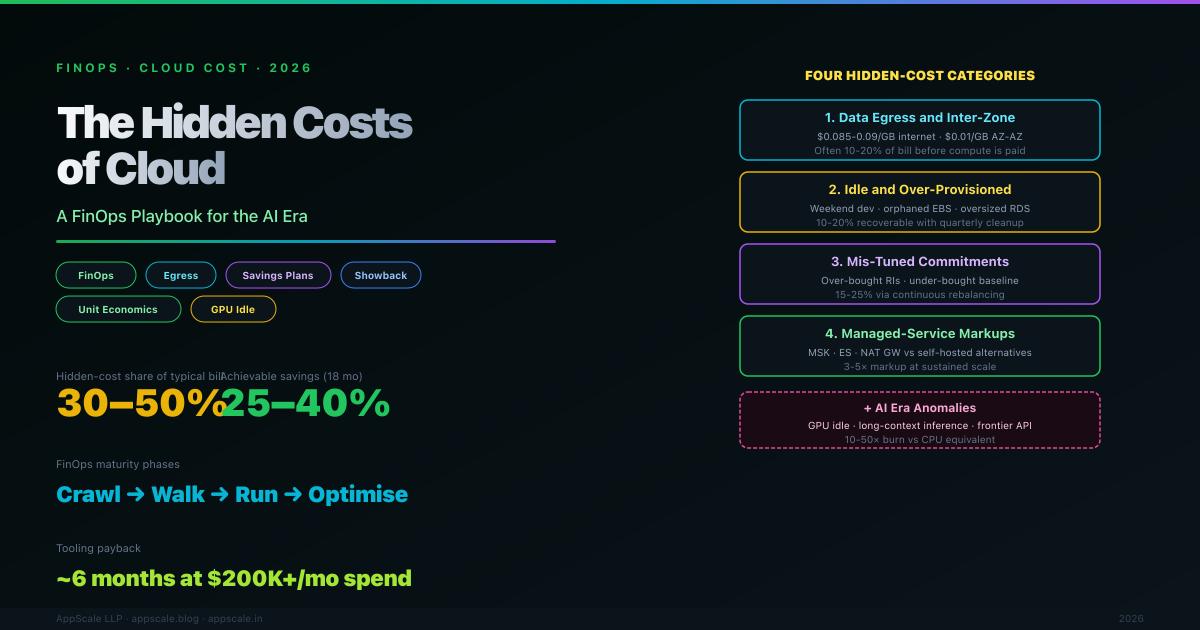
The Hidden Costs of Cloud: A FinOps Playbook for the AI Era (2026)


A working architect reference for the on-prem vs cloud vs hybrid AI inference decision in 2026. The five placement drivers (utilisation, data gravity, latency, regulatory, model dependency), the GPU cost crossover math (~60% utilisation), the federation control plane (Karmada / Argo CD / Cilium ClusterMesh / Prometheus federation), the model-serving stack across boundaries (vLLM / NIM / Triton / Bedrock / Azure OpenAI), the LLM gateway pattern that makes self-hosted and hosted models indistinguishable, and the failure modes (cluster drift, identity divergence, egress costs, burst surprises) that derail real hybrid deployments.
Production AI systems compound three expensive cost centers — LLM inference, vector search, and cloud compute — into every request. This architectural guide provides a systematic framework for reducing costs across all three layers through tiered model routing, semantic caching, prompt optimization, vector quantization, and GPU fleet management, scaling from prototype to hyper-scale production.
A complete 2026 guide to multi-cloud infrastructure architecture — landing zones, zero-trust security, FinOps, data residency, and resilience across AWS, Azure, and GCP.
Most enterprises in 2026 still alert on static thresholds while operating systems too complex for any human to triage. AIOps closes the gap with adaptive anomaly detection, event correlation that collapses storms into incidents, automated root cause analysis, and autonomous remediation for known patterns. This guide covers what AIOps actually does in production, the leading platforms (Dynatrace Davis, Datadog Bits AI, PagerDuty AIOps, Moogsoft, BigPanda, Splunk ITSI, New Relic AI), the reference architecture for inserting AI into an existing observability stack, the maturity model, the common failure modes, and how AIOps integrates with AI workload observability.
Advertise and partner
Reach engineering leaders and CTOs reading about AI, mobile and cloud architecture.
Sponsored mentions and co-authored articles or technical deep-dives. Relevant products only, always disclosed.