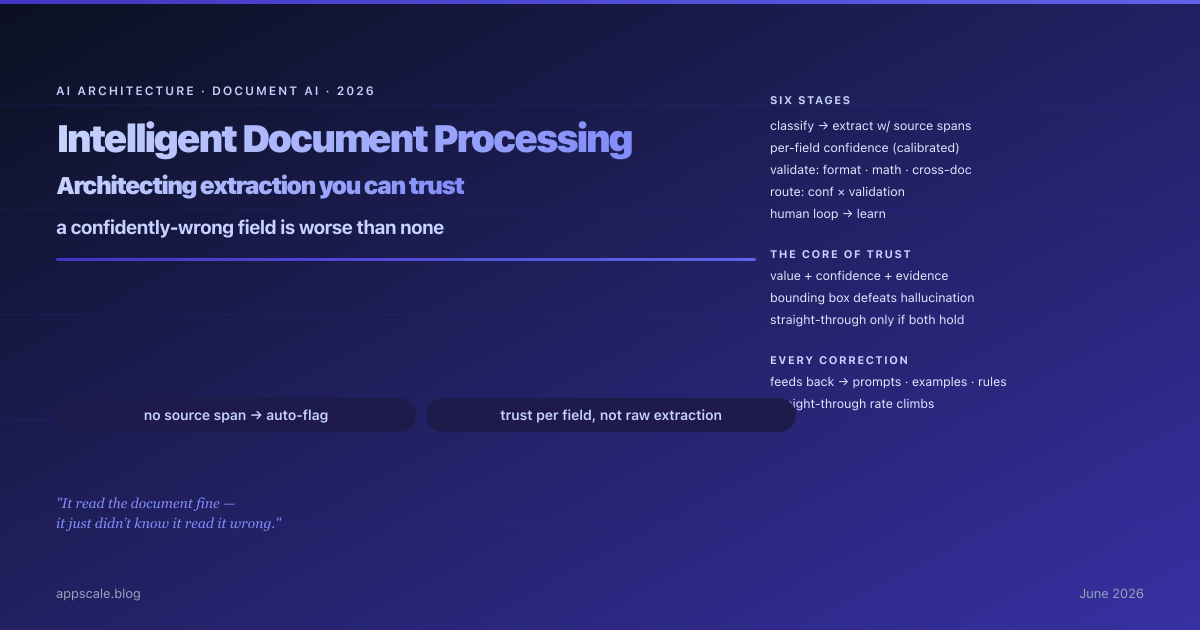
Intelligent Document Processing: Architecting Extraction You Can Trust (2026)


Text-to-SQL fails at the right query, not the syntax. Schema grounding, a semantic layer, a query firewall, and verification turn the demo into analytics you can trust.
Having backups is not resilience: ransomware crews delete them first. Immutable WORM copies, an isolated recovery plane, bounded blast radius and an RTO you have proven.
Three live versions, nobody moves off v1, every change is a negotiation. Versioning strategies, what really counts as breaking, and designing an exit you can actually use.
Zero trust is the security posture in which no network location, no identity, and no prior authentication is treated as inherently trustworthy — every access decision is made fresh, against current context, on the principle of least privilege, with continuous verification rather than perimeter assumption. This article maps the NIST 800-207 components onto AI-specific components: model endpoints, agent runtimes, tool gateways, retrieval indexes, fine-tuning jobs, and model artefacts. It walks through a threat model that names the realistic adversaries, presents a reference architecture diagram that names every enforcement point, and concludes with the operational disciplines (audit, behaviour analytics, key rotation, supply-chain attestation) that distinguish a zero-trust AI system from a conventional AI system with a few extra firewalls.
Advertise and partner
Reach engineering leaders and CTOs reading about AI, mobile and cloud architecture.
Sponsored mentions and co-authored articles or technical deep-dives. Relevant products only, always disclosed.