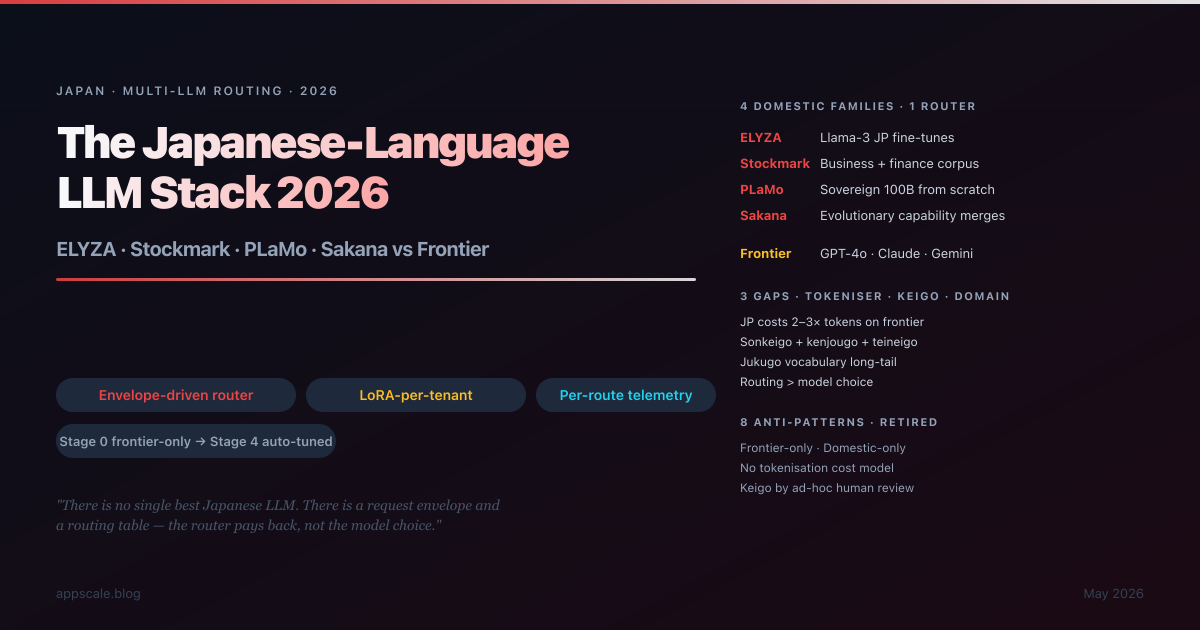
The Japanese-Language LLM Stack 2026: ELYZA, Stockmark, PLaMo vs Frontier — When to Use Which


Polish enterprises in 2026 face a choice they are largely unprepared for: pick a frontier model and live with the cost and residency consequences, or build a stack around domestic models (Bielik, PLLuM) and live with the eval discipline that requires. This article maps the three-tier Polish stack (Bielik · PLLuM · Frontier), the 5-axis decision framework, the 5-step workload-specific eval methodology, the eval-driven routing architecture, PL-specific operational considerations (tokenisation, 7-case inflection, formality register, sector corpora, safety evals, data residency under DPA/GDPR/EU AI Act), 8 anti-patterns, and the 5-stage maturity ladder. Portable to NL, CZ, HU, KR, TH, VN ecosystems.
The Lambda-versus-Fargate question stopped being binary and became openly hybrid by 2026. Teams shipping the cleanest production architectures use Lambda for its cold-start economics on sporadic event-driven work, Fargate for its long-running container economics on sustained traffic, and route between the two intelligently. This article covers the cost-curve arithmetic that decides most choices, the AI inference workload caveats including the 2026 GPU-on-Fargate gap, the hybrid routing pattern using ALB / EventBridge / Step Functions, NestJS deployment patterns that target both runtimes from one codebase, a real cost comparison spreadsheet for a 50M-request-per-month API, and the observability discipline required to run both together.
Public benchmarks tell you which LLM is best in general. They do not tell you which model is best for your RAG pipeline, your agentic system, or your summarisation workflow. This guide covers how to build a golden dataset, measure faithfulness and relevance, automate evaluation in CI/CD, and make model selection decisions based on real task performance data.
The default — pick the largest frontier model and route every request through it — is the wrong default for a meaningful share of production workloads in 2026. Small language models in the 2 to 14 billion parameter range (Phi-4, Llama 3.1 8B, Gemma 2, Mistral 7B, Qwen 2.5) handle classification, extraction, summarisation, and RAG re-ranking at one-fiftieth the cost per token of frontier models, with 5 to 10x lower latency. This guide covers the workloads where SLMs win, the model families and hardware to choose, the role of quantisation and fine-tuning, and the small-first routing pattern with frontier model fallback that most mature deployments converge on.
Advertise and partner
Reach engineering leaders and CTOs reading about AI, mobile and cloud architecture.
Sponsored mentions and co-authored articles or technical deep-dives. Relevant products only, always disclosed.