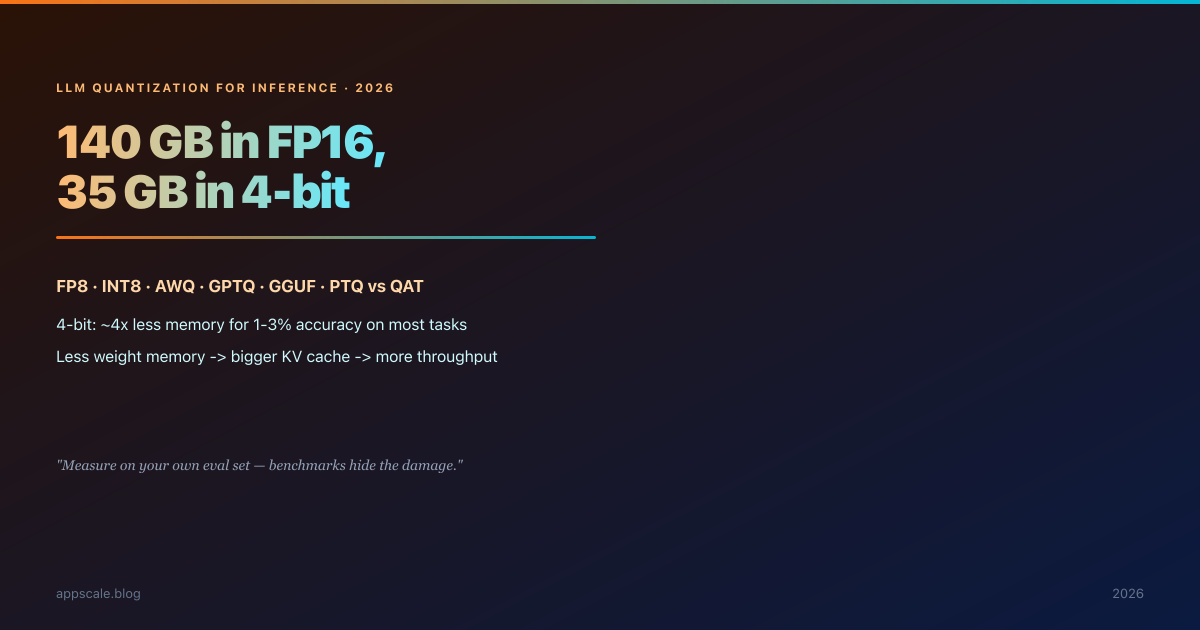
LLM Quantization for Production Inference: INT8, FP8, AWQ, and GGUF


The single largest under-used lever in production LLM inference in 2026 is speculative decoding. A correctly tuned vLLM deployment with EAGLE-3 or Medusa heads delivers 2.5–3.2× throughput on the same hardware for the same model with bit-exact outputs. The arithmetic: with α=0.8 acceptance, K=5 speculation length, and draft/target cost ratio c=0.08, the speedup formula (1 − α^(K+1)) / ((1 − α) × (K × c + 1)) lands around 2.4× and rises to 3× as α climbs. Most production deployments have not adopted it, not because the technique is exotic but because the operational subtleties — draft-model selection, acceptance-rate decay on long contexts, batch interaction effects, and the cases where naive speculation actively loses — are not well understood. This article is the production playbook: what speculative decoding actually does to the autoregressive loop, the EAGLE / Medusa / Lookahead / n-gram family, the vLLM integration surface, the four workload shapes where speculation wins or loses, the long-context failure mode that catches teams off-guard, eight anti-patterns, and a five-stage maturity ladder.
A complete 13-chapter architecture guide for deploying large language models in production at enterprise scale. Covers the eight-component production LLM architecture, Multi-LLM Routing, agentic orchestration with LangGraph, RAG evolution from 2024 to 2026, LLM-as-Judge observability, token quota governance, Zero-Trust AI security, hallucination prevention, and a CTO Action Plan for the first 90 days.
Production LLM agents fail on cost, latency, and memory when the context window is filled like a bucket. Context engineering treats it as a budget allocated every turn.
Why LLMs give different answers at temperature 0, how batch invariance in vLLM and SGLang fixes it, what it costs, and which 2026 workloads should pay.
Advertise and partner
Reach engineering leaders and CTOs reading about AI, mobile and cloud architecture.
Sponsored mentions and co-authored articles or technical deep-dives. Relevant products only, always disclosed.