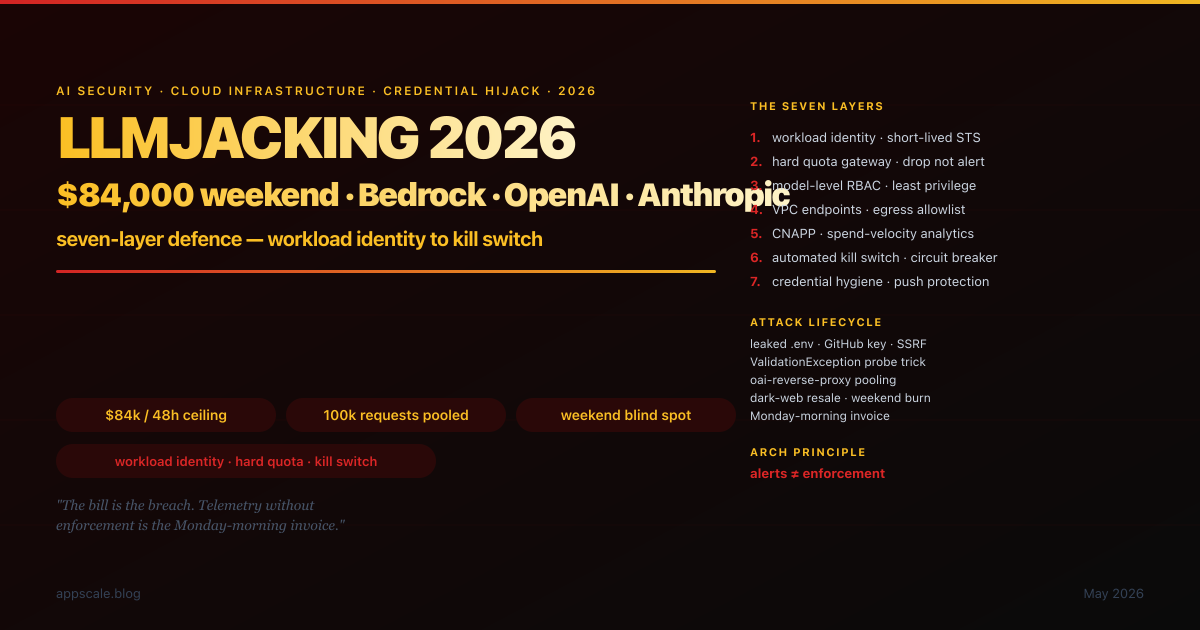
LLMjacking 2026: How Attackers Hijack Your Bedrock and OpenAI Quota — and the Seven-Layer Defence That Stops the $84,000 Weekend


Your coding agent invented a package name. An attacker already registered it. Slopsquatting, why typosquatting defences miss it, and the install-time gates that stop it.
Multi-tenant RAG has a security model that does not exist in single-tenant RAG and is not covered by generic SaaS multi-tenant discipline. The 2024–2025 incident record now has enough cross-tenant RAG leakage cases to classify the failure modes, and the result is a seven-vector taxonomy: cross-tenant retrieval leakage, embedding-space collisions, metadata-filter bypass, shared-index poisoning, re-ranker leakage, eval-set contamination, response-cache cross-talk. This article is the seven vectors with their mechanism and architectural defence, the per-tenant namespace pattern that closes them at every data surface, the eight anti-patterns that produce the bad outcomes, and the maturity ladder from Stage 0 (single shared everything) to Stage 4 (continuously-validated isolation).
A Denial of Wallet attack keeps your LLM endpoint up and runs up the bill. Why request rate limits miss it, and the token-and-dollar controls that stop it.
Your team rewrote the same feature three times in four years. The innovation-budget framework for choosing technology that lasts — and spotting churn wearing a business case.
Advertise and partner
Reach engineering leaders and CTOs reading about AI, mobile and cloud architecture.
Sponsored mentions and co-authored articles or technical deep-dives. Relevant products only, always disclosed.