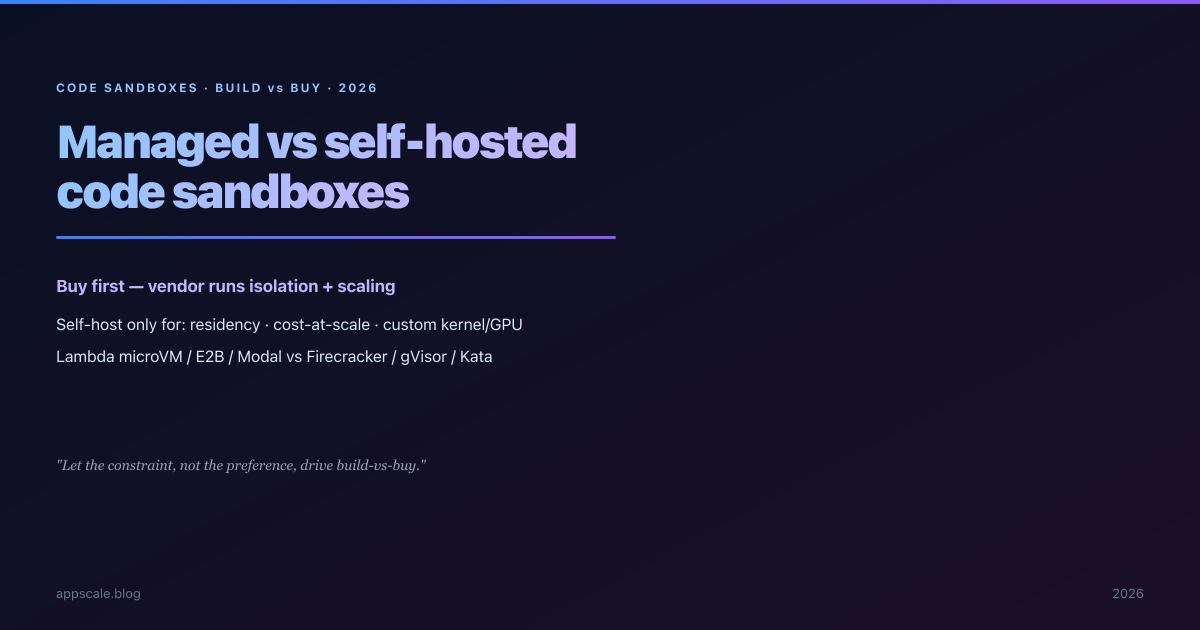
Managed vs Self-Hosted Code Sandboxes: A Build-vs-Buy Decision for AI Code Execution


The most consequential AI decision organizations face is not which model to use — it is whether to build AI capability or buy it. This article provides a principled framework for leaders navigating that decision, built around the distinction between commodity AI (which should usually be bought) and strategic AI (which should usually be built or owned). It covers three-year cost comparison thinking, vendor dependency risk, the hybrid architecture that works in practice, governance and regulatory considerations, and the long-term compounding advantage that comes from owning the right capabilities at the right time. Written for senior executives who need to make this decision with clarity rather than urgency.
An AI agent that runs code executes attacker-influenceable input on your infrastructure. Isolate it in a microVM with no credentials, default-deny egress, hard caps, and audit.
A comprehensive step-by-step guide to building production AI agents using LangChain (with LangGraph) and CrewAI. Covers core agent architecture concepts, practical code examples for tool definition, graph-based orchestration, multi-agent coordination, and memory management. Includes enterprise production architecture patterns, cost analysis comparing chatbots to single and multi-agent systems, governance and compliance frameworks, scaling strategies from pilot to 50K tasks per day, and a framework-comparison decision matrix.
Your team merges AI code faster than anyone can review it — and trust breaks first. The verification pyramid, blast-radius tiers, and org design for reviewing at generation speed.
Advertise and partner
Reach engineering leaders and CTOs reading about AI, mobile and cloud architecture.
Sponsored mentions and co-authored articles or technical deep-dives. Relevant products only, always disclosed.