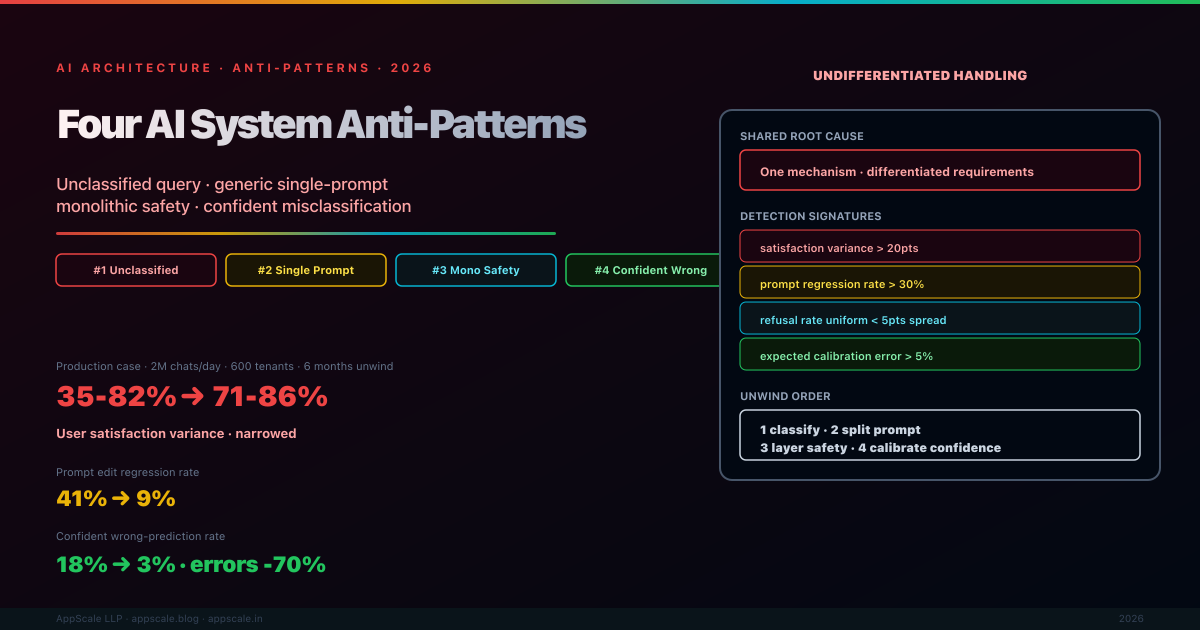
Four AI System Anti-Patterns: Unclassified Query, Generic Single-Prompt, Monolithic Safety, and Confident Misclassification (2026)


Once a platform has more than a handful of services, orchestration becomes its own architectural concern. Two anti-patterns recur in every multi-service platform: synchronous blocking enrichment fans out to N downstream services in-line and waits for each, paying the sum of all latencies for every request and inheriting the product of all availabilities; centralised orchestration bottlenecks put every multi-step workflow through one shared orchestrator that becomes a single point of failure and a deployment chokepoint as the platform grows. Both share an underlying single-process mental model and both fail at scale. This article covers credible failure stories, architectural diagnoses, the fixes (parallel async enrichment and per-domain saga orchestration), the unwinding order that works in production, detection signatures including the latency-to-fan-out ratio, and configuration values from real platforms.
The single biggest mistake in production AI safety is treating the guardrail layer as a global, category-blind filter. Run medical, legal, finance, code, and general queries through one global guardrail and you get the worst of both worlds: under-protected high-risk categories, over-restricted general traffic, and a guardrail layer that fails compliance audit. Category-aware guardrails fix this by treating safety as a per-domain policy executed after the classification-first router has decided which category a request belongs to. This article covers the pattern in detail: structuring per-category policies (medical, legal, finance, code, general), integration with the classification-first router, the production case study showing 2.4s → 1.3s latency and 11% → 1.4% false-positive reduction, the anti-patterns that defeat the pattern, and the configuration values that work at scale.
A practical architect's guide to microservices patterns purpose-built for AI systems — from Model-as-a-Service and async queue processing through Decomposed RAG, LLM Router, Semantic Caching, Circuit Breaker, Shadow Deployments, and security patterns including Dual-LLM Guardrail, ACL-aware Retrieval, and Egress Filter.
Most microservices outages do not trace back to exotic edge cases — they trace back to four infrastructure anti-patterns that the team knew about in principle but had not engineered against in practice. Synchronous blocking calls turn one slow downstream into a complete platform freeze. Missing idempotency turns a network blip into duplicate charges and ghost orders. Tightly coupled services turn the independent-deployment promise into a distributed monolith. Centralised retry logic turns a brief degradation into a stampede that prevents recovery. This article walks through all four with credible failure stories, architectural diagnoses, fix patterns with cross-links to the positive constructions, the unwinding order that works in production, detection signatures that catch the anti-patterns early, and configuration values that work at scale.
Advertise and partner
Reach engineering leaders and CTOs reading about AI, mobile and cloud architecture.
Sponsored mentions and co-authored articles or technical deep-dives. Relevant products only, always disclosed.