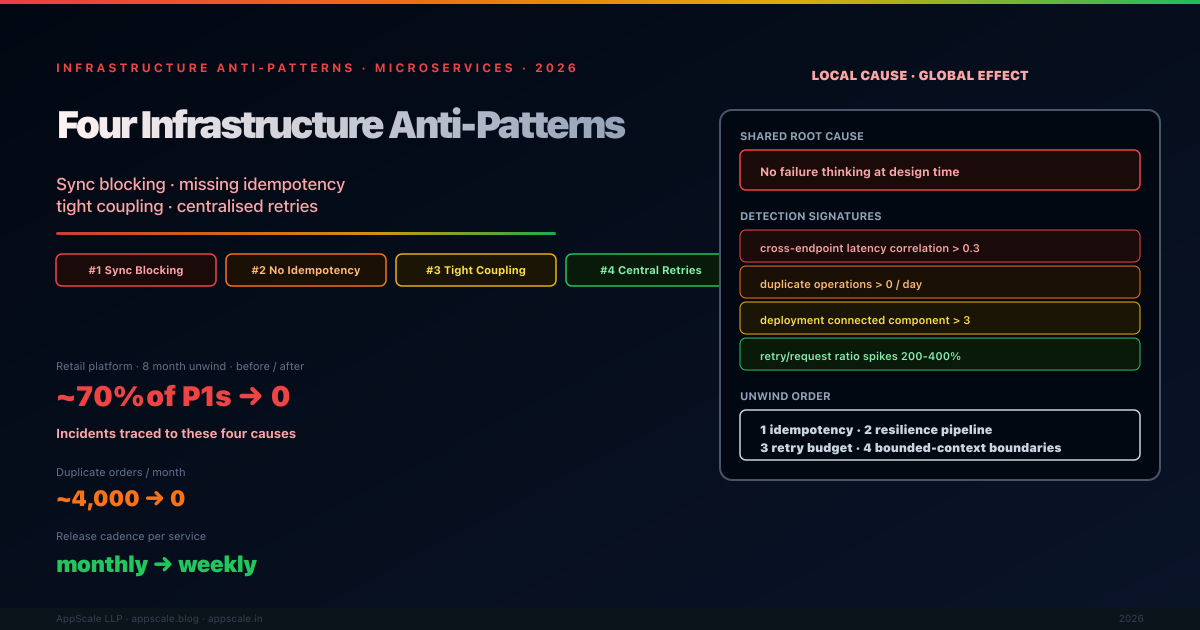
Microservices Infrastructure Anti-Patterns: Synchronous Blocking, Missing Idempotency, Tight Coupling, Centralised Retries (2026)


Once a platform has more than a handful of services, orchestration becomes its own architectural concern. Two anti-patterns recur in every multi-service platform: synchronous blocking enrichment fans out to N downstream services in-line and waits for each, paying the sum of all latencies for every request and inheriting the product of all availabilities; centralised orchestration bottlenecks put every multi-step workflow through one shared orchestrator that becomes a single point of failure and a deployment chokepoint as the platform grows. Both share an underlying single-process mental model and both fail at scale. This article covers credible failure stories, architectural diagnoses, the fixes (parallel async enrichment and per-domain saga orchestration), the unwinding order that works in production, detection signatures including the latency-to-fan-out ratio, and configuration values from real platforms.
Network retries, message re-delivery, and client timeouts mean write operations in distributed systems can be triggered more than once. Without idempotency, the result is duplicate charges, double inventory deductions, and incorrect state. This article covers the idempotency key pattern, Redis-based key stores with atomic SET NX, database unique constraints as the second line of defence, message queue deduplication, HTTP method semantics, and how idempotency integrates with Saga and Outbox patterns.
Most AI system failures in production are not novel; they are repeat performances of a small number of well-known anti-patterns that teams keep rediscovering because the lessons are scattered across post-mortems that never get aggregated. This article bundles four of the most damaging into one reference: the unclassified query (treating every input as one category routed through one flow), the generic single-prompt (one giant 4-8k token system prompt covering every behaviour), monolithic safety (one configuration applied to every category and tenant regardless of differing requirements), and confident misclassification (the model is wrong but expresses high confidence so the system acts on the wrong answer). Each looks reasonable when small; each becomes a load-bearing failure mode as the system grows; each has a structural fix described in the dedicated positive patterns elsewhere in this series. The four share a structural theme — undifferentiated handling of inputs that have meaningfully different requirements — and they compound: each makes fixing the others harder. This article documents the failure modes, the detection signatures, the unwinding order, and a production case study that improved every metric.
A practical architect's guide to microservices patterns purpose-built for AI systems — from Model-as-a-Service and async queue processing through Decomposed RAG, LLM Router, Semantic Caching, Circuit Breaker, Shadow Deployments, and security patterns including Dual-LLM Guardrail, ACL-aware Retrieval, and Egress Filter.
Advertise and partner
Reach engineering leaders and CTOs reading about AI, mobile and cloud architecture.
Sponsored mentions and co-authored articles or technical deep-dives. Relevant products only, always disclosed.